

Chichén Itzá vs Tulum vs Uxmal: Which Ruins to Visit
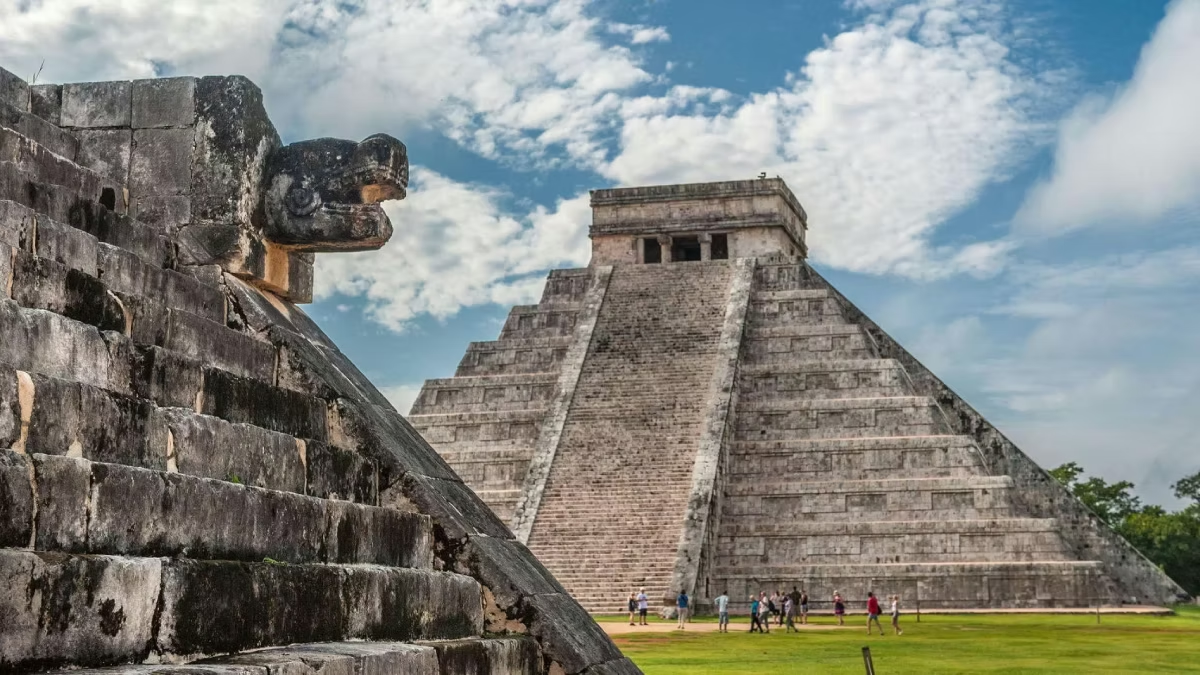
Choose Chichén Itzá for iconic status, historical depth, and the architectural grandeur of El Castillo (one of the New Seven Wonders) — but expect big crowds and a $40 entry fee. Choose Tulum if you want a short, easy visit with a dramatic Caribbean clifftop setting — the ruins themselves are small but the ocean backdrop is unique in the Maya world. Choose Uxmal if you prioritize quieter crowds, exceptional Puuc-style stone carving, and architectural refinement — it’s the connoisseur’s pick, with a fraction of Chichén Itzá’s visitors. All three are UNESCO sites, all three are worth seeing if you have a week in the Yucatán. For a single-visit decision, Chichén Itzá wins for most first-timers, Uxmal for architecture lovers, and Tulum for beach-holiday convenience.
These are the three most-visited archaeological sites in the Yucatán Peninsula, and most first-time visitors end up choosing between them rather than doing all three. Each offers a different kind of Maya experience: Chichén Itzá delivers iconic scale, Tulum delivers coastal drama, and Uxmal delivers architectural refinement. This guide compares them honestly across size, scenery, crowds, cost, and travel time — and tells you which one to prioritize based on what matters to you.
Quick Comparison at a Glance
| Feature | Chichén Itzá | Tulum | Uxmal |
|---|---|---|---|
| Location | Central Yucatán | Caribbean coast | Near Mérida |
| Size | ~4 sq mi (large) | ~0.2 sq mi (small) | ~1.5 sq mi (medium) |
| Distance from Cancún | 200 km / 2.5–3 hr | 130 km / 1.5–2 hr | 360 km / 4.5–5 hr |
| Distance from Mérida | 120 km / 2 hr | 370 km / 4.5 hr | 80 km / 1.5 hr |
| Entry fee (2026) | ~692 MXN (~$40) | ~90 MXN (~$5) | ~533 MXN (~$27) |
| Can you climb? | No | No | Partial (some structures) |
| Typical visit time | 2.5–3 hours | 1–1.5 hours | 2–3 hours |
| Crowd level | Very high | High | Low |
| UNESCO site | Yes (1988) | No (National Park) | Yes (1996) |
| New 7 Wonder | Yes (2007) | No | No |
| Best for | First-time iconic experience | Coastal setting, quick visit | Architecture, peaceful exploration |
Chichén Itzá — the Iconic One
Chichén Itzá is the largest, most famous, and most architecturally complete of the three sites. It’s a New Seven Wonder of the World, covers 4 square miles, and contains El Castillo (the Temple of Kukulkán), the largest Mesoamerican ball court, the Temple of the Warriors, the Sacred Cenote, and the El Caracol observatory. It’s also the most expensive (~$40 entry) and most crowded, with 2.5+ million visitors per year. The drive from Cancún is 2.5–3 hours each way.
What Makes Chichén Itzá Stand Out
- El Castillo — the most recognizable Maya structure in the world, with its 365-step geometry and equinox serpent shadow
- The Great Ball Court — 168 meters long, with preserved acoustic engineering you can still test
- El Caracol — one of the few confirmed pre-Columbian astronomical observatories
- The Sacred Cenote — a 60-meter natural sinkhole used for Maya rain-god rituals
- Historical depth — the site layers Maya, Toltec, and other Mesoamerican influences across multiple centuries
Where Chichén Itzá Falls Short
- Very crowded from 10:30 AM onward
- Highest entry fee of any Mexican Maya site
- You cannot climb any structures (banned since 2006)
- Almost no shade in the main plaza
- Long drive from every major base city except Mérida and Valladolid
For more on whether Chichén Itzá is right for your trip, see Is Chichén Itzá Worth It?
Tulum — the Coastal One
Tulum is a compact, walled Maya city perched on 40-foot cliffs above the Caribbean Sea — the only major Maya site with a beach setting. It’s small (visitable in 1–1.5 hours), the cheapest of the three to enter (~$5), and the easiest to reach from the Riviera Maya resort zone. The ruins themselves are smaller and less architecturally elaborate than Chichén Itzá or Uxmal, but the dramatic coastal backdrop makes it one of the most photogenic archaeological sites in the world.
What Makes Tulum Stand Out
- The clifftop setting — postcard views of turquoise Caribbean Sea behind ancient stone structures
- Compact and quick — you can comfortably see everything in 1–1.5 hours
- Cheapest entry fee of the three (~90 MXN / $5 USD)
- Easy from Cancún, Playa del Carmen, or Tulum town (20 minutes from Tulum center)
- Can combine with beach time — a cove beach sits directly below the ruins
- Flatter, more accessible walking terrain than Chichén Itzá or Uxmal
Where Tulum Falls Short
- Small in scale — you’ll feel you’ve seen it quickly
- Limited architectural depth compared to Chichén Itzá or Uxmal
- Extremely busy in peak hours despite its small size
- Less shade than either of the other two — you’re walking on an exposed bluff
- You cannot climb any structures
Tulum works best as a half-day stop when you’re already based in the Riviera Maya. It’s not worth a long dedicated trip the way Chichén Itzá or Uxmal are.
Uxmal — the Connoisseur’s Pick
Uxmal is a medium-sized, beautifully preserved Maya city near Mérida, famous for its Puuc-style architecture — smooth stone walls, elaborate stone mosaics, and refined geometric proportions. It’s the quietest of the three sites (roughly 10% of Chichén Itzá’s annual visitors), and you can still climb a few structures, including parts of the Great Pyramid. At ~$27 entry, it’s significantly cheaper than Chichén Itzá. The trade-off: it’s 4.5+ hours from Cancún, making it a logical pair with a Mérida-based trip rather than a Riviera Maya one.
What Makes Uxmal Stand Out
- Puuc-style architecture — considered the peak of Maya artistic refinement by many archaeologists
- The Pyramid of the Magician — a unique oval-base pyramid found nowhere else in the Maya world
- The Nunnery Quadrangle, the Governor’s Palace — exceptional stone mosaics
- Far fewer visitors — you can often stand alone in front of major structures
- Partial climbing allowed — you can ascend parts of some pyramids (rules change periodically, verify on arrival)
- Surrounded by the Puuc Route — easily paired with Kabah, Sayil, and Labná for a multi-site day
Where Uxmal Falls Short
- Far from the coastal resort zone — practical only if based in Mérida or on a Yucatán road trip
- Less internationally famous — if your reason for visiting is “seeing a Wonder of the World,” Uxmal isn’t it
- Fewer combo tours — most operators run Chichén Itzá tours, not Uxmal tours
- Less visitor infrastructure — smaller visitor center, fewer food options, fewer guides
Architecture enthusiasts who visit all three almost universally name Uxmal as their favorite.
Scenery and Atmosphere
- Chichén Itzá: Vast flat plazas, exposed sun, formal grandeur. Best early morning light.
- Tulum: Turquoise sea, cliffs, salt breeze. The Mexican Caribbean in one frame.
- Uxmal: Rolling Puuc hills, dense stone carving, quiet. The most contemplative of the three.
Cost Comparison
| Site | 2026 Foreign Adult Entry | Typical Combo Tour Cost |
|---|---|---|
| Chichén Itzá | ~692 MXN (~$40 USD) | $70–150 USD (from Cancún) |
| Tulum | ~90 MXN (~$5 USD) | $45–80 USD (from Riviera Maya) |
| Uxmal | ~533 MXN (~$27 USD) | $50–90 USD (from Mérida) |
Chichén Itzá’s entry fee is 7–8x more expensive than Tulum and roughly 30% more than Uxmal. The high cost reflects Chichén Itzá’s visitor volume and UNESCO/Wonder-of-the-World status, not necessarily a proportional increase in what you’ll see.
Crowds
- Chichén Itzá: Peak — up to 15,000 visitors on equinox days, 5,000–8,000 on a typical high-season weekday. Arrive at 8 AM or not at all.
- Tulum: High — the small site fills fast. Arrive at 8 AM opening or after 3 PM.
- Uxmal: Low — you can have major structures largely to yourself even mid-morning.
Driving Times and Logistics
Where you’re staying determines which site is practical. Round-trip driving times:
| Base | Chichén Itzá | Tulum | Uxmal |
|---|---|---|---|
| Cancún | 5–6 hours | 3–4 hours | 9–10 hours |
| Playa del Carmen | 5–6 hours | 1.5–2 hours | 8–9 hours |
| Tulum | 5–6 hours | 30 min | 8–9 hours |
| Mérida | 4 hours | 9 hours | 3 hours |
| Valladolid | 1.5 hours | 3–4 hours | 6 hours |
For how to reach each site, see our how to get to Chichén Itzá guide.
Which Should You Visit?
If You’re on a Beach Holiday in Cancún or the Riviera Maya
- Primary choice: Chichén Itzá (full day tour) + Tulum (half day)
- Skip: Uxmal (too far from your base)
If You’re Based in Mérida or Doing a Yucatán Road Trip
- Primary choice: Chichén Itzá + Uxmal (both within 2 hours of Mérida)
- Optional: Tulum (requires an overnight on the coast)
If You Only Have Time for One
- For iconic recognition and historical depth: Chichén Itzá
- For architectural beauty and quiet exploration: Uxmal
- For coastal setting and a quick half-day visit: Tulum
If You’ve Seen Chichén Itzá Before
- Visit Uxmal — the next-best architectural experience in the Yucatán, with far fewer people
- Or Ek Balam — smaller, closer to Chichén Itzá, and you can still climb
The Lesser-Known Alternatives Worth Knowing
If you’re already considering multiple ruins, three other Yucatán sites deserve mention:
- Ek Balam (1 hour from Chichén Itzá) — smaller, less famous, but you can climb the Acropolis, and the stucco carvings are among the best-preserved in the Maya world
- Cobá (45 minutes from Tulum) — jungle setting, rent bikes to cover 8 km of paths, you can climb Nohoch Mul, the tallest pyramid in the Yucatán peninsula
- The Puuc Route (near Uxmal) — Kabah, Sayil, Labná, and Xlapak form a circuit of smaller Puuc sites with virtually no crowds
All three are viable alternatives or additions depending on your interest and travel time.
Our Recommendation
For most first-time Yucatán visitors, the ideal plan is:
- Chichén Itzá on the main arrival day (arrive 8 AM, combined with Cenote Ik Kil and Valladolid)
- Tulum as a half-day paired with a Tulum town lunch or beach afternoon
- Uxmal only if you have 5+ days in the region and can base in or near Mérida
If you’ve already seen Chichén Itzá or prioritize a quieter, more substantive archaeological experience, go straight to Uxmal and pair it with Ek Balam for climbing. You’ll leave with a more contemplative memory than the combo-tour machinery at Chichén Itzá allows.
Frequently Asked Questions
Which is better: Chichén Itzá or Tulum?
For most visitors, Chichén Itzá — it’s significantly larger, more architecturally complete, and more historically significant. Tulum’s appeal is its dramatic coastal setting rather than the ruins themselves. However, Tulum is much easier to reach from Cancún and the Riviera Maya, and works well as a half-day visit when Chichén Itzá is a full commitment.
Is Uxmal better than Chichén Itzá?
For architecture and peacefulness, yes. For iconic recognition, no. Uxmal has finer stone carving, far fewer visitors, and partial climbing access — qualities many experienced travelers prefer. Chichén Itzá has El Castillo, the equinox serpent shadow, and New Seven Wonders status, all of which make it non-negotiable for first-timers.
Can I visit Chichén Itzá and Tulum in one day?
Technically yes, but it’s a punishing day — 6+ hours of driving plus both visits. It’s far better to do them on separate days. If you must combine ruins in one day, pair Chichén Itzá with Ek Balam (both in Yucatán state) or Tulum with Cobá (both near the Riviera Maya).
Can I visit Chichén Itzá and Uxmal in one day?
Not recommended. They’re on opposite sides of the Yucatán Peninsula — about 3 hours apart by car with Mérida in between. A comfortable plan is one full day per site with a night in Mérida between them.
Which of the three sites has the best Mayan ruins?
“Best” depends on what you value. Chichén Itzá is the most architecturally and historically significant. Uxmal has the finest stone craftsmanship. Tulum has the most spectacular setting but the least architectural substance.
Are the ruins at Tulum worth it?
If you’re already in the Riviera Maya, yes — it’s a quick, inexpensive, scenic visit. If you’re deciding between Tulum and driving to Chichén Itzá, most visitors find Chichén Itzá more rewarding despite the longer trip.
Which Mayan site is least crowded?
Uxmal is by far the least crowded of the major Yucatán sites. Chichén Itzá and Tulum both see huge daily visitor numbers, while Uxmal typically has a fraction. For the quietest experience, visit the Puuc Route sites (Kabah, Sayil, Labná) near Uxmal — often nearly empty.
Can you climb the pyramids at any of the three?
Chichén Itzá: No, all climbing banned since 2006. Tulum: No, protected structures only viewable. Uxmal: Partial — some structures allow climbing, with rules changing periodically. If climbing is important, go to Ek Balam (Acropolis) or Cobá (Nohoch Mul), both of which still allow it.
Which has the best photos?
Chichén Itzá: El Castillo at 8 AM — iconic Mayan pyramid shot. Tulum: El Castillo of Tulum at golden hour with turquoise Caribbean behind — arguably the most instantly recognizable Maya image after Chichén Itzá’s main pyramid. Uxmal: Pyramid of the Magician in afternoon light — elegant and uncrowded.
