

Nunnery Complex Chichén Itzá 2026: Las Monjas, La Iglesia, Chichén Viejo
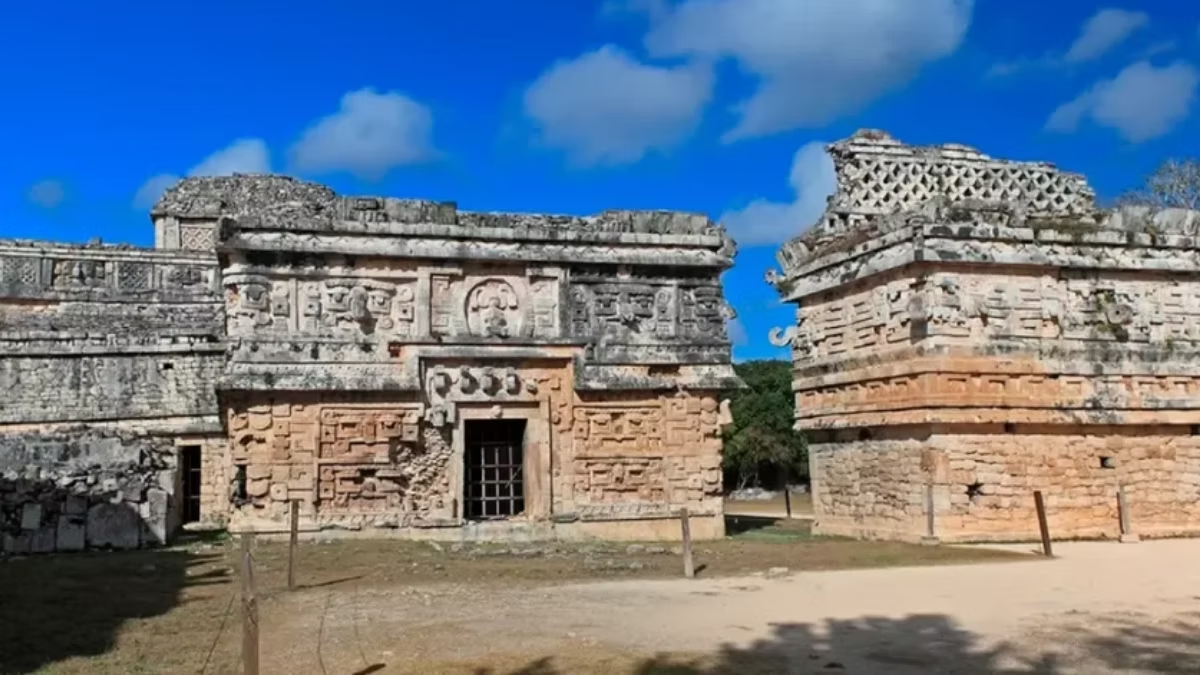
The Nunnery Complex (Spanish: Grupo de las Monjas) is a cluster of Terminal Classic Puuc-style buildings in the southern section of Chichén Itzá — the older, pre-Toltec heart of the city. The centerpiece is Las Monjas (“The Nunnery”), a massive three-tiered palace approximately 60 meters long, 30 meters wide, and 20 meters high (Lonely Planet dimensions) — named by Spanish explorers because its numerous small rooms reminded them of European convents, though it was actually a governmental palace for Maya royalty. Adjacent buildings include La Iglesia (“The Church”), a small elegant one-room structure covered in carved Chaac masks (the Maya rain god), and the Nunnery Annex with its distinctive Chenes-style facade. East of the Nunnery stands Akab Dzib (“House of Dark Writing” or “Obscure Writing”) — potentially the oldest standing structure at Chichén Itzá, named for undeciphered hieroglyphic inscriptions inside. Further south, the area known as Old Chichén or Chichén Viejo contains additional Puuc-style buildings including the Initial Series Group, Phallic Temple, Platform of the Great Turtle, Temple of the Owls, and Temple of the Monkeys. Chichén Viejo was closed to tourism for years during restoration and reopened to visitors in 2024. The Nunnery Group’s hieroglyphic inscriptions frequently mention a ruler named K’ak’upakal K’inich K’awil — the paramount 9th-century king whose dynasty connected Chichén Itzá to nearby Ek Balam.
The Nunnery Complex is where you see the Maya Chichén Itzá — before the Toltec influence, before El Castillo, before the warrior columns and tzompantli. This is the older architectural language of the site: Puuc-style mosaic decoration, Chaac masks, intricately carved friezes, and smaller, more intimate ceremonial spaces. Most visitors skip this part of the site in favor of the famous northern structures, which means the Nunnery area is quieter, less crowded, and often more atmospheric.
Understanding Puuc style
Puuc (pronounced “pook”) is the name of an architectural style developed in the northwestern Yucatán Peninsula during the Terminal Classic period (~800-1000 CE). The style is named after the Puuc Hills region of Yucatán, where it originated and was perfected at cities like Uxmal, Kabah, Sayil, and Labná. Puuc architecture is characterized by: plain lower walls with smooth stone; elaborately decorated upper façades featuring geometric stone mosaics; Chaac masks (long-nosed rain god carvings) at corners and doorways; stepped-fret patterns carved into friezes; vault-roofed interior rooms; and a general sense of horizontal composition with strong visual contrast between plain and decorated surfaces. At Chichén Itzá, Puuc style appears primarily in the Nunnery Complex and Old Chichén — the pre-Toltec parts of the site, constructed before the cultural shift toward central Mexican (Toltec) influence around 900-1000 CE. Puuc buildings at Chichén Itzá represent the earlier Maya architectural tradition of the city, contrasting sharply with the later Toltec-influenced structures (El Castillo, Temple of the Warriors, Great Ball Court) that most tourists come to see.
Puuc vs. Toltec styles at Chichén Itzá
The contrast between the two main architectural styles at Chichén Itzá:
| Feature | Puuc (Maya, earlier) | Toltec-influenced (later) |
|---|---|---|
| Typical era | ~600-900 CE | ~900-1200 CE |
| Location at site | Southern (Nunnery, Old Chichén) | Central/northern (main plaza) |
| Plain wall surfaces | Yes — lower walls smooth | Less emphasis on contrast |
| Mosaic decoration | Yes — intricate geometric patterns | Less common |
| Chaac masks | Prominent — long-nosed rain god | Some, but reduced |
| Feathered-serpent columns | Rare | Prominent |
| Chac Mool sculptures | Not present | Yes — distinctly Toltec |
| Warrior iconography | Minimal | Heavy — columns, reliefs |
| Skull imagery (Tzompantli) | Absent | Present |
| Vault-roofed interiors | Typical | Less common |
| Overall feel | Refined, decorative | Monumental, militaristic |
Visiting both areas gives you a complete picture of Chichén Itzá’s cultural evolution — from a Classic Maya city with regional architectural traditions to a Toltec-influenced post-Classic regional capital.
Las Monjas (The Nunnery)
The main building of the complex is Las Monjas — a large three-tiered palace structure. Its dimensions and details:
| Feature | Detail |
|---|---|
| Length | ~60 m / 197 ft |
| Width | ~30 m / 98 ft |
| Height | ~20 m / 66 ft |
| Floors/levels | 3 tiers |
| Construction stages | At least 6 identified |
| Occupation period | Long — multiple centuries |
| Primary style | Puuc (lower sections); Puuc-Toltec fusion (upper sections) |
| Orientation | Faces north |
| Name meaning | "The Nuns" or "The Nunnery" (Spanish) |
| Actual function | Governmental palace |
Why it’s called “The Nunnery”
Spanish explorers who first encountered the structure in the 16th-19th centuries saw a building with numerous small rooms and immediately associated it with the convents and nunneries they knew from Europe — buildings designed for communal religious living with many individual cells.
The name stuck despite being wrong. Archaeologists now believe Las Monjas was a governmental palace — a residence and administrative center for Chichén Itzá’s royal family during the Terminal Classic period. The multiple small rooms were elite residence spaces, administrative chambers, and ceremonial rooms, not monastic cells.
The Alfred Maudslay description
Alfred Maudslay, who photographed and documented Chichén Itzá extensively in 1889, provided one of the best early descriptions of Las Monjas. Maudslay noted the building was the best-preserved major structure at the site when he arrived. He described the basement as a solid mass of masonry with slightly sloping sides and rounded corners — dimensions he measured as approximately 165 feet long, 89 feet wide, and 35 feet high.
Maudslay also documented significant damage: the builders of the nearby Hacienda Chichén (the colonial-era ranch built atop the ruins) had used Las Monjas as a quarry, removing stone from the structure to build the ranch buildings. The southwest end was substantially removed; tunnels had been driven into the basement; and the western side of the great stairway had been breached.
When Maudslay worked at Chichén Itzá in 1889, he stayed in an apartment inside Las Monjas itself — living amid the ruins during his documentation project.
The hieroglyphic inscriptions
Las Monjas is distinguished by extensive hieroglyphic texts carved on lintels (the stone beams above doorways) and other surfaces. These texts date to the Late to Terminal Classic period and frequently mention a ruler named:
K’ak’upakal K’inich K’awil — the paramount 9th-century ruler of Chichén Itzá
K’ak’upakal’s name appears more frequently in Chichén Itzá inscriptions than any other ruler, and his dynasty links Chichén Itzá to the neighboring Maya city of Ek Balam (north of Chichén Itzá). Some epigraphic evidence suggests K’ak’upakal’s dynasty was foreign to the earlier Late Classic inhabitants of Chichén Itzá — possibly arriving from Ek Balam or another regional power and establishing new rulership around 870-900 CE.
The Las Monjas inscriptions are a primary source for understanding Chichén Itzá’s political history before the Toltec influence period.
The East Wing and skyband
The East Wing of Las Monjas contains particularly well-preserved Puuc-style decoration including a carved skyband — a horizontal band depicting astronomical symbols, including constellations and the body of a plumed serpent. Art historian Linda Schele and other scholars have studied this band as evidence of the Maya astronomical knowledge integrated into architectural decoration.
The serpent head motifs at the ends of the skyband are stylistically similar to those at Uxmal’s Nunnery Quadrangle — reinforcing the Puuc architectural connection between the two sites. Traces of original red paint are still visible on the carved surfaces.
La Iglesia (The Church)
Immediately east of Las Monjas stands La Iglesia — a small, elegant, one-room structure. Spanish explorers named it “The Church” because of its isolated position and temple-like appearance.
| Feature | Detail |
|---|---|
| Shape | Rectangular, single room |
| Style | Exaggerated Puuc Hills style |
| Lower walls | Plain |
| Upper frieze | Elaborately decorated with Chaac masks |
| Roof comb | Large, ornamental |
| Primary iconography | Chaac (rain god) masks at corners and doorways |
| Additional motifs | Sky beings, animal figures |
| Carnegie consolidation | 1930s (John S. Bolles team) |
| INAH restoration | 2019-2020 |
The Chaac mask decoration
La Iglesia is almost entirely covered in carved Chaac masks — the distinctive long-nosed rain god iconography that dominates Puuc and Chenes architecture. Chaac masks on La Iglesia appear at:
- Corners of the upper frieze
- Doorways — stacked above openings
- Roof comb — the decorative vertical element above the main roof
- Panel divisions — between sections of the frieze
This density of Chaac masks on a single small building is distinctive. Most Puuc structures include Chaac imagery but distribute it across larger surfaces; La Iglesia concentrates it densely, making the building one of the most visually striking examples of Puuc decoration anywhere.
The restoration history
La Iglesia has been stabilized in two major restoration campaigns:
1930s Carnegie work — Archaeologist John S. Bolles and his team consolidated the structure under the broader Carnegie Institution of Washington project that restored many Chichén Itzá buildings (including the Temple of the Warriors 1925-1928).
2019-2020 INAH work — Mexico’s National Institute of Anthropology and History conducted further stabilization and preservation work, updating conservation approaches and addressing damage that had accumulated since the Carnegie restoration.
La Iglesia today is in relatively stable condition thanks to these efforts.
The Nunnery Annex
Connected to Las Monjas on the east side is the Nunnery Annex — a smaller building with its own distinctive architectural character. While Las Monjas uses Puuc style throughout, the Annex’s east-facing façade departs from pure Puuc and incorporates elements of the Chenes style.
Chenes style
Chenes is the architectural style of the Chenes region of northeastern Campeche state (south-central Yucatán Peninsula), roughly contemporaneous with Puuc. Chenes buildings are characterized by:
- Doorways framed as monster mouths — the entrance represented as the open jaws of a deity or sky serpent
- Heavier, more three-dimensional facade decoration
- More dramatic iconographic compositions than Puuc style
- Chaac masks integrated into complex mythological scenes
The Nunnery Annex’s Chenes-style façade shows that Chichén Itzá’s Terminal Classic architects were aware of and drew from multiple regional architectural traditions — Puuc, Chenes, and eventually central Mexican/Toltec influences.
Akab Dzib
East of the Nunnery Complex stands Akab Dzib — one of the most intriguing buildings at Chichén Itzá.
Name meaning
“Akab Dzib” means “House of the Dark Writing” or “Obscure Writing” in Yucatec Maya. The name refers to:
- Dzib = writing
- Akab = dark, night, obscure, or hidden
The name comes from the hieroglyphic inscriptions inside the building, which remained undeciphered during early archaeological work (and most of which remain partially undeciphered today).
Possibly the oldest structure
Some archaeologists believe Akab Dzib is the oldest standing structure at Chichén Itzá. The central chambers show the earliest known architectural features at the site — suggesting the building dates from the early phase of Chichén Itzá’s occupation, possibly 6th-7th century CE.
This is not universally accepted — other candidates for oldest structure exist, and dating is complicated by multiple construction phases. But Akab Dzib is consistently among the oldest identified buildings.
Traces of original color
Akab Dzib preserves traces of original red paint on walls and carved surfaces — a reminder that Chichén Itzá buildings were originally brilliantly painted in red, blue, green, and other colors. The weathered limestone visitors see today is a pale ghost of the original appearance.
Old Chichén (Chichén Viejo)
Old Chichén (Spanish: Chichén Viejo) is the name given to a cluster of Puuc-style structures located south of Chichén Itzá’s main ceremonial center. This area represents the earliest substantial occupation of the site — hence “Old Chichén” as opposed to the later, more monumental New Chichén (the central area with El Castillo, the Great Ball Court, and Temple of the Warriors). Notable structures in Old Chichén include: the Initial Series Group (named for a stone with the earliest hieroglyphic date at the site), the Phallic Temple, the Platform of the Great Turtle, the Temple of the Owls, and the Temple of the Monkeys. Most of Old Chichén was closed to tourism for many years during archaeological excavations and restorations — and the area reopened to visitors in 2024, providing access to parts of Chichén Itzá that previous generations of tourists couldn’t see. The reopening has transformed what visitors can experience at the site.
The Initial Series Group
The most historically significant structure in Old Chichén is the Initial Series Group, named for a carved lintel with the earliest hieroglyphic date found at Chichén Itzá — a Long Count date corresponding to 832 CE. This date anchors the chronology of the site, confirming that significant construction and hieroglyphic recording was happening at Chichén Itzá by the early 9th century.
Edward Herbert Thompson (the American archaeologist who later dredged the Sacred Cenote) discovered this dated lintel during his early 20th-century exploration work.
The Phallic Temple
One of the more unusual structures at Old Chichén, the Phallic Temple is named for its carved phallic sculptures and iconography. The building is related to Maya fertility cult traditions and represents a relatively rare category of explicitly fertility-focused ritual architecture in the Maya world.
The Platform of the Great Turtle
A ceremonial platform featuring a large carved turtle — turtles had significant symbolic meaning in Maya cosmology, associated with the earth, creation, and the mythological origin of the world. In some Maya creation stories, the earth is a turtle’s back.
The Temple of the Owls and Temple of the Monkeys
Two smaller temples named for their iconographic decoration:
- Temple of the Owls — featuring carved owl imagery. Owls in Maya culture were associated with the underworld, night, and messenger birds for the Xibalba lords
- Temple of the Monkeys — featuring carved monkeys. Maya monkey iconography is complex; monkeys appear in the Popol Vuh as transformed humans and in various other mythological contexts
The 2024 reopening
Chichén Viejo was closed to tourism for decades as archaeologists and conservators worked on restoration. The closure meant that generations of Chichén Itzá visitors couldn’t see this part of the site. The 2024 reopening was a significant moment for Mexican archaeology and tourism.
Visitors now have access to structures that were previously only visible through archaeological publications. The additional area meaningfully expands what’s visible at Chichén Itzá and adds significant educational value for travelers interested in the full scope of the ancient city.
Location and orientation at Chichén Itzá
The Nunnery Complex and Old Chichén are in the southern section of the archaeological zone — the opposite end from the main ceremonial plaza with El Castillo.
From El Castillo’s central plaza, walking south:
- Pass El Caracol (The Observatory) — approximately 400m south of El Castillo
- Reach the Nunnery Complex — Las Monjas, La Iglesia, the Annex
- Continue to Akab Dzib — just east of the Nunnery
- Enter Old Chichén (Chichén Viejo) — further south, the 2024-reopened area
The full walk from El Castillo to Old Chichén takes approximately 15-20 minutes at a moderate pace. The southern section is shaded by trees and generally cooler than the exposed central plaza.
When to visit
- For minimum crowds: Anytime — this area sees dramatically less foot traffic than the main ceremonial center
- For photography: Morning (8:00-10:00 AM) catches the Nunnery facade in clean east light
- For La Iglesia detail: Mid-morning direct light shows the Chaac masks at their best
- For the most complete experience: After visiting the main plaza first — the contrast between Puuc and Toltec styles is striking when seen consecutively
- For Old Chichén: Plan extra time (30-45 minutes) if you want to explore the 2024-reopened area
Most guided tours do not visit the Nunnery Complex — they focus on El Castillo, Great Ball Court, Temple of the Warriors, and Sacred Cenote before concluding. If you want to see the Nunnery area, either:
- Choose a private or small-group tour that includes extended time
- Take a standard guided tour and then stay at the site to explore independently
- Go with entry ticket only (no guide) and navigate yourself — the distance is manageable
What to look for when you visit
At Las Monjas
– The scale of the three tiers – Carved hieroglyphic lintels (K’ak’upakal’s name appears frequently) – The damaged southwest section (where the hacienda builders quarried stone) – The skyband on the East Wing – Remnants of original red paint
At La Iglesia
– The density of Chaac masks — count how many you can identify – The distinct “long-nosed” profile of each Chaac mask – The oversized roof comb above the building – The contrast between plain lower walls and decorated upper frieze
At Akab Dzib
– The hieroglyphic inscriptions (mostly undeciphered) – Traces of red paint – The simple, early architectural character suggesting ancient date – The overall modest scale compared to later buildings
At Old Chichén (if accessing the reopened area)
– The Initial Series Group’s 832 CE dated lintel location – Phallic Temple sculptures – The Great Turtle carving – Owl and monkey iconography on the smaller temples
Quick reference
| Detail | Value |
|---|---|
| Complex name | Nunnery Group / Grupo de las Monjas |
| Primary style | Puuc |
| Construction period | ~600-900 CE (earlier than main plaza) |
| Main buildings | Las Monjas, La Iglesia, Nunnery Annex, Akab Dzib |
| Las Monjas dimensions | ~60m × 30m × 20m (3-tier palace) |
| Las Monjas function | Governmental palace (not actually a convent) |
| La Iglesia notable feature | Densely carved Chaac masks on upper frieze |
| Akab Dzib notable | Possibly oldest structure at Chichén Itzá |
| Key ruler mentioned | K'ak'upakal K'inich K'awil (9th century) |
| Old Chichén status | Reopened 2024 after years of closure |
| Location at site | Southern section, 400m+ south of El Castillo |
| Typical visit time | 30-45 min (often skipped entirely) |
| Climbing | Prohibited (site-wide policy) |
Frequently Asked Questions
What is the Nunnery Complex at Chichén Itzá?
A cluster of Terminal Classic Puuc-style buildings in the southern section of Chichén Itzá, representing the earlier (pre-Toltec) Maya architectural tradition at the site. The complex includes Las Monjas (a large three-tiered palace), La Iglesia (a small temple covered in Chaac masks), the Nunnery Annex, and the nearby Akab Dzib. Despite the name, Las Monjas was not a convent — it was a governmental palace for Maya royalty.
Why is it called “The Nunnery”?
Spanish explorers in the colonial era saw the building’s many small rooms and associated it with European convents. The name stuck despite being wrong. Archaeologists now understand Las Monjas was a governmental palace — a royal residence and administrative center, not a religious community dormitory.
What was Las Monjas actually used for?
A governmental palace — residence and administrative center for Chichén Itzá’s royal family and elite during the Terminal Classic period (~800-900 CE). The multiple small rooms were elite residence spaces, administrative chambers, and ceremonial rooms. The building shows evidence of six construction stages suggesting long occupation and periodic renovation.
How big is Las Monjas?
Approximately 60 meters long, 30 meters wide, and 20 meters high according to Lonely Planet’s measurements. Alfred Maudslay in 1889 measured the basement as approximately 165 feet × 89 feet × 35 feet (~50m × 27m × 10.7m for the basement alone, with the upper structures adding height). The building has three tiers and is among the largest palace structures at Chichén Itzá.
What is La Iglesia at Chichén Itzá?
A small, elegant one-room Puuc-style temple immediately east of Las Monjas, named “The Church” by Spanish explorers. It’s distinguished by its dense carved Chaac masks (the long-nosed Maya rain god) on the upper frieze and roof comb. It’s one of the most visually striking examples of Puuc architecture anywhere — the plain lower walls contrast dramatically with the elaborate decorated upper sections.
What are Chaac masks?
Stylized carved representations of Chaac, the Maya rain god — characterized by a distinctive long, curved snout-like nose, large eyes, and stretched earlobes. Chaac masks appear throughout Puuc architecture (at Uxmal, Kabah, Labná, and Chichén Itzá). They’re especially prominent at La Iglesia, where they cover most of the upper frieze.
What is Akab Dzib?
A building east of the Nunnery Complex whose name means “House of the Dark Writing” or “Obscure Writing” in Yucatec Maya. The name refers to undeciphered hieroglyphic inscriptions inside. Some archaeologists consider it the oldest standing structure at Chichén Itzá, possibly dating from the 6th-7th century CE. Traces of original red paint are still visible on its surfaces.
What is Puuc style?
A Maya architectural style from the Terminal Classic period (~800-1000 CE), developed in the northwestern Yucatán Peninsula (the Puuc Hills region). Characterized by: plain lower walls contrasting with elaborately decorated upper façades featuring geometric stone mosaics, Chaac masks, stepped-fret patterns, and vault-roofed interiors. The best-known Puuc cities are Uxmal, Kabah, Sayil, and Labná; at Chichén Itzá, Puuc style appears in the Nunnery Complex and Old Chichén.
What is the difference between Puuc style and Toltec style at Chichén Itzá?
Puuc (Maya, earlier ~600-900 CE): Plain-wall contrast with decorated upper façades; Chaac masks; mosaic stone decoration; vault-roofed interiors. Toltec-influenced (later ~900-1200 CE): Feathered-serpent columns; Chac Mool sculptures; warrior column carvings; tzompantli (skull platforms); atlantean figures. Puuc represents the earlier Maya tradition; Toltec-influenced represents the later cultural fusion with central Mexican influences. Most famous Chichén Itzá structures (El Castillo, Temple of the Warriors, Great Ball Court) are Toltec-influenced.
What is Old Chichén (Chichén Viejo)?
The southern section of Chichén Itzá containing the earliest Puuc-style structures, including the Initial Series Group, Phallic Temple, Platform of the Great Turtle, Temple of the Owls, and Temple of the Monkeys. Closed to tourism for years during restoration work, Old Chichén reopened to visitors in 2024 — significantly expanding what Chichén Itzá visitors can now see.
When did Old Chichén reopen to tourists?
2024. After years of closure for archaeological excavations and restoration work, Old Chichén (Chichén Viejo) reopened to visitors. The reopening provides access to Puuc-style structures that previous generations of tourists couldn’t see and meaningfully expands the scope of what’s visible at the site.
Who is K’ak’upakal?
K’ak’upakal K’inich K’awil — the paramount 9th-century ruler of Chichén Itzá. His name appears in more Chichén Itzá hieroglyphic inscriptions than any other ruler, particularly on the lintels of Las Monjas. Some epigraphic evidence suggests his dynasty was foreign to Chichén Itzá’s earlier Late Classic inhabitants — possibly linked to the nearby Maya city of Ek Balam north of Chichén Itzá. K’ak’upakal’s rule (approximately 869-890 CE) represents a pivotal transitional period at the site.
Why are most tourists not shown the Nunnery Complex?
Standard guided tours focus on the main ceremonial center — El Castillo, Great Ball Court, Temple of the Warriors, Sacred Cenote — and usually end after 2-3 hours. The Nunnery Complex is in the southern section, approximately 400+ meters from the central plaza, and visiting it requires additional walking time that most tour operators don’t include. Travelers interested in the Nunnery area should either choose a longer/private tour, stay at the site after a guided tour ends, or visit independently with an entry ticket.
What’s the walk from El Castillo to the Nunnery like?
Approximately 15-20 minutes at a moderate pace, along a shaded path through the southern section of the site. You’ll pass El Caracol (The Observatory) along the way. The path is generally easier and cooler than the exposed central plaza — trees provide shade, and the terrain is flat. Comfortable walking shoes are sufficient; no special fitness required.
How does the Nunnery Complex fit into Chichén Itzá’s history?
It represents the earlier, pre-Toltec phase of Chichén Itzá — when the city was a Terminal Classic Maya center using regional architectural traditions (Puuc, Chenes). The inscriptions of K’ak’upakal and other rulers document the political history of this period. After approximately 900 CE, the city shifted toward central Mexican / Toltec influence, and new monumental construction moved to the central ceremonial plaza (El Castillo and surrounding structures). The Nunnery Complex continued in use during the Toltec period but wasn’t the focus of new construction.
What hieroglyphs are on the Las Monjas lintels?
Dynastic and ceremonial inscriptions mentioning rulers (especially K’ak’upakal K’inich K’awil), dates, and religious events. The Las Monjas inscriptions include some of the most well-preserved Classic Maya texts at Chichén Itzá. They’ve been extensively studied by Mayanist epigraphers and provide primary evidence for the city’s political history in the 9th century. The texts are partially deciphered; new translations and interpretations continue to emerge as Maya epigraphy advances.
Is the Nunnery Complex worth visiting?
Yes — especially for travelers interested in Maya architecture, pre-Toltec history, or quieter site experience. The Nunnery area sees dramatically less foot traffic than the main plaza, offering a more contemplative experience. For casual visitors who want the “greatest hits” of Chichén Itzá in limited time, the main plaza structures are priority. For travelers planning a full-day or half-day visit with time to explore, the Nunnery Complex meaningfully enriches the experience.
