

Chichén Itzá Symbols & Carvings 2026: Kukulkán, Chaac, Jaguars, Glyphs
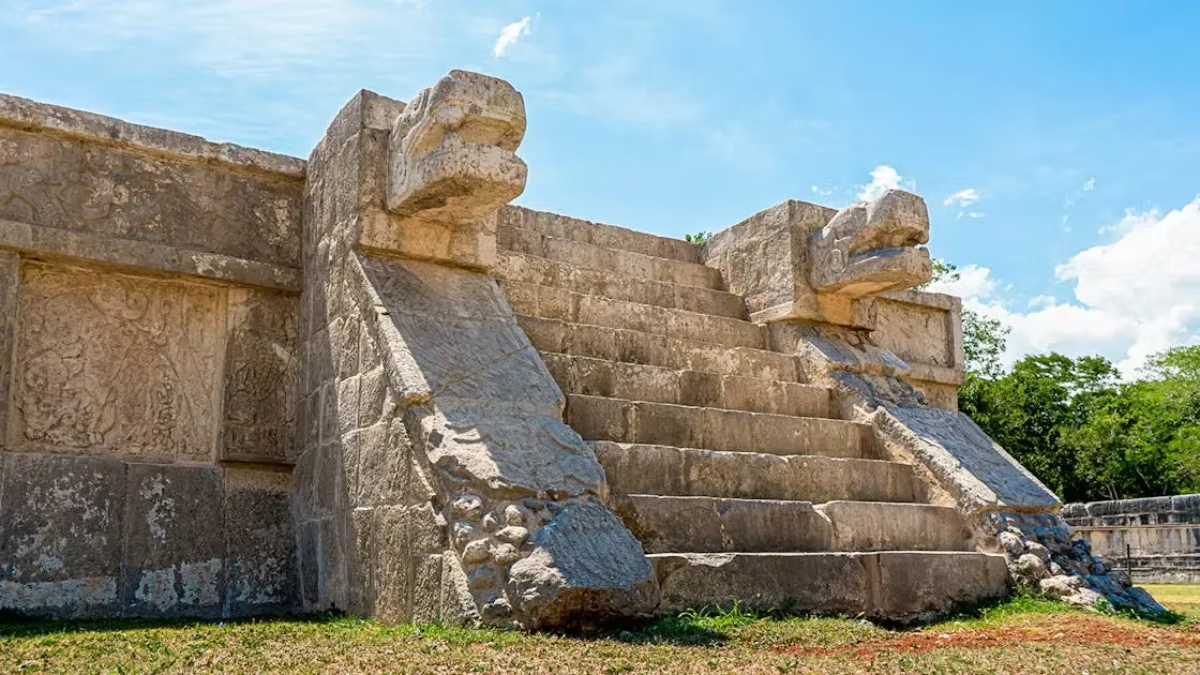
Chichén Itzá contains thousands of carved symbols across its major structures, most representing Maya and Toltec-influenced religious iconography. The most important recurring symbols are: Kukulkán (the feathered serpent) — the deity whose worship dominates post-Classic Chichén Itzá, represented as a snake with feathers, appearing on El Castillo’s staircase, Temple of the Warriors columns, and throughout the site; Chaac (the rain god) — long-nosed mask imagery most prominent in Puuc-style structures (La Iglesia, Nunnery Complex) but also at the Temple of the Warriors; eagles and jaguars — representing elite Toltec-influenced military orders, often shown devouring human hearts on the Platform of the Eagles and Jaguars and the Temple of the Warriors; Chac Mool sculptures — reclining figures with offering plates on their stomachs, found throughout the site (more than a dozen at Chichén Itzá); skull iconography (the Tzompantli); feathered-serpent columns framing temple entrances (El Castillo, Temple of the Warriors); warrior figures in bas-relief on columns; glyphs and hieroglyphic writing on lintels (especially at Las Monjas and Akab Dzib); and astronomical/calendar symbols encoded in architectural features. Understanding these symbols transforms a visit from “looking at pretty ruins” to reading the visual language of Maya and Toltec religion.
The Maya and their Toltec-influenced successors at Chichén Itzá didn’t carve decorations for decoration’s sake — every element carried religious, political, or astronomical meaning. A feathered serpent isn’t just a design; it’s Kukulkán, the god of wind, rain, life, transformation, and royal authority. A long-nosed mask isn’t a decorative flourish; it’s Chaac, the rain god whose favor determined whether crops survived. Knowing these meanings is essential for understanding what you’re seeing at Chichén Itzá.
Kukulkán: The Feathered Serpent
Kukulkán (also spelled Kukulcán; in Nahuatl Quetzalcoatl) is the Maya feathered-serpent deity — the most important god at post-Classic Chichén Itzá. Kukulkán embodies a fusion of two elemental forms: the serpent (earth, water, underworld, transformation, the ground-dwelling realm) and feathers (sky, wind, flight, heaven, the upper realm). The combination represents a deity connecting earth and sky, water and wind, underworld and heaven — a god of cosmic unity. At Chichén Itzá, Kukulkán is associated with: El Castillo (named the “Temple of Kukulkán” and featuring the equinox shadow-serpent descent); Venus as the morning star (Kukulkán was identified with Venus’s cyclical appearance); royal authority (rulers claimed descent from or special relationship with Kukulkán); wind and rain (Kukulkán was a breath and weather deity); and civilizational founding (the legendary Topiltzin Quetzalcoatl/Kukulkán is said to have arrived from Tula around 987 CE). Feathered-serpent imagery appears throughout the site: carved serpent heads at the base of El Castillo’s northern staircase, feathered-serpent columns at the Temple of the Warriors’ summit, serpent balustrades on the western staircase of El Caracol, carved rings decorating the Great Ball Court, and intertwining serpents throughout architectural decoration.
Where to find Kukulkán
At El Castillo: – Carved serpent heads at the base of the northern staircase (ground level, where the equinox shadow-serpent “arrives”) – Feathered-serpent columns at the top of the pyramid temple – The equinox shadow effect itself — the descending serpent of light and shadow on the western balustrade
At the Temple of the Warriors: – Two massive feathered-serpent columns framing the entrance to the top temple – Rattlesnake tails rising to support the doorway lintel – Serpent heads resting at ground level with open mouths – Similar columns at the Upper Temple of the Jaguars
At El Caracol: – Intertwining serpents’ heads on the balustrades of the western staircase – Feathered serpent frieze (partially eroded) on the tower
At the Great Ball Court: – Stone goal rings carved with feathered serpents – Serpents on balustrades leading to the North Temple – Feathered serpents at the end of relief panels showing ball players
Throughout the site: – Architectural decoration on virtually every major structure – Jade ornaments recovered from the Sacred Cenote featuring feathered-serpent imagery
Kukulkán’s significance
Kukulkán was worshipped across Mesoamerica in various forms. At Chichén Itzá specifically:
- Central deity of the post-Classic cult
- Represented political authority — the ruler’s connection to cosmic forces
- Associated with wind (bringing rain), water (essential in the Yucatán), and transformation
- Linked to Venus as the morning star
- His “descent” at equinox symbolized divine blessing of the agricultural cycle
Chaac: The Rain God
Chaac (also spelled Chac or Chaak) is the Maya rain god — arguably the most important deity in the Yucatán Peninsula, where agriculture depended entirely on rainfall (no rivers). Chaac is represented with distinctive iconography: a long curved snout-like nose (sometimes described as an elephant’s trunk or a hooked beak), large circular eyes, stretched earlobes, and often fangs or teeth visible. Chaac masks are most prominently displayed at Chichén Itzá’s Puuc-style structures — particularly La Iglesia (where the upper frieze and roof comb are covered in Chaac masks) and throughout the Nunnery Complex. Chaac also appears (less densely) at Toltec-influenced structures, including the Temple of the Warriors corners and friezes. In Maya belief, Chaac was a water-wielding deity who split clouds with his lightning-axe to release rain — failure of rain (droughts) was interpreted as Chaac’s disfavor, prompting human sacrifice and cenote offerings specifically to regain his favor. The Sacred Cenote at Chichén Itzá was dedicated to Chaac, and the 30,000+ artifacts recovered from it were offerings to this deity.
How to identify a Chaac mask
Look for: – Long curved nose — most distinctive feature, projecting outward from the wall surface – Large circular eyes above and flanking the nose – Stretched earlobes with ornaments – Fangs or prominent teeth – Stylized feathers around the face – Often arranged in series — corners of buildings, above doorways
Chaac iconography evolution
- Classic Maya period: Chaac depicted with more varied features
- Terminal Classic Puuc style: Highly stylized masks with exaggerated long noses
- Post-Classic Toltec influence: Less prominent, integrated with other iconography
At Chichén Itzá, the Puuc-style Chaac masks are the most archaeologically significant — especially those at La Iglesia.
Where to find Chaac
Primary locations: – La Iglesia — covered in Chaac masks on frieze and roof comb – Nunnery Complex (Las Monjas, Annex) — multiple masks – Akab Dzib — simpler but present – Temple of the Warriors corners — integrated with other decoration – Old Chichén / Chichén Viejo structures — traditional Puuc-style masks
Eagles and Jaguars
The Platform of the Eagles and Jaguars (just south of the Great Ball Court and immediately adjacent to the Tzompantli) features prominent carvings of eagles and jaguars, and these same animals appear on the columns of the Temple of the Warriors and elsewhere.
What they represent
Eagles and jaguars were the two elite military orders in Toltec culture — specialized warrior classes with distinct insignia, rituals, and ranks. At Chichén Itzá (which absorbed Toltec influence), these animals appear as military and political symbols:
- Eagle warriors — elite warriors associated with the sky, sun, and daytime; represented active, aggressive force
- Jaguar warriors — elite warriors associated with night, the underworld, and stealth; represented concealed, predatory power
Together, eagles and jaguars covered the full spectrum of warrior archetype — sky and earth, day and night, active and stealthy.
The “devouring hearts” motif
A recurring image at Chichén Itzá shows eagles and jaguars devouring human hearts — visible on: – Platform of the Eagles and Jaguars (named for this imagery) – Temple of the Warriors columns (some carved columns show this scene) – Tzompantli bas-relief panels
This imagery connects the elite military orders to human sacrifice — the warriors (represented symbolically by eagles and jaguars) were the instruments of ritual killing, and the gods received the extracted hearts as nourishment. The image is deliberately visceral, communicating both political power (warriors demonstrating their reach) and religious obligation (feeding the gods).
Chac Mool: The Offering Figure
The Chac Mool is a distinctive Mesoamerican sculptural form — a reclining human figure on its back with knees drawn upward, head turned 90 degrees to one side, and a flat plate or receptacle resting on the stomach designed to hold offerings. The name “Chac Mool” means “great red jaguar” in Yucatec Maya, though the figure itself isn’t jaguar-shaped — the name was applied by Augustus Le Plongeon when he excavated the first known example in 1875 at Chichén Itzá. Chac Mool sculptures are strongly associated with Toltec culture — similar statues exist at Tula (the Toltec capital) and other post-Classic Mesoamerican sites. Over a dozen Chac Mool sculptures have been found at Chichén Itzá, including the famous one at the top of the Temple of the Warriors. Interpretations of the figure’s purpose vary: some scholars view Chac Mool as an intermediary between gods and humans (offerings placed on the stomach would be received by the deities); others interpret the plate as a receptacle for hearts extracted during human sacrifice; still others see the figure as representing a fallen warrior or a rain deity. Most accepted modern interpretation: the Chac Mool served as an altar for offerings which could include incense, food, or — in the most dramatic ceremonies — sacrificial hearts. The figure’s consistent posture across dozens of examples suggests a codified religious tradition.
Where to find Chac Mools at Chichén Itzá
Primary location: – Top of the Temple of the Warriors — the iconic Chac Mool visible from the plaza below
Other locations: – Upper Temple of the Jaguars (overlooking the Great Ball Court) – Temple of the Tables (within the Group of the Thousand Columns) – Temple of the Carved Columns – Various smaller structures around the site – Hidden Temple of the Chac Mool (inside the Temple of the Warriors — closed to visitors)
How to identify a Chac Mool
- Reclining on its back with knees bent upward
- Head turned 90 degrees (usually left, sometimes right)
- Flat plate or bowl resting on the stomach
- Hands holding the plate or positioned at the sides
- Elaborately carved regalia including earspools, necklaces, and ceremonial dress
- Typically life-sized or slightly smaller
Atlantean Figures
The Temple of the Tables (in the Group of the Thousand Columns area) contains atlantean figures — small carved warriors supporting an altar above them. These are related to the famous Atlantes at Tula (Toltec capital), where four massive warrior columns at the top of Pyramid B support the temple roof.
At Chichén Itzá, atlantean figures are smaller (roughly 1-1.5 meters tall) and function more as decorative altar supports than structural columns. They represent warriors bearing celestial burden — the sky or altar resting on their shoulders — a concept connecting warrior status to cosmic duty.
Warrior Columns
Throughout the Temple of the Warriors and Group of the Thousand Columns, square columns are carved with bas-relief images of Toltec warriors.
What’s depicted
- Warriors in full ceremonial dress — feathered headdresses, shields, spears
- Weapons and regalia shown in detail
- Different ranks and orders — some columns show eagle warriors, others jaguar warriors
- Ritual ornamentation — earspools, pectorals, anklets, backrack devices
- Decorated sandals and other footwear
Significance
These columns transform the Temple of the Warriors plaza into a permanent architectural procession of Toltec military force. Each column represents a specific warrior figure or warrior concept. The combined visual effect — 200+ warriors surrounding the pyramid — was a powerful statement of political authority.
Serpents: Beyond Kukulkán
While Kukulkán is the feathered serpent, other serpent imagery appears throughout Chichén Itzá:
Sky serpents
On the East Wing of Las Monjas, a carved sky band features serpent heads at the ends with constellations and astronomical symbols along the body. This represents the celestial serpent — a concept connecting serpents to the Milky Way and the night sky.
Ball game decapitation serpents
On the Great Ball Court walls, the dramatic carving of a decapitated ball player shows seven serpents emerging from the severed neck — representing blood or life force transferring between worlds.
Two-headed serpents
Some iconography shows two-headed serpents — a representation of the sky-water connection (sky serpent’s head + earth serpent’s head), duality, or liminal/boundary power.
Rattlesnake iconography
Many serpent columns specifically depict rattlesnakes — identifiable by the carved rattles at the tail. Rattlesnakes had religious significance in Mesoamerican cultures, associated with warning, sound, and the underworld.
Glyphs and Hieroglyphic Writing
Chichén Itzá contains Maya hieroglyphic inscriptions on multiple structures, particularly on the lintels (stone beams above doorways) of Las Monjas and on carved stelae and lintels at other buildings. Classic Maya writing is a logosyllabic system combining logographs (single signs representing whole words) and syllabic signs (representing sounds), making it one of the most sophisticated writing systems developed independently in the ancient Americas. Maya writing was partially deciphered during the 20th century through the work of scholars including Yuri Knorozov, Tatiana Proskouriakoff, Linda Schele, and David Stuart. At Chichén Itzá, the inscriptions include dynastic dates (especially mentioning ruler K’ak’upakal K’inich K’awil), religious and ceremonial texts, and astronomical/calendrical notations. The earliest dated inscription is from the Initial Series Group (832 CE); the latest known date is on the Osario temple (998 CE). The glyphs at Akab Dzib (“House of the Dark/Obscure Writing”) remain largely undeciphered — the building is named for these unread inscriptions. Modern Maya epigraphy continues to advance; new readings and interpretations of Chichén Itzá’s glyphs are periodically published.
Where to find glyphs
- Las Monjas lintels — the most concentrated inscriptions, mentioning K’ak’upakal and other rulers
- Akab Dzib — undeciphered glyphs (hence the name)
- Initial Series Group (Old Chichén) — 832 CE dated lintel
- Osario temple — 998 CE dated inscription
- Various stelae throughout the site
- Temple of the Warriors columns — some with glyph inscriptions
What the glyphs record
- Dynastic histories — names of rulers, dates of accession, significant events
- Calendar dates in Long Count and Calendar Round notation
- Religious content — deity invocations, ceremonial events
- Astronomical observations — eclipse dates, Venus events
- Building dedication — when structures were completed or consecrated
Partial decipherment
Classic Maya writing is partially but not fully deciphered — approximately 90% of signs can now be read, but many texts contain rarely used or context-specific signs that remain uncertain. The Akab Dzib glyphs in particular have resisted full reading.
The Diagonal Mat Pattern
The diagonal mat or flower lattice pattern appears on Puuc-style structures including parts of the Nunnery Complex and similar buildings at Uxmal.
Art historian Linda Schele interpreted this pattern as representing:
- Flower-laden scaffolding used in Maya ritual
- A visual reference to the “flower house” (nikte’il nah) — which in 16th-century Yukatek Maya dictionaries is glossed as an assembly house or community house
- A place where elites gathered to “deal with the affairs of state, and to teach dancing for community festivals”
This interpretation suggests that buildings decorated with the diagonal mat pattern had a specific governmental or assembly function — encoding the building’s purpose into its decoration. The pattern appears on Las Monjas, supporting the identification of the building as a governmental palace.
Astronomical Symbolism in Architecture
Many Chichén Itzá “symbols” aren’t carvings at all but architectural elements with astronomical meaning:
El Castillo’s step count
– 365 steps = solar year (see Maya Astronomy)
El Caracol’s orientation
– Windows aligned with Venus positions and solstices
Sky band on Las Monjas
– Astronomical symbols carved along horizontal band
Equinox shadow-serpent
– Kukulkán’s descent = Venus/astronomical event physicalized in shadow
These architectural “symbols” are as meaningful as any carved image — the Maya didn’t separate visual decoration from cosmic meaning.
Symbols Not Found at Chichén Itzá
It’s worth noting what’s not present, to avoid confusion with other Mesoamerican sites:
- Olmec-style colossal heads — these are from a much earlier (and different) culture, not Maya
- Aztec Tenochtitlan iconography — Chichén Itzá predates the Aztec empire by centuries
- Pyramid of the Sun/Moon imagery — those are at Teotihuacan, a different site
- Machu Picchu-style terraces — that’s Inca, South America, different continent
- Specific Egyptian or Old World symbols — despite occasional fringe claims of connections, there’s no archaeological evidence for Old World contact
Visitors sometimes conflate Mesoamerican cultures; Chichén Itzá is specifically Maya with post-Classic Toltec influences — not Aztec, not Olmec, not Teotihuacano (though there are related iconographic traditions).
How to read a Chichén Itzá carving
When you encounter a carved panel or relief at the site, ask these questions:
- What animals or figures are shown? (Serpents, eagles, jaguars, humans, skulls)
- What objects do they hold or interact with? (Hearts, shields, offerings, ceremonial tools)
- Is there a recognizable deity? (Kukulkán, Chaac, Chac Mool)
- What’s the architectural context? (Puuc or Toltec style? Public or elite space?)
- Are there hieroglyphs nearby? (Dates, names, dedications)
- What direction does it face? (Astronomical orientation?)
Most panels communicate multiple overlapping meanings — religious (representing a deity), political (demonstrating authority), cosmological (connecting to celestial order), and historical (recording specific events or rulers).
Quick reference — symbol identification guide
| Symbol | Key features | Primary meaning | Main locations |
|---|---|---|---|
| Kukulkán | Feathered serpent | Central Chichén Itzá deity | El Castillo, Temple of Warriors, Great Ball Court |
| Chaac mask | Long curved nose, big eyes | Rain god | La Iglesia, Nunnery Complex, Temple of Warriors corners |
| Eagle | Feathered bird with weapons | Elite warrior order | Platform of Eagles and Jaguars, Temple of Warriors |
| Jaguar | Spotted feline, fanged | Elite warrior order (night/underworld) | Platform of Eagles and Jaguars, Temple of the Jaguars |
| Chac Mool | Reclining figure with belly plate | Offering altar/intermediary | Temple of Warriors top, many other structures |
| Skulls | Rows of stylized crania | Sacrificial victims | Tzompantli |
| Atlanteans | Small warrior figures | Supporting altars/sky | Temple of Tables, various smaller altars |
| Warriors | Standing figures with regalia | Military rank/procession | Group of Thousand Columns, Temple of Warriors |
| Glyphs | Hieroglyphic writing | Dynastic/calendrical | Las Monjas lintels, Initial Series Group, Akab Dzib |
| Feathered serpent column | Snake with feathers as column | Architectural Kukulkán | Temple of Warriors, Temple of Jaguars entrance |
| Diagonal mat pattern | Lattice with flowers | Possibly assembly house marker | Las Monjas, Nunnery |
| Seven serpents | Emerging from decapitated player | Blood/life force | Great Ball Court carvings |
Frequently Asked Questions
What is Kukulkán?
Kukulkán is the Maya feathered serpent deity — the most important god at post-Classic Chichén Itzá. The name means “feathered serpent” or “plumed serpent.” Kukulkán combines the serpent (earth, water, underworld) and feathers (sky, wind, heaven), representing a god who connects all cosmic realms. Kukulkán is also identified with Venus as the morning star and is the equivalent of the Aztec/Toltec Quetzalcoatl. The legendary ruler Topiltzin Quetzalcoatl who reportedly arrived at Chichén Itzá around 987 CE was identified with the god Kukulkán.
What does the long-nosed mask mean?
The long-nosed mask represents Chaac, the Maya rain god. The distinctive long curved nose (sometimes described as elephant-trunk-like or hook-like) is Chaac’s defining iconographic feature, along with large circular eyes and stretched earlobes. Chaac was the most important deity in the Yucatán Peninsula, where agriculture depended entirely on rainfall. Chaac masks are most prominently displayed on Puuc-style structures like La Iglesia and the Nunnery Complex.
What is a Chac Mool?
A reclining stone figure lying on its back, with knees bent upward, head turned to one side, and a flat plate or bowl on its stomach used for offerings. The name means “great red jaguar” in Yucatec Maya, though the figure isn’t jaguar-shaped. Chac Mools are distinctly Toltec in origin — similar statues exist at Tula and other post-Classic sites. Over a dozen examples have been found at Chichén Itzá, most famously the one at the top of the Temple of the Warriors. Interpretations vary: intermediary between gods and humans, sacrificial altar, or both.
What do eagles and jaguars represent?
Elite Toltec-influenced military orders. Eagle warriors were associated with the sky, sun, and daytime (active, aggressive force); jaguar warriors with night, the underworld, and stealth (concealed, predatory power). Together they cover the full warrior spectrum. At Chichén Itzá, eagles and jaguars frequently appear devouring human hearts — connecting military power to sacrificial religion. The Platform of the Eagles and Jaguars is named for this imagery.
What is the feathered serpent column?
Architectural columns carved in the shape of feathered serpents (Kukulkán) — with the head at ground level and open mouth, the body forming the column shaft, and the rattlesnake tail rising upward to support a lintel (horizontal beam) over a doorway. The most famous examples frame the entrance to the top temple at the Temple of the Warriors. Similar columns appear at El Castillo’s summit and the Upper Temple of the Jaguars. They represent Kukulkán descending from the sky to the earth.
What are the glyphs at Chichén Itzá?
Maya hieroglyphic inscriptions — a logosyllabic writing system combining logographs and syllabic signs. Chichén Itzá’s glyphs appear primarily on lintels (stone beams above doorways), most concentrated at Las Monjas and other Nunnery Complex structures. They record dynastic dates (especially mentioning ruler K’ak’upakal), religious and ceremonial content, and astronomical observations. The earliest dated inscription is 832 CE (Initial Series Group); the latest is 998 CE (Osario temple). Akab Dzib is named “House of Dark/Obscure Writing” because its glyphs remain largely undeciphered.
Can we read all the Maya writing?
Approximately 90% of Classic Maya signs can now be read thanks to 20th-century decipherment work by scholars including Yuri Knorozov, Tatiana Proskouriakoff, Linda Schele, and David Stuart. Many inscriptions are fully translatable; others contain rare or context-specific signs that remain uncertain. The Akab Dzib glyphs specifically have resisted full reading — hence the building’s name meaning “House of Dark Writing.” Maya epigraphy continues to advance; new readings are published regularly.
What does the diagonal mat pattern mean?
Art historian Linda Schele interpreted the diagonal mat (or “flower lattice”) pattern on Puuc-style buildings as representing flower-laden scaffolding used in Maya ritual, and specifically as a visual reference to “flower house” (nikte’il nah) — a term glossed in 16th-century Yucatec dictionaries as an assembly house or community house. This interpretation suggests that buildings decorated with this pattern had a governmental or assembly function — encoding the building’s purpose into its decoration. Las Monjas features this pattern, supporting its identification as a governmental palace.
Why are there skulls carved everywhere?
The Tzompantli (Wall of Skulls) features rows of carved skulls representing sacrificial victims — a Toltec-introduced tradition of publicly displaying the skulls of enemies and ritual victims. The original wooden structure above the stone platform held actual human skulls; the carved stone replicas remain. Skull iconography also appears on the Platform of Venus and occasionally elsewhere, reflecting the broader Toltec-influenced religious emphasis on sacrifice. It’s concentrated at the Tzompantli; most of the site doesn’t feature skull imagery.
What is the significance of seven serpents?
On the Great Ball Court carvings, a dramatic scene shows a decapitated ball player with seven serpents emerging from the severed neck. The seven serpents represent blood and life force transferring between worlds — the sacrificial killing connecting the earthly realm to divine realms. Seven was a sacred number in Maya cosmology (associated with various cosmological concepts including the seven directions: four cardinal + center + above + below).
What animals are on the Temple of the Warriors columns?
Eagles and jaguars devouring human hearts are common imagery on the Temple of the Warriors columns and the Platform of the Eagles and Jaguars. The columns themselves primarily feature Toltec warriors in full ceremonial dress with shields, spears, feathered headdresses, and military regalia. The warrior imagery represents the militarized culture of post-Classic Chichén Itzá.
Where can I see the most concentrated Chaac masks?
La Iglesia (the small temple east of Las Monjas) is almost entirely covered in Chaac masks on its upper frieze and roof comb. The density of Chaac iconography on a single small building is distinctive — most Puuc structures distribute Chaac imagery across larger surfaces, but La Iglesia concentrates it. Count how many Chaac masks you can identify on the structure.
Is the equinox serpent shadow considered a “symbol”?
Yes — it’s the most dramatic “symbol” at Chichén Itzá, formed by light and shadow rather than carved stone. On the days near equinox (March 20-21, September 22-23), sunlight creates triangular shadows on El Castillo’s northern staircase balustrade that combine with the carved serpent head at ground level to form an apparent complete descending serpent. This visual effect is interpreted as Kukulkán descending from the sky to the earthly realm — a religious symbol manifested through architectural engineering.
What’s the difference between Maya and Toltec symbols at the site?
Maya symbols (earlier, ~600-900 CE, Puuc style): Chaac masks dominate; refined decorative patterns; vault-roofed interiors; geometric mosaics; minimal warrior imagery. Toltec-influenced symbols (later, ~900-1200 CE): Feathered-serpent columns; Chac Mool sculptures; warrior column carvings; tzompantli (skull rack); eagle-and-jaguar imagery; atlantean figures. The southern section (Nunnery Complex, Old Chichén) is Maya-Puuc; the central ceremonial plaza (El Castillo, Temple of the Warriors, Great Ball Court, Tzompantli) is Toltec-influenced.
Should I hire a guide to understand the symbols?
Yes — a good guide dramatically improves understanding. Without context, the carvings at Chichén Itzá look decorative rather than meaningful. A knowledgeable guide explains who Kukulkán is, why Chaac has a long nose, what the eagles devouring hearts mean, and how the Chac Mool fits into Toltec religious practice. Self-guided visitors with background reading (including this article) can follow along, but the site genuinely rewards expert interpretation. Consider a certified INAH guide for the most accurate historical information. Budget approximately $50-100 USD for private guides; $15-25 USD for shared-group guides.
Are any carvings still brightly painted?
No — visible paint has weathered away. Virtually every structure at Chichén Itzá was originally painted in brilliant colors (reds, blues, greens, yellows, purples) on plastered surfaces. Centuries of rain, sun, and jungle exposure dissolved the plaster and faded the pigment. Traces of original red paint are still visible on protected surfaces of Akab Dzib, parts of the Nunnery Complex, and under specific lighting conditions on some Temple of the Warriors columns. The current weathered limestone appearance of Chichén Itzá is a ghost of the original riotous color. Reconstructed archaeological models and museum exhibits can give you a sense of how the site originally looked.
