

El Caracol Observatory Chichén Itzá 2026: Maya Venus Astronomy
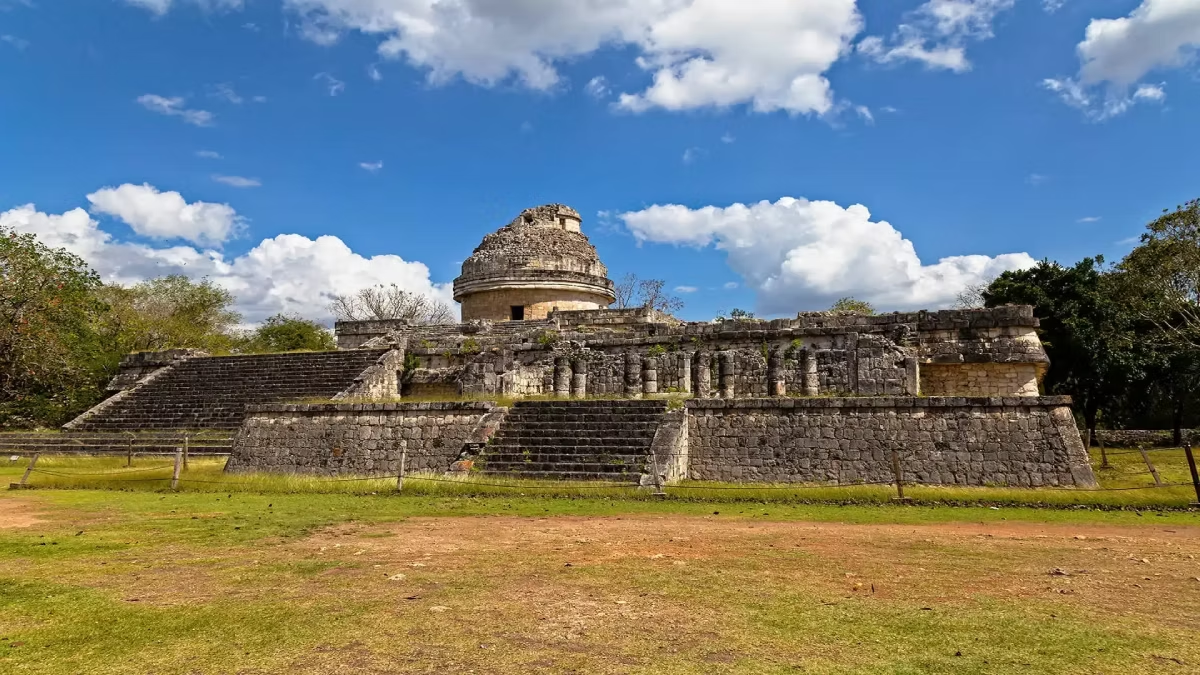
El Caracol (Spanish for “the snail”) is a round stone tower at Chichén Itzá widely identified as an ancient Maya astronomical observatory. The structure stands approximately 22.5 meters (75 feet) tall on a rectangular platform and is dated to around 906 CE based on a stele on its upper platform. The name comes from the spiral staircase inside the central tower — “caracol” means snail in Spanish, referring to the snail-shell-like coiling of the interior stairway. The building’s most remarkable feature is a set of viewing windows in the upper tower whose alignments correspond to astronomically significant positions of the planet Venus (extreme northern and southern horizon points), the solstices, and the equinoxes. Of 29 possible astronomical events that would have been significant to Mesoamerican observers, sightlines for 20 can be identified in the structure’s architecture. Venus was central to Maya religion — associated with war, timekeeping, and the god Kukulkán — and the Maya tracked Venus’s 225-day cycle with extraordinary precision, knowing that 5 Venus cycles equaled 8 solar years. El Caracol is among the most important archaeoastronomical sites in the ancient Americas and a major piece of evidence for the sophistication of Maya scientific knowledge.
El Caracol looks different from every other structure at Chichén Itzá — it’s round, it doesn’t fit the standard Maya pyramid template, and it has deteriorated in ways that hint at its unusual function. Standing in front of it, you’re looking at a purpose-built scientific instrument. The upper tower’s collapsed dome once held narrow viewing windows from which Maya priest-astronomers, working without telescopes or any of the technology we associate with astronomy, tracked the movements of Venus and the sun with accuracy that modern archaeoastronomers still find impressive. It’s the closest thing the ancient Maya built to a university observatory.
The Architecture: What You’re Looking At
El Caracol is a layered structure — three superimposed buildings rising from a large rectangular base to a round tower at the top. Working from bottom to top:
| Level | Feature |
|---|---|
| Lower platform | Large rectangular base, stepped on multiple sides |
| Upper platform | Rectangular platform on top of the base, supporting the tower |
| Round tower | Central cylindrical structure with spiral staircase |
| Upper chamber | Now-collapsed dome with viewing windows |
| Total height | ~22.5 m / 75 ft |
| Construction date | ~906 CE (based on dated stele) |
| Construction period | Terminal Classic / Early Post-Classic |
The Round Tower
The tower is the most distinctive feature — built of two concentric circular walls enclosing a pair of circular chambers, each with four doorways. Inside, a spiral staircase winds upward to the viewing chamber — the architectural feature that gives the building its name. The staircase resembles the coiled shell of a snail, hence “caracol.”
Round buildings are rare in Maya architecture. Other round structures exist at Ake, Cozumel, and Puerto Rico (Campeche), but the Caracol is the most elaborate and best-preserved Maya round building. The rarity of the round form itself suggests something unusual about the structure’s function — most Maya ceremonial architecture uses rectangular or square plans.
The Upper Chamber and Windows
The upper viewing chamber is the astronomically critical element. This chamber once had a vaulted ceiling (partially collapsed today) with narrow horizontal windows cut through the walls at specific orientations. Three main windows survive today; originally there were more.
The windows aren’t decorative — they’re narrow slits specifically sized and positioned to frame particular portions of the horizon. When viewed through the window from the correct position inside the chamber, the sightline passes through the opening to a specific horizon point.
The Western Staircase
On the west side of the larger base, a staircase leads up from ground level. Its balustrades are adorned with intertwining carved serpents’ heads — connecting El Caracol stylistically to Kukulkán iconography found throughout Chichén Itzá. The western orientation of this approach itself may be astronomically significant.
The Chaac Mask Frieze
The upper frieze above the tower doorways features a carved mask of Chaac (the Maya rain god) and a seated figure, framed with feather and serpent motifs. This places the structure firmly in the Maya religious tradition while its form and function point toward Toltec-influenced astronomical interest.
The Astronomy: What the Building Does
El Caracol’s astronomical alignments are documented in a landmark 1975 study by Anthony Aveni and colleagues published in the journal Science. Of 29 astronomical events (solstices, equinoxes, eclipses, Venus positions, and bright-star risings/settings) that would have been significant to Mesoamerican observers, 20 sightlines correspond to identifiable alignments in the building. The most archaeologically significant alignments are to Venus — the windows in the upper tower point to Venus’s northern and southern extreme horizon positions. The stairwell leading up to the tower points toward Venus’s northern extreme, while the building’s northeast-to-southwest diagonal aligns with summer solstice sunrise and winter solstice sunset. A window alignment approximates the equinox sunset direction. Since Maya astronomers tracked Venus with a known 225-day cycle (verified in the Dresden Codex, a Maya astronomical manuscript), these alignments provided physical reference points for calibrating and predicting Venus’s appearances — which had profound religious, military, and calendrical implications.
Why Venus Mattered So Much to the Maya
Venus was the most important celestial body in Maya religion after the sun and moon — arguably more ritually charged than the sun itself in some respects. Multiple reasons:
- Visibility — Venus is the brightest object in the sky after the sun and moon, visible even through cloud cover at its brightest
- Cyclical reliability — Venus’s 225-day synodic period and 584-day apparent cycle are predictable with naked-eye observation
- Identification with Kukulkán — the feathered serpent deity, central to Chichén Itzá’s religion, was specifically associated with Venus as the morning star
- War and warfare associations — Maya rulers timed military campaigns to Venus positions, believing certain Venus phases were auspicious for war
- Calendrical utility — 5 Venus cycles = 8 solar years, making Venus a long-period calibration for the calendar
The Dresden Codex Connection
The Dresden Codex — one of the few surviving pre-Hispanic Maya books, preserved after the Spanish Conquest — contains extensive Venus tables tracking the planet’s movements over hundreds of years with extraordinary precision. These tables predict Venus’s position so accurately that modern astronomers can use them to calibrate dates.
The connection between the Dresden Codex’s mathematical Venus tracking and El Caracol’s architectural Venus alignments is one of the great synergies of Maya astronomy — the same civilization that built paper tables for Venus prediction also built stone architecture as physical calibration devices.
The 5-to-8 Venus-Solar Ratio
The Maya knew that 5 cycles of Venus (5 × 584 days = 2,920 days) equals 8 solar years (8 × 365 days = 2,920 days). This mathematical coincidence meant Venus would return to its extreme northern and southern positions at 8-year intervals — allowing long-term prediction of astronomical events.
For astronomers at El Caracol, this meant:
- Sight Venus at northern extreme through window (establishes calibration point)
- 8 solar years later, Venus will return to same alignment
- The intervening 8 years can be subdivided into 5 Venus cycles
- Predictable astronomical reference throughout the 8-year period
The 1975 Aveni Study
In 1975, archaeoastronomer Anthony Aveni and colleagues published The Caracol Tower at Chichen Itza: An Ancient Astronomical Observatory? in the journal Science. The paper measured every accessible alignment in the structure and compared them to calculated astronomical positions for the period of the building’s use. The findings confirmed that:
- Multiple windows align with Venus’s extreme horizon positions
- The platform orientation aligns with solstices
- Window I approximates equinox sunset
- The building was intentionally designed as an observatory, not retrofitted into one
The Aveni study remains the authoritative archaeoastronomical assessment of El Caracol and is cited in virtually all subsequent research.
Why a Flat Landscape Required This Building
The Yucatán Peninsula is extraordinarily flat — there are no mountains, few hills, and limited natural horizon markers near Chichén Itzá. In other civilizations (Greek, Egyptian, Inca), astronomers could use mountain peaks, natural ridges, or coastlines as reference points for tracking where the sun or Venus rose or set on specific dates.
The Maya had no such natural markers. To track astronomical events accurately, they needed artificial horizon markers — which is exactly what El Caracol’s windows and orientations provide. A window cut through a stone wall at a specific compass bearing creates a permanent, reliable “sightline” that produces consistent data across seasons and decades.
This makes El Caracol a practical engineering solution to the Yucatán’s flat topography, not merely a symbolic structure. The Maya needed it to do astronomy; they didn’t build it for show.
How Maya Astronomy Actually Worked
Maya astronomy is sometimes romanticized as “advanced” in vague terms — it’s worth being specific about what the Maya could and couldn’t do.
What the Maya Knew
- Sun’s apparent position on the horizon at sunrise and sunset, tracked through the year
- Solstice and equinox dates with accuracy of approximately ±1 day
- Moon’s synodic period (29.5 days) and cycle of phases
- Venus’s synodic period (584 days) with high accuracy
- Lunar eclipse cycles — the Dresden Codex contains eclipse tables predicting lunar eclipses hundreds of years in advance
- Solar eclipse possibility — the Maya could predict when solar eclipses might occur, though not always where they would be visible
- Mars, Jupiter, and Mercury movements — tracked but less documented
- Bright star risings and settings at specific points in the year
- Precession of the equinoxes — long-term shifts in stellar positions (possibly, though this is debated)
What the Maya Didn’t Know
- Heliocentric model — the Maya assumed Earth was the center
- Actual distances to planets, stars, and the sun
- Nature of stars as distant suns
- Physical causes of astronomical phenomena (no gravity theory)
- Telescopic detail — all observations were naked-eye
What the Maya Did With Their Knowledge
- Calendar calibration — correcting dates and predicting future events
- Religious timing — scheduling ceremonies at astronomically significant moments
- Agricultural planning — timing planting, harvesting, and burn cycles
- Military timing — launching campaigns at favorable Venus positions
- Architectural alignment — positioning buildings to frame astronomical events
- Ruler legitimacy — prophesying eclipses and other events to demonstrate divine favor
Why the Building Is Called “The Snail”
El Caracol’s Spanish name is a straightforward description: the spiral staircase inside the central tower coils upward like a snail’s shell, and the Spanish word “caracol” means both “snail” and “spiral.” Spanish explorers, encountering the ruin in the colonial and early modern periods, named it descriptively.
The original Maya name is lost. The Maya likely had a ceremonial or astronomical designation for the building, but no surviving text or glyph preserves it. “El Caracol” is a colonial-era nickname that stuck because it’s both accurate and memorable.
Why the Upper Dome Is Collapsed
Photos of El Caracol show a partially collapsed dome at the top of the tower — a rough, broken top rather than a complete structure. Several factors contributed:
- Natural decay — vaulted stone roofs are inherently unstable over centuries; many Maya buildings have lost their top structures
- Vegetation damage — tree roots and plants grew into the masonry for centuries before conservation
- Stone quality — the upper vault may have used less-durable stone than the base
- Earthquake and hurricane damage — the Yucatán gets both
- Uncovered 19th century — when European explorers found the site, the upper structure was already partially collapsed
Visitors today see a truncated version of the original tower. Full reconstruction would require reassembly of the vault, something archaeologists haven’t attempted.
Location at Chichén Itzá
El Caracol is located in the southern section of the archaeological zone — in the area sometimes called “Old Chichén” or the Puuc-style area of the site. This places it geographically apart from El Castillo, the Great Ball Court, the Temple of the Warriors, and the Sacred Cenote (all in the northern ceremonial center).
The walk from El Castillo to El Caracol takes approximately 10 minutes at a moderate pace. Some tours skip El Caracol to save time at the primary ceremonial center; travelers interested in Maya astronomy should ensure their tour or itinerary includes it.
When to Visit
- For astronomical alignment viewing (symbolic): Equinox dates (March 20–21, September 22–23) or solstice dates (June 20–21, December 21–22) — though you cannot enter the tower or see through the windows, the day itself adds meaning
- For photography: Morning light (8:00–10:00 AM) — the eastern-facing side catches clean sunlight
- For minimum crowds: Early morning — El Caracol sees lighter foot traffic than the primary ceremonial center
- Typical tour allocation: 5–10 minutes (often rushed)
- Recommended time: 15–25 minutes to appreciate the architecture
What You Can and Can’t Do
You can:
- Walk around the rectangular base on the exterior
- View the tower and windows from multiple angles
- Photograph the structure from all sides
- Read the interpretive signs (Spanish and English)
You cannot:
- Climb the staircase or enter the tower (closed for preservation)
- Access the upper chamber or viewing windows
- Descend to the base of the tower (roped off)
- Use drones (banned site-wide)
The Limitations of Archaeoastronomy
It’s worth being skeptical about some archaeoastronomical claims. The 1975 Aveni paper itself is careful to note:
- Not every alignment in the building can be matched to an astronomical event
- Individual star alignments are weak evidence — any bright star can be found to match an alignment if you search hard enough
- Some alignments may be coincidental rather than deliberate
- The equinox window alignment is approximate, not exact
What’s well-supported: Venus alignments, solstice alignments, and the building’s overall orientation. What’s more speculative: specific stellar alignments, ceremonial timing details, and interpretive claims about Maya astronomical purpose.
Modern consensus: El Caracol was genuinely designed as an observatory with real astronomical function, but not every alignment discussed in popular writing is equally well-evidenced.
Quick Reference
| Detail | Value |
|---|---|
| Structure name | El Caracol (The Observatory) |
| Height | ~22.5 m / 75 ft |
| Construction date | ~906 CE |
| Shape | Round tower on rectangular platform |
| Named for | Spiral staircase inside (caracol = snail) |
| Main function | Astronomical observatory (Venus, solstices, equinoxes) |
| Total sightlines | 20 of 29 possible astronomical events |
| Key alignments | Venus extreme positions, summer solstice, winter solstice |
| Key research | Aveni 1975 study (Science journal) |
| Location | Southern section of Chichén Itzá |
| Walk from El Castillo | ~10 minutes |
| Climbing | Prohibited |
| Typical visit time | 5–10 min (recommend 15–25) |
Frequently Asked Questions
What does “El Caracol” mean?
“El Caracol” is Spanish for “the snail” (or “the spiral”). The structure is named for the spiral staircase inside the central tower, which winds upward like a snail’s coiled shell. The name is a colonial-era nickname given by Spanish explorers; the original Maya name for the building is lost.
Is El Caracol really an astronomical observatory?
Yes, with strong evidence. The 1975 study by archaeoastronomer Anthony Aveni published in Science demonstrated that 20 of 29 astronomically significant alignments can be found in the structure. Windows align with Venus’s extreme horizon positions, solstices, and equinoxes. The structure’s orientations are deliberate, not coincidental. While some individual alignments remain debated, scholarly consensus is that El Caracol was intentionally designed as an observatory.
How old is El Caracol?
Approximately 906 CE, dated by a carved stele on the upper platform. This places it in the Terminal Classic / Early Post-Classic period — roughly contemporaneous with El Castillo’s main construction phase and during the period of Toltec cultural influence at Chichén Itzá.
What did the Maya use El Caracol for?
Primarily tracking the planet Venus, plus the sun’s position at solstices and equinoxes. Maya astronomy served multiple practical purposes: calendar calibration, agricultural timing, religious ceremony scheduling, military timing (Venus was associated with warfare), and demonstrating rulers’ ability to predict celestial events — reinforcing political legitimacy.
Why was Venus so important to the Maya?
Venus was the most important celestial body after the sun and moon in Maya religion. It’s the brightest object in the night sky; its 225-day cycle is predictable with naked-eye observation; it was identified with Kukulkán (the feathered serpent deity); and its movements were tied to war timing and calendar calibration. The Maya tracked Venus with exceptional accuracy — verified in the Dresden Codex, a surviving Maya astronomical manuscript.
Can you climb El Caracol?
No — climbing and interior access are prohibited. The structure is closed to visitors for preservation reasons. You can walk around the exterior base and view the tower from multiple angles, but cannot ascend the spiral staircase or enter the observation chamber.
How tall is El Caracol?
Approximately 22.5 meters (75 feet) — this is the total height of the structure including the base platform and the tower. The tower itself rises from the top of the rectangular platform.
What are the windows in the tower for?
The windows are narrow openings cut through the stone walls at specific orientations. When viewed from the correct position inside the tower, each window frames a specific portion of the horizon — creating permanent sightlines for tracking astronomical events. The most significant alignments are to Venus’s extreme northern and southern horizon positions and to the solstices.
Why is the top of El Caracol damaged?
The upper vault has partially collapsed over the centuries due to natural decay, tree root damage, earthquakes, hurricanes, and the inherent instability of ancient vaulted stone roofs. The tower was already partially ruined when European explorers documented it in the 19th century. Complete reconstruction has not been attempted.
Who studied El Caracol’s astronomy?
The most important study is Anthony Aveni’s 1975 paper in Science titled “The Caracol Tower at Chichen Itza: An Ancient Astronomical Observatory?” Aveni and colleagues measured every accessible alignment and compared them to calculated astronomical positions. Their work is the foundational research on El Caracol’s archaeoastronomy and is cited in virtually all subsequent scholarship. Earlier archaeological documentation by Karl Ruppert (Carnegie Institution, 1935) provided the architectural baseline.
How did Maya astronomers predict eclipses without telescopes?
Through extremely long-term observation and mathematical pattern recognition. By recording eclipse events across many generations, Maya astronomers identified that lunar eclipses occur on an approximately 6,585-day (~18-year) cycle. The Dresden Codex contains eclipse prediction tables that remain accurate over hundreds of years. Solar eclipses were harder to predict precisely, but the Maya knew the possibility window for each.
Where is El Caracol at Chichén Itzá?
In the southern section of the archaeological zone, in the area sometimes called “Old Chichén” or the Puuc-style zone. It’s about a 10-minute walk from El Castillo, heading south. Some tours skip it to save time at the main ceremonial center, but travelers interested in Maya astronomy should confirm El Caracol is included in their visit.
Is El Caracol the oldest observatory in the world?
No. Older astronomical structures exist — Egyptian temples with solar alignments date back 3,000+ years; Stonehenge’s astronomical alignments are 4,000+ years old; various Mesopotamian observatories predate the Caracol by a millennium or more. What makes El Caracol remarkable is its specificity (purpose-built for astronomy), its sophistication (multiple simultaneous alignments), and its archaeological preservation relative to many ancient observatories.
Are there other Maya observatories?
Yes — several, though few as elaborate. Round astronomical structures have been documented at Puerto Rico (Campeche), Ake, and Isla Cozumel. Many Maya pyramids and temples (including El Castillo itself) contain astronomical alignments, though they served primarily religious rather than observational purposes. El Caracol is distinguished by being purpose-built for astronomy rather than a temple with astronomical features.
What’s the difference between El Caracol and El Castillo’s astronomy?
El Castillo embeds astronomical symbolism (365 steps = solar year; equinox serpent shadow) in a ceremonial structure whose primary function was religious. El Caracol appears to be a working astronomical instrument whose primary function was observation and measurement. El Castillo celebrates Maya astronomical knowledge; El Caracol produced that knowledge. Both are astronomical but they operate in different roles.
What’s the 5-to-8 Venus-solar relationship?
The Maya recognized that 5 Venus cycles (5 × 584 days = 2,920 days) equals exactly 8 solar years (8 × 365 days = 2,920 days). This mathematical coincidence meant Venus’s extreme horizon positions repeat at 8-year intervals — a long-term reference point that allowed astronomers to calibrate Venus predictions over centuries. El Caracol’s Venus-alignment windows served as physical reference points for this cycle.
Is El Caracol worth visiting?
Yes — for travelers interested in archaeology, astronomy, or Maya science. For casual visitors who want to see the famous El Castillo and move on, El Caracol may feel like a side stop. But for anyone genuinely curious about Maya scientific achievement, it’s among the most important structures at the site. The round architecture is visually distinctive; the astronomical context is fascinating; and the building sees fewer tour buses than the main ceremonial center, giving you a quieter experience.
