

Thousand Columns Chichén Itzá 2026: Plaza, Market, Temple Complex
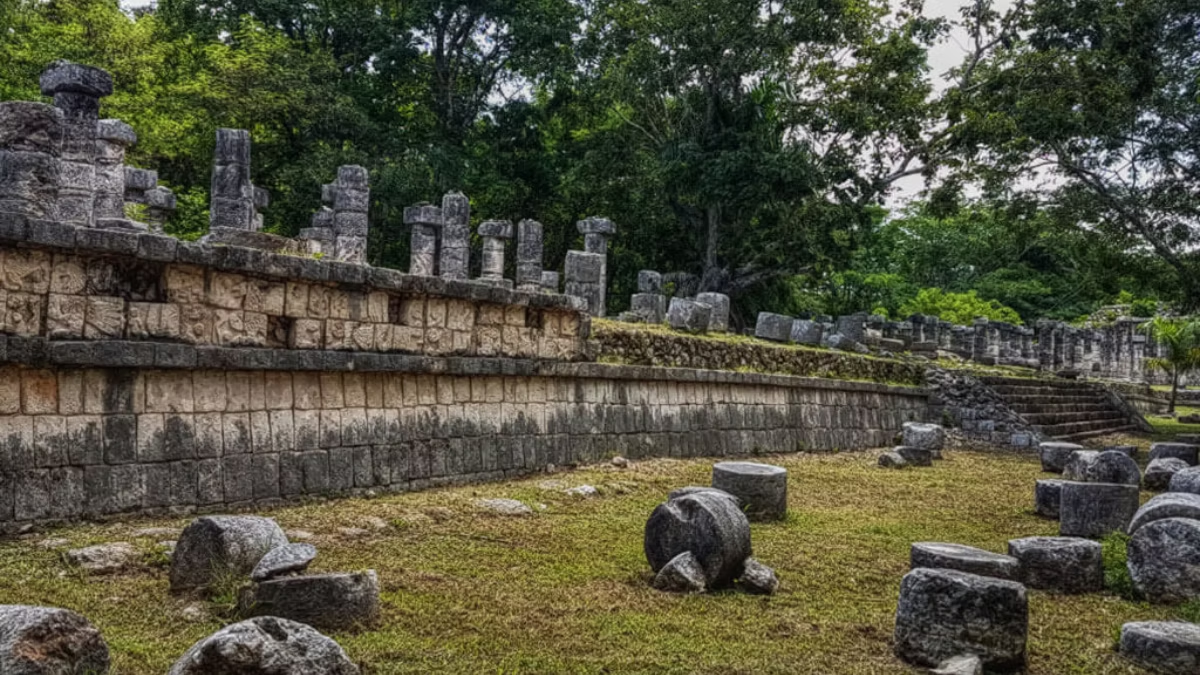
The Group of the Thousand Columns (Spanish: Grupo de las Mil Columnas) is a vast plaza complex at Chichén Itzá located immediately south of the Temple of the Warriors. Despite the name, the structure contains several hundred columns (not a full thousand) — the “thousand” is a colonial-era approximation, not a literal count. The columns are arranged in multiple rows around a central plaza, originally supporting a wooden roof that created an enormous covered ceremonial and administrative space. The roof has collapsed over centuries, leaving the columns as freestanding stone sculptures — many carved with bas-relief images of Toltec warriors, some with ritual scenes. Around the plaza are several smaller associated structures: the Mercado (possibly a market building), the Temple of the Tables, the Temple of the Carved Columns, and Thompson’s Temple. The complex is considered one of the best examples of Toltec architectural influence in the Maya world, with its scale, column arrangement, and warrior iconography drawing direct parallels to the Toltec capital of Tula in central Mexico. Some archaeologists interpret the complex as an elite residence and administrative space; others see it as primarily ceremonial. Most consensus: the plaza served multiple functions — ceremonial gathering, administrative meetings, possibly market activity, and elite residence areas.
If the Temple of the Warriors is the pyramid, the Group of the Thousand Columns is its plaza. The two structures function together as an architectural whole — the pyramid marks the ceremonial focus, the columns define the surrounding space. Standing in the plaza today, surrounded by a forest of carved stone columns in every direction, you’re standing in what was once the largest covered ceremonial space in the Maya world. The wooden roof is gone, the columns are weathered, but the scale of the complex remains extraordinary.
The Architecture: What You’re Looking At
The Group of the Thousand Columns occupies a large rectangular plaza immediately south of the Temple of the Warriors. The plaza is defined on multiple sides by rows of stone columns — some in straight lines, some arranged around smaller internal structures.
| Feature | Detail |
|---|---|
| Plaza dimensions | Approximately 100m × 70m (main plaza) |
| Actual column count | Several hundred (far fewer than 1,000) |
| Column types | Round and square; some smooth, some carved |
| Original configuration | Roofed plaza with wooden beams atop columns |
| Roof material | Wood (rotted away centuries ago) |
| Construction period | ~900–1100 CE (Toltec influence period) |
| Associated structures | Temple of the Warriors (north), Mercado (south), Temple of the Tables (NE), Temple of the Carved Columns (SE) |
The Columns Themselves
Columns vary considerably in style and decoration:
Square columns:
- Carved on four sides with bas-relief images of Toltec warriors
- Warriors depicted in full ceremonial dress with shields, spears, and feathered headdresses
- Some columns show multiple warriors stacked vertically (one per carved panel)
- Originally painted in brilliant colors — reds, blues, yellows, greens — now weathered to plain limestone
Round columns:
- Typically smooth, undecorated stone
- Supported roof beams structurally
- Distributed throughout the plaza
Feathered serpent columns:
- A few columns carved as feathered serpents (similar to those at the Temple of the Warriors summit)
- Heads at ground level with open mouths
- Tails rising upward to support lintels/roof beams
- Located at specific entrance points to smaller structures
Why “Thousand” If There Aren’t a Thousand?
The name “Mil Columnas” (Thousand Columns) was applied by Spanish and early explorers as a poetic approximation — meaning “a very large number” rather than a literal count. Actual census counts of columns at the site vary depending on how you count (do partial fragments count? do round vs. square count separately?), but the total is somewhere between 200–400 columns, not a thousand.
The name stuck because it captures the visual impression — standing in the plaza does feel like being surrounded by an overwhelming number of columns. “Hundreds of Columns” is less evocative.
The Toltec Connection
The Group of the Thousand Columns shows strong architectural influence from the Toltec capital of Tula, approximately 1,000 kilometers north in central Mexico. Specific parallels include: column-lined plazas (Tula has similar though smaller plazas), warrior columns with bas-relief carvings (a distinctly Toltec iconographic tradition), atlantean figures (small warrior sculptures supporting altars — Tula’s famous Atlantes at the top of Pyramid B are the template), feathered-serpent columns (Toltec Quetzalcoatl imagery), and the overall scale and organization of the ceremonial plaza. These parallels are among the strongest pieces of evidence for direct Toltec cultural influence at Chichén Itzá during the Terminal Classic / Early Post-Classic period (~900–1200 CE). Whether the Toltec physically migrated to Chichén Itzá or whether local Maya adopted Toltec architectural styles through trade and cultural exchange is still debated, but the architectural evidence for contact is unambiguous.
The Warrior Iconography
The carved warriors on the columns represent a distinct Toltec military aesthetic:
- Full ceremonial dress with elaborate headdresses
- Shields and spears prominently displayed
- Armor and ornamentation carved in detail
- Eagle and jaguar warrior orders — elite military ranks shown devouring human hearts
- Feathered headdresses indicating high status
- Weapons and regalia accurately portrayed
This warrior imagery reflects the militarized culture of post-Classic Chichén Itzá — a shift from the more priestly, ceremonial focus of earlier Classic Maya civilization toward an emphasis on military authority and conquest.
What the Columns Originally Looked Like
The plaza you see today is dramatically different from the original. When built:
- Wooden roof beams rested on top of the columns, spanning between them
- Stone roof tiles or thatch covered the beams
- Brilliant paint coated the stone columns — reds, blues, yellows, greens
- Stucco plaster covered rough stone surfaces
- Painted murals decorated the smooth column surfaces not already carved
- Ritual objects likely displayed on columns and between them
The complex was a colored, covered space — not the open limestone ruin you see today. Over centuries, the wood rotted, the plaster washed away, the paint faded, and the roof collapsed. The carved columns survived because stone is more durable than any other building material used.
The Associated Structures
Several smaller buildings are integrated into or adjacent to the plaza:
The Mercado
A long rectangular building on the southern side of the plaza, built on a raised platform with a long portico. Early archaeologists named it “El Mercado” (the Market) because the architectural layout resembled what they imagined a Mesoamerican marketplace would have looked like.
Key features:
- Long portico with columns
- Interior patio surrounded by a shelf of stone
- Small chamber at one end
- Staircase access from the plaza
Function debated:
- Original interpretation: A marketplace where goods were displayed on the stone shelf
- Modern interpretation: More likely an administrative or elite meeting space
- Alternative: A ceremonial dining or council chamber
- Most likely: Some combination of functions varying by time and event
The name “Mercado” has stuck even though archaeologists now question whether it was truly a market. In tours, it’s referred to as “the Mercado” regardless of the functional uncertainty.
Temple of the Tables
Northeast of the main plaza, in a partially unrestored state. Named for the stone “tables” (altar-like surfaces) inside, supported by small carved warrior figures called atlantes — similar to those at the top of Tula’s Pyramid B. The name comes from these stone tables, not from dining furniture.
Temple of the Carved Columns
Southeast of the plaza, a small elegant building with:
- Front gallery opening toward the plaza
- Inner corridor leading to an altar
- Chac Mool statue inside (smaller than the Temple of the Warriors’ example)
- 40+ personages carved in bas-relief on columns
- X’s and O’s motif on a section of the upper façade (displayed separately)
Thompson’s Temple
A smaller, two-story structure on the south side. The alternative name “Palace of Ahau Balam Kauil” refers to two carved figures: “Balam” (jaguar in Maya) and Kahuil (a Maya deity). The temple features friezes depicting jaguars — hence the Maya-alternative name. “Thompson’s Temple” comes from early 20th-century archaeologist Edward Herbert Thompson’s work at the site.
Temple of the Small Tables
A smaller, unrestored mound south of the Temple of the Warriors and near the Mercado. Not currently accessible or extensively interpreted. Its relationship to the plaza and other structures is unclear.
Functions: What Happened Here
The Group of the Thousand Columns likely served multiple overlapping functions rather than a single specific purpose. Proposed uses include: (1) Elite residence — archaeological evidence suggests some areas housed Chichén Itzá’s ruling class, with administrative or living quarters behind the columns; (2) Administrative and governance space — meetings of councils, military leaders, and priestly elites took place in the covered plaza; (3) Marketplace — the Mercado structure’s layout suggests commercial activity, though this is debated; (4) Ceremonial gathering — large religious events that required more space than a pyramid summit could accommodate; (5) Military muster — Toltec-period Chichén Itzá had significant military activity, and the plaza’s scale could have accommodated troop assembly. Most archaeologists now favor a multi-function interpretation — the complex served different roles depending on time of day, ceremonial calendar, and political event. A Maya version of a civic plaza: gathering space, council chamber, market on some days, ritual space on others, and elite residential district along the edges.
Evidence for Elite Residence
Some rooms along the plaza’s edges show:
- Domestic artifacts (ceramics, food remains)
- Interior privacy walls suggesting separate rooms
- Fire hearths for cooking
- Smaller scale than pure ceremonial structures
This points to partially residential use — likely for high-status individuals whose work or religious role required daily access to the ceremonial center.
Evidence for Administrative Use
- Large covered space suggests gathering capacity
- Stone benches (some carved) would have accommodated seated participants
- Access control — clearly defined entrances and internal divisions
- Proximity to Temple of the Warriors — the primary ceremonial structure
This points to council or administrative meeting use — a Maya parliament or elite chamber where governance decisions occurred.
Evidence for Market Use
Frankly weak. The Mercado’s layout was interpreted as a market by early archaeologists based on assumption rather than strong evidence. Modern archaeologists are skeptical that the primary function was commercial. However, some commercial activity — perhaps seasonal markets or craft distribution — may have occurred here alongside other uses.
The Modern Visitor Experience
Walking through the Group of the Thousand Columns today, you’re experiencing:
- Enter from the Temple of the Warriors plaza — this is the standard approach route
- Walk between the column rows — the central paths through the columns
- Examine carved warrior columns up close — roped off but visible
- Notice the scale — the sheer number of columns stretching in every direction
- Visit the Mercado on the southern edge
- See the Temple of the Tables on the northeast (partially accessible)
- Pass the Temple of the Carved Columns on the southeast
- Observe the smaller structures around the plaza perimeter
- Return via a different path — the plaza can be navigated multiple ways
Most guided tours allocate 15–25 minutes to the Group of the Thousand Columns in combination with the Temple of the Warriors. Serious visitors should plan 30–45 minutes for the combined area.
Conservation and State of Restoration
The Group of the Thousand Columns is partially restored. Major restoration work was carried out by:
- 1925–1928: Carnegie Institution of Washington, led by Earl H. Morris (coordinated with Temple of the Warriors restoration)
- Subsequent INAH (Mexican National Institute of Anthropology and History) projects — ongoing consolidation and protective measures
What’s been restored:
- Columns standing in their original positions
- Exposed carvings cleared of vegetation and stabilized
- Temple of the Tables atlantean figures reassembled
- Some interior structures (Mercado, Temple of the Carved Columns) consolidated
What remains partial or unrestored:
- Original roof — not reconstructed; would require extensive work
- Painted surfaces — faded paint is not restored (would be speculative)
- Plaster and stucco — weathered away; not restored
- Fallen columns — many columns or column fragments remain on the ground where they fell
- Temple of the Small Tables — unrestored mound
Photography Tips
- Wide-angle lens captures the scale of the column forest
- Morning light (8:00–10:00 AM) lights the carved columns from the east, showing relief clearly
- Late afternoon light (3:00–5:00 PM) lights from the west — good for west-facing column carvings
- Shadow detail is best mid-day when the roped-off columns aren’t in shadow
- Individual column detail requires zooming in on single columns (no climbing or close approach)
When to Visit
- For minimum crowds: 8:00–9:30 AM (early arrival) or 3:00–4:00 PM (post-peak)
- For column carving detail: Direct sunlight periods, raking angle
- For Mercado exploration: Mid-morning — enough light to see interior details
- Peak congestion: 11:00 AM–2:00 PM
- Typical tour allocation: 15–25 min combined with Temple of the Warriors
Quick Reference
| Detail | Value |
|---|---|
| Complex name | Group of the Thousand Columns (Grupo de las Mil Columnas) |
| Actual column count | Several hundred (not a literal thousand) |
| Column types | Round (smooth), square (carved with warriors) |
| Plaza dimensions | ~100m × 70m main plaza |
| Construction period | ~900–1100 CE (Toltec influence) |
| Adjacent to | Temple of the Warriors (north) |
| Main associated buildings | Mercado, Temple of the Tables, Temple of the Carved Columns, Thompson’s Temple |
| Original roof | Wooden beams supported by columns (long-rotted) |
| Toltec parallel | Tula, central Mexico |
| Restoration | Carnegie Institution 1925–1928; ongoing INAH work |
| Functions | Elite residence, administrative, ceremonial, possibly market |
| Typical visit time | 15–25 min (combined with Temple of the Warriors) |
Frequently Asked Questions
How many columns are actually at the Group of the Thousand Columns?
Several hundred — estimates range from 200–400 depending on counting methodology. The “Thousand Columns” name is a poetic approximation, not a literal count. Early Spanish explorers named it to convey the impression of an overwhelming number, and the name stuck.
What are the columns made of?
Local limestone, quarried from nearby sources. The Yucatán Peninsula is a limestone plateau, making this the natural building material for all Chichén Itzá construction. The columns were originally plastered and painted but centuries of weathering have left the bare limestone exposed.
What did the columns support?
A wooden roof — horizontal wooden beams rested on top of the columns, supporting roof tiles or thatching. This created an enormous covered plaza — one of the largest covered ceremonial spaces in the Maya world. The wood rotted away centuries ago; only the stone columns remain.
What are the carvings on the columns?
Bas-relief images of Toltec warriors on the square columns. Each warrior is depicted in full ceremonial dress with shields, spears, feathered headdresses, and sometimes representations of eagles or jaguars (elite Toltec military orders) devouring human hearts. The round columns are generally smooth and uncarved.
What is the Mercado?
A long rectangular building on the southern side of the plaza, named “the Market” by early archaeologists because its layout resembled what they imagined a marketplace would be. Modern archaeologists are skeptical that it was primarily a marketplace; it was more likely an administrative or elite meeting space. The name has stuck despite the functional uncertainty.
What was the Group of the Thousand Columns used for?
Multiple overlapping functions depending on time and event: elite residence areas along the edges; administrative and council meetings in the central plaza; ceremonial gatherings for large religious events; possibly markets or trade; and military muster for troop assembly. The complex functioned as a Maya version of a civic plaza — multipurpose space for governance, religion, and commerce.
How is this related to the Temple of the Warriors?
The two structures function as a single architectural complex. The Temple of the Warriors is the stepped pyramid at the northern edge of the plaza; the Group of the Thousand Columns is the plaza itself. Tourists often visit them together because they’re physically connected and share iconography. In guided tours, the two are usually treated as one integrated stop.
Is the Temple of the Tables inside the Thousand Columns area?
Yes — it’s at the northeast corner of the plaza. The Temple of the Tables is named for the stone “tables” (altar-like surfaces) inside, supported by small carved warrior figures called atlantes. These atlantean figures are similar to those at the top of Tula’s Pyramid B, reinforcing the Toltec architectural connection.
How does the Thousand Columns complex relate to Tula in central Mexico?
Strong architectural parallels exist, including: column-lined plazas, warrior-column carvings, atlantean figures, feathered-serpent columns, and overall scale and organization. This is among the strongest evidence for direct Toltec cultural influence at Chichén Itzá during the post-Classic period (900–1200 CE). Whether the Toltec physically migrated to Chichén Itzá or whether local Maya adopted Toltec styles is debated, but the architectural contact is unambiguous.
How old is the Group of the Thousand Columns?
Approximately 900–1100 CE — the Terminal Classic to Early Post-Classic period. This is roughly contemporaneous with the main construction phases of El Castillo, the Temple of the Warriors, and other major Chichén Itzá structures from the Toltec influence era.
Can you walk among the columns?
Yes — the central paths through the plaza are open to visitors. You can walk between the rows of columns, approach many of them (though roped barriers prevent touching), and explore the associated structures (Mercado, Temple of the Carved Columns, etc.). Climbing onto columns or raised structures is prohibited.
Why are some columns round and some square?
Square columns have four flat sides perfect for bas-relief carvings (warriors, ceremonial scenes, iconography). Round columns are structural — simpler to carve and position, they provided the primary roof support. The mixed arrangement allowed both structural support (round) and decorative communication (square) throughout the plaza.
What’s Thompson’s Temple?
A small two-story structure on the south side of the plaza. The name comes from archaeologist Edward Herbert Thompson (who also dredged the Sacred Cenote). Its alternative name is “Palace of Ahau Balam Kauil” — “Ahau Balam” means jaguar lord, “Kahuil” is a Maya deity. The temple features friezes of jaguars and glyphs of Maya gods.
What happened to all the paint on the columns?
Weathering over centuries. The original paint was mineral-based (iron oxides for red, charcoal for black, plant dyes for other colors) applied to plaster. Over 1,000+ years of exposure to rain, sun, humidity, and jungle vegetation, the plaster dissolved and the paint faded to nothing. Traces of original pigment survive only on protected surfaces examined under magnification. The visible columns today are weathered limestone, but they would have been brilliantly colorful when the complex was active.
Is the Group of the Thousand Columns worth a separate visit?
Usually visited with the Temple of the Warriors rather than separately. The two structures are physically connected and share architectural context, so most visitors explore them as one stop. Allocate 30–45 minutes combined for both, rather than trying to separate them.
Are there other similar column complexes at Chichén Itzá?
Smaller complexes exist elsewhere at Chichén Itzá but none at the same scale. The Group of the Thousand Columns is unique in its size, integration with the Temple of the Warriors, and extensive Toltec-warrior column carving program. Other Chichén Itzá areas have occasional carved columns or smaller colonnaded structures, but nothing approaching this scale.
