

History of Chichén Itzá 2026: Founding, Peak, Decline, Spanish Conquest
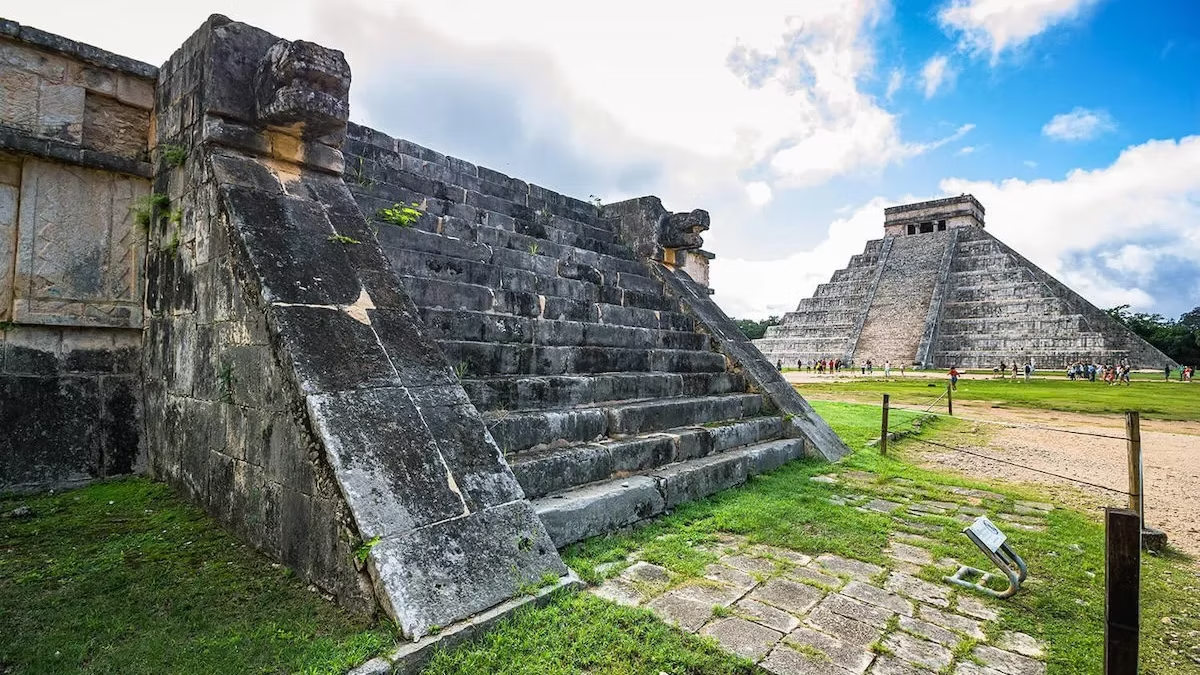
Chichén Itzá was founded approximately the 6th century CE (~550 CE) by Maya peoples drawn to the area by its cenotes (natural freshwater sinkholes) in a region with no surface rivers. The city rose to regional prominence toward the end of the Early Classic period (~600 CE), became a major regional capital during the Terminal Classic (~800–900 CE), and reached its peak during the Early Postclassic period (~900–1200 CE). The earliest hieroglyphic date at the site is 832 CE; the latest is 998 CE. The 9th-century ruler K’ak’upakal K’inich K’awil consolidated power and built many of the Puuc-style structures in the southern section. Around 987 CE, legends describe the arrival of Kukulkán/Quetzalcoatl from the Toltec capital of Tula, initiating a period of cultural fusion that produced El Castillo, the Temple of the Warriors, and the Great Ball Court. The city transitioned from divine-king rule to a multepal council system of shared power. Around 1020 CE a devastating drought lasted nearly a century, contributing to decline. The city was attacked and looted ~1200 CE. Mayapan emerged as the regional power; according to chronicles, Hunac Ceel conquered Chichén Itzá in the 13th century (~1221 CE) and the Itza rulers fled to Petén (Guatemala). The Sacred Cenote remained a pilgrimage destination through the Spanish Conquest. Spanish conquistador Francisco de Montejo the Younger attempted to establish a capital at Chichén Itzá in 1532 but was forced to abandon it in 1534. The site became a Spanish-era cattle ranch by 1588. Archaeological investigation began in the 19th century and continues today, with the Great Museum of Chichén Itzá opening in 2025 and the site receiving 9.9 million visitors in 2025.
Chichén Itzá’s history spans nearly 1,500 years of continuous significance — from a 6th-century Maya settlement to a 13th-century regional capital to a colonial cattle ranch to a modern tourist destination. No other Mesoamerican site combines this depth of continuous history with this level of archaeological preservation. Understanding the city’s story requires moving through several distinct phases: founding and early Maya period, Terminal Classic rise, Toltec-influenced peak, decline and conquest, Spanish period, and modern archaeological era.
The founding: why here?
Chichén Itzá was founded approximately 550 CE (6th century) by Maya peoples who had occupied the Yucatán Peninsula since the Pre-Classic Period (1500 BCE–300 CE). The founders were drawn to this specific location by easy access to freshwater through cenotes (natural limestone sinkholes) — a critical resource in a region with no surface rivers. The Yucatán Peninsula sits on porous limestone bedrock; rainwater percolates through the stone to form an underground river network accessible only through cenotes. The site chosen for Chichén Itzá had multiple cenotes within walking distance, including what would become the Sacred Cenote and the Xtoloc Cenote (which provided daily drinking water). The name “Chichén Itzá” translates from Yucatec Maya as “at the mouth of the well of the Itzá” — “Chi’” (mouth) + “Ch’e’en” (well) + “Itzá” (the name of the Maya group). The city’s entire identity centered on its access to water through these cenotes, which also carried profound religious significance as portals to Xibalba (the Maya underworld).
The earliest settlers
Before Chichén Itzá itself existed, the area was occupied by Maya peoples who had been in the Yucatán for over 2,000 years. The earliest occupation phase of the future Chichén Itzá site centered around:
- Xtoloc Cenote — a smaller cenote in what would become the site’s southwestern area, providing daily drinking water
- Basal platforms that now underlie Las Monjas and El Caracol
- Modest structures in the southern section of the eventual city
This earliest phase produced the structures that later became the foundations of the Nunnery Complex and Chichén Viejo (Old Chichén) — the southern, Puuc-style area of the site.
The Itzá arrive
Around 800 CE, a group called the Itzá arrived in the region. Their origins are debated — possibly Chontal Maya from the Gulf Coast region, possibly from other Maya territories. They were sufficiently foreign that local Maya gave them the name “Itzá,” meaning approximately “those who speak our language brokenly” — an ethnographic observation that survives in the city’s name.
The Itzá brought distinct cultural and religious practices, and their arrival marks an important transition in the city’s history.
The Terminal Classic rise (~800–900 CE)
Chichén Itzá rose to major regional prominence during the Terminal Classic period (~800–900 CE) — the era when many southern lowland Maya cities were collapsing and declining.
The political consolidation
The best-documented ruler from this era is K’ak’upakal K’inich K’awil, whose name appears extensively on inscriptions at Las Monjas and other structures. K’ak’upakal:
- Ruled approximately 869–890 CE
- Was the paramount ruler (k’uh[ul] ajaw, divine lord)
- Had connections to neighboring Ek Balam (north of Chichén Itzá)
- Is the only Chichén Itzá noble mentioned in hieroglyphic inscriptions outside the site itself
- May have led a dynasty that was foreign to Chichén Itzá’s earlier inhabitants
K’ak’upakal’s dynasty consolidated political power at Chichén Itzá while the southern Maya lowlands were collapsing. The city became a regional capital by absorbing populations and political influence from declining neighbors.
The earliest dated inscription
The earliest hieroglyphic date found at Chichén Itzá is on a carved lintel in the Initial Series Group (Old Chichén), corresponding to 832 CE. This Long Count date anchors the chronology of the site, confirming active construction and political activity by the early 9th century.
The Puuc-style construction
During the Terminal Classic, Chichén Itzá’s builders constructed the structures now grouped as:
- Las Monjas (The Nunnery) — governmental palace
- La Iglesia (The Church) — small elaborate temple
- Akab Dzib — possibly oldest standing structure, with undeciphered glyphs
- Initial Series Group in Old Chichén
- Various other Puuc-style buildings
This architecture reflects Chichén Itzá’s connection to the Puuc Hills cultural region of northwestern Yucatán — shared aesthetic traditions with Uxmal, Kabah, and other Puuc cities.
The Toltec-influenced peak (~900–1200 CE)
Around 900–1000 CE, Chichén Itzá transformed dramatically through cultural fusion with central Mexican Toltec traditions. Colonial-era chronicles describe the arrival of Topiltzin Quetzalcoatl (known to the Maya as Kukulkán) from the Toltec capital of Tula — some accounts place this around 987 CE. Archaeological evidence is more nuanced: some “Toltec” features at Chichén Itzá may actually predate similar features at Tula, suggesting complex cultural exchange rather than one-directional conquest or migration. What’s clear is that during this period Chichén Itzá built its most famous structures — El Castillo (Temple of Kukulkán), the Temple of the Warriors, the Great Ball Court, the Tzompantli, and other monumental buildings — using an architectural and iconographic style that combined Maya and central Mexican elements. The city’s religious focus shifted toward Kukulkán (the feathered serpent deity), ritual human sacrifice intensified (reflected in the Tzompantli and Sacred Cenote deposits), and political organization changed from divine single-ruler kingship to a multepal council system of shared power among elite families. During this period Chichén Itzá dominated the northern Yucatán Peninsula — the largest and most influential Maya city of its time.
The Kukulkán legend
Post-Conquest chronicles preserve a legend that around 987 CE, a leader named Topiltzin Quetzalcoatl (or Ce Acatl Topiltzin Quetzalcoatl) was expelled from Tula during political conflicts and migrated southeast to the Yucatán. The Maya identified him with their feathered serpent deity and called him Kukulkán.
This legend combines historical memory (there was genuine central Mexican cultural influence) with mythology (the specific story of Topiltzin Quetzalcoatl is partly symbolic). Modern archaeology suggests:
- Cultural exchange was real — Toltec and Maya elites were in regular contact
- The exchange was bidirectional — influence flowed both ways
- Some “Toltec” features predate Tula — challenging the simple migration narrative
- The Kukulkán cult intensified — whether through migration or cultural adoption
Recent archaeological analysis emphasizes that Chichén Itzá’s architects and artists were active participants in creating the hybrid “International style,” not passive recipients of foreign influence.
The multepal system
At some point during this era — possibly after K’ak’upakal’s death in the late 9th or early 10th century — Chichén Itzá’s political system shifted away from divine single-ruler kingship toward a multepal system (from the Yucatec Maya word for “joint rule”):
- Governance by council of elite lineages rather than a single king
- Shared power protecting against assassination or incompetence
- More flexible, collective decision-making
- Reflected in architecture: open plazas and galleries rather than enclosed royal palaces
- Reflected in art: emphasis on warriors, priests, and merchants rather than individual ruler portraits
The multepal system distinguished Chichén Itzá from contemporary Maya cities, most of which maintained the older divine-king model. Some scholars have questioned aspects of the multepal interpretation in recent years, but the overall pattern of less personalized, more institutional governance is well-supported.
The monumental construction program
During the peak period, Chichén Itzá built:
- El Castillo (Temple of Kukulkán) — the defining pyramid
- Temple of the Warriors and Group of the Thousand Columns
- Great Ball Court — largest in Mesoamerica
- Tzompantli (Wall of Skulls)
- Platform of Venus and Platform of the Eagles and Jaguars
- El Caracol (renovated and expanded from earlier construction)
- Osario (High Priest’s Grave / Temple of Bones)
- Sacbeob (raised stone causeways) connecting structures, including the 300m sacbe to the Sacred Cenote
Archaeologists have identified at least 10 major construction episodes for the Great Platform alone, showing that the center of Chichén Itzá wasn’t built at one time but evolved gradually over centuries.
The economic reach
Chichén Itzá became the hub of a vast trade network reaching:
- Costa Rica and Panama — gold (imported; not native to Yucatán)
- Guatemalan highlands — jade (from Motagua Valley)
- Central Mexico — obsidian, copper, turquoise
- American Southwest — turquoise (from modern Arizona/New Mexico)
- Coastal areas — salt, shells, rubber, dyes
- Highlands — cacao, feathers, ceramics
The Sacred Cenote’s 30,000+ recovered artifacts demonstrate this trade reach — materials from across Mesoamerica and beyond converged at Chichén Itzá as pilgrimage offerings.
The decline (~1020–1200 CE)
Chichén Itzá’s golden age ended through a combination of environmental, political, and military factors.
The Terminal Classic drought
Around 1020 CE, a devastating drought began that persisted nearly a century. Paleoclimate research (analyzing lake sediments, tree rings, and cave formations) confirms an extended dry period during this era. In a region already dependent on rainfall for agriculture (no rivers for irrigation), a multi-decade drought was catastrophic.
The Maya response was to intensify religious ritual aimed at rain god Chaac — increased sacrifice, more frequent cenote offerings, expanded ceremonial architecture. But no amount of ritual could overcome the climate pressure.
Population decline and relocation
During the 11th century, Chichén Itzá saw steep population decline as inhabitants:
- Relocated to coastal areas where maritime resources supplemented failing agriculture
- Migrated to nearby centers like Mayapan that emerged during this period
- Abandoned outlying settlements to concentrate in the most viable locations
The city’s population dropped dramatically, though it wasn’t fully abandoned.
The latest inscription
The latest known hieroglyphic date at Chichén Itzá is on the Osario (High Priest’s Grave) temple, dating to 998 CE. After this, new monumental inscription activity at the site declines sharply — suggesting the ruling elite had lost the resources or political stability needed to commission major projects.
The 1200 CE attack
Around 1200 CE, archaeological evidence shows Chichén Itzá was attacked and looted:
- Burning of the Temple of the Warriors
- Burning of the Mercado
- Destruction of ceremonial objects
- Evidence of armed conflict in site deposits
Whether this was an external attack (possibly from Mayapan), civil conflict, or a combination remains debated. Earlier historical accounts attributed this to Mayapan’s conquest (see below), but modern archaeology suggests Chichén Itzá had already declined before Mayapan became a regional power.
The Hunac Ceel legend
According to the Book of Chilam Balam of Chumayel (a post-Conquest Maya chronicle), Hunac Ceel, ruler of Mayapan, conquered Chichén Itzá in the 13th century (chronicles date this to ~1221 CE). The legend includes Hunac Ceel’s dramatic leap into the Sacred Cenote — surviving the plunge and prophesying his own rise to power, which he then fulfilled through conquest.
The Hunac Ceel story may be partly legendary but reflects genuine 13th-century political dynamics. The Itza rulers reportedly fled southward to the Petén region of Guatemala, where they established new settlements (eventually including the city that would become Tayasal, the last independent Maya kingdom, not conquered by Spain until 1697).
Mayapan’s regional dominance (1221–1441 CE)
After Chichén Itzá’s decline, Mayapan became the regional capital of the northern Yucatán — ruling from 1221 to 1441 CE. Mayapan was finally defeated by a confederation of cities headed by Uxmal in 1441, fracturing the northern Yucatán into independent city-states just before the Spanish arrival.
Continued pilgrimage
Even after political decline, Chichén Itzá remained a sacred pilgrimage destination — specifically the Sacred Cenote, which continued to receive offerings through the Spanish Conquest. Diego de Landa’s 16th-century account confirms that Maya people were still making offerings to the cenote when Europeans arrived.
The Spanish period (1526–1821)
Spanish contact with Chichén Itzá began in 1526 when conquistador Francisco de Montejo petitioned the King of Spain for a charter to conquer Yucatán. His 1527 campaign decimated his forces but established a small fort at Xaman Ha’ (south of modern Cancún). Montejo returned in 1531 with reinforcements and sent his son Francisco Montejo the Younger north in late 1532 to conquer the interior — with the goal of establishing a Spanish capital at Chichén Itzá. Montejo the Younger occupied the site but was besieged by hostile Maya who cut off supply lines. After losing 150 troops in an attempted breakout, he was forced to abandon Chichén Itzá in 1534 under cover of darkness. By 1535, all Spanish forces had been driven from the Yucatán Peninsula. Montejo later returned with an Indigenous-Spanish alliance and eventually conquered Yucatán through a different strategy — but Chichén Itzá was never made a Spanish capital. A Spanish land grant later established Chichén Itzá as a working cattle ranch by 1588, which it remained through the colonial period. The site’s Maya religious significance ended with Spanish suppression, but Maya people continued to live in the region and the physical ruins remained largely intact under the ranch’s ownership.
Francisco de Montejo’s failed conquest
Montejo was a veteran of the Grijalva and Cortés expeditions who sought his own conquistador glory in the Yucatán:
- 1526: Petitioned Spanish crown for conquest charter
- 1527: First campaign — severe losses, small fort established
- 1531: Second campaign with reinforcements, base at Campeche
- 1532: Son Francisco Montejo the Younger sent north to take Chichén Itzá
- 1533: Spanish occupy Chichén Itzá briefly
- 1534: Maya siege forces Spanish abandonment under cover of darkness
- 1535: All Spanish driven from Yucatán
The Yucatán Maya resistance was fierce; unlike central Mexican indigenous populations who were conquered relatively quickly, Yucatán remained outside Spanish control for additional decades. Chichén Itzá as a Spanish capital was an early casualty.
The cattle ranch era
Eventually Spain consolidated control over Yucatán. The land containing Chichén Itzá was granted to Spanish settlers. By 1588, the site was a working cattle ranch — this reduced the ruins to scenery surrounding grazing pastures, but also preserved them from more intensive destruction. The ranch structure (Hacienda Chichén) was built partly quarrying stone from Las Monjas and other ancient structures — contributing to damage, but on a smaller scale than active demolition would have caused.
The archaeological era (1841–present)
Stephens and Catherwood (1841)
John Lloyd Stephens (American diplomat and explorer) and Frederick Catherwood (British artist) visited Chichén Itzá in 1841 as part of their expedition documenting Maya ruins. Their publications — especially Stephens’s Incidents of Travel in Yucatan (1843) with Catherwood’s detailed illustrations — introduced Chichén Itzá to European and American audiences and sparked modern archaeological interest.
Le Plongeon’s Chac Mool discovery (1875)
Augustus Le Plongeon, an early archaeological photographer, visited Chichén Itzá with his wife Alice Dixon Le Plongeon. In 1875, he excavated the first Chac Mool statue — a reclining figure with a plate on its stomach. Le Plongeon’s interpretations of Maya culture were often eccentric, but his documentation was valuable, and the Chac Mool he found became iconic of the site.
Maudslay’s documentation (1889)
Alfred Maudslay, a British explorer and early Mayanist, visited Chichén Itzá in 1889 and produced the first systematic photographic documentation of major structures. Maudslay’s Biologia Centrali-Americana (published 1889–1902) is a foundational text of Maya archaeology and preserves images of structures in their condition before 20th-century restoration. Maudslay stayed in an apartment inside Las Monjas during his work.
Thompson’s acquisition and exploration (1894–1904)
Edward Herbert Thompson, American Consul to Yucatán, purchased Hacienda Chichén (including the ruins) for approximately $50 in 1894. For 30 years he explored the site, including:
- Discovering the earliest dated lintel in the Temple of the Initial Series (832 CE)
- Excavating graves in the Osario (High Priest’s Temple)
- Dredging the Sacred Cenote (1904–1910) — recovering 30,000+ artifacts
- Smuggling artifacts to Peabody Museum at Harvard via diplomatic pouch
Thompson’s legacy is complex — his work was scientifically significant but his extraction methods are now considered cultural heritage theft. Some artifacts were returned to Mexico in 1959 and 1976.
Carnegie Institution restoration (1923–1940s)
In 1923, the Mexican government awarded the Carnegie Institution of Washington a 10-year archaeological permit (later extended another decade). Carnegie researchers under Earl H. Morris and others restored:
- Temple of the Warriors (1925–1928)
- El Caracol (multiple campaigns)
- Other major structures including portions of the Nunnery Complex
Simultaneously, the Mexican government restored El Castillo and the Great Ball Court. This era of major restoration is why Chichén Itzá appears relatively complete today — without it, the site would be far more ruined.
UNESCO and modern recognition
- 1988: Chichén Itzá named UNESCO World Heritage Site
- 2007: Named one of the New Seven Wonders of the World (by popular vote)
- 2006: Climbing of El Castillo and other pyramids prohibited for preservation
Recent developments
- 2024: Old Chichén (Chichén Viejo) reopened to tourism after years of restoration closure
- 2024: Genetic DNA study of chultún remains revealed all-male sacrificial victims, many aged 3–6 — transforming understanding of Maya sacrifice demographics
- 2025: Great Museum of Chichén Itzá opened near the site — 3,400 m² with 14 thematic exhibits including multimedia Sacred Cenote recreation, Chac Mool sculptures, and offerings from sacbeob excavations
- 2025: Cobá Nohoch Mul pyramid reopened for climbing (at nearby Cobá, not Chichén Itzá) — December 8, 2025
- 2025: Chichén Itzá received approximately 9.9 million visitors — one of the most-visited archaeological sites in the world
Chronological summary
| Date | Event |
|---|---|
| ~550 CE | Chichén Itzá founded by Maya peoples drawn to cenotes |
| ~600 CE | Rises to regional prominence, end of Early Classic |
| ~800 CE | Itzá people arrive, expanding cultural influence |
| 832 CE | Earliest dated hieroglyphic inscription at the site |
| 869–890 CE | Reign of K’ak’upakal K’inich K’awil |
| ~900–1000 CE | Toltec cultural influence period, monumental construction |
| 987 CE | Legendary arrival of Kukulkán/Topiltzin Quetzalcoatl |
| 998 CE | Latest hieroglyphic date (Osario temple) |
| ~1020 CE | Devastating drought begins, persisting nearly a century |
| ~1100 CE | City declining as regional center |
| ~1200 CE | Chichén Itzá attacked and looted; Temple of Warriors burned |
| ~1221 CE | Hunac Ceel of Mayapan conquers (per chronicles); Itza flee to Petén |
| 1221–1441 CE | Mayapan dominates northern Yucatán |
| 1441 CE | Mayapan defeated by Uxmal-led confederation |
| 1526 CE | Francisco de Montejo petitions Spain to conquer Yucatán |
| 1532 CE | Montejo the Younger attempts to make Chichén Itzá Spanish capital |
| 1534 CE | Spanish forced to abandon Chichén Itzá |
| 1535 CE | All Spanish driven from Yucatán |
| 1588 CE | Chichén Itzá is a working Spanish cattle ranch |
| 1841 CE | Stephens and Catherwood document the site |
| 1875 CE | Le Plongeon excavates first Chac Mool statue |
| 1889 CE | Maudslay conducts systematic documentation |
| 1894 CE | Edward Herbert Thompson purchases Hacienda Chichén |
| 1904–1910 | Thompson dredges Sacred Cenote |
| 1923 CE | Carnegie Institution receives 10-year archaeological permit |
| 1925–1928 | Carnegie restoration of Temple of the Warriors |
| 1988 CE | UNESCO World Heritage Site designation |
| 2006 CE | Climbing of El Castillo banned |
| 2007 CE | Named one of New Seven Wonders of the World |
| 2024 CE | Old Chichén (Chichén Viejo) reopens to tourism |
| 2025 CE | Great Museum of Chichén Itzá opens; 9.9 million visitors |
Quick reference
| Detail | Value |
|---|---|
| Founded | ~550 CE (6th century) |
| Peak period | ~900–1200 CE |
| Earliest dated inscription | 832 CE |
| Latest dated inscription | 998 CE |
| Primary 9th-c ruler | K’ak’upakal K’inich K’awil |
| Toltec influence period | ~900–1200 CE |
| Decline begins | ~1020 CE (drought) |
| Attacked and looted | ~1200 CE |
| Mayapan conquest | ~1221 CE (per chronicles) |
| Spanish attempt | 1532–1534 (failed) |
| Cattle ranch | By 1588 CE |
| Thompson acquired site | 1894 CE |
| UNESCO World Heritage | 1988 CE |
| New Seven Wonders | 2007 CE |
| Old Chichén reopens | 2024 CE |
| Great Museum opens | 2025 CE |
| Annual visitors 2025 | ~9.9 million |
Frequently Asked Questions
When was Chichén Itzá founded?
Approximately 550 CE (6th century) by Maya peoples drawn to the area by access to freshwater through cenotes — critical in a region with no surface rivers. The city rose to regional prominence around 600 CE (end of Early Classic period) and became a major regional capital during the Terminal Classic (~800–900 CE).
Who built Chichén Itzá?
Maya peoples — specifically, Yucatec Maya who had occupied the region since the Pre-Classic period (before 300 CE). During the Terminal Classic, a group called the Itzá arrived and gave the city part of its name. During the later post-Classic peak (~900–1200 CE), Toltec cultural influence from central Mexico transformed the architectural style — whether through migration or cultural exchange remains debated. The buildings themselves were constructed by Maya labor throughout all periods.
What does “Chichén Itzá” mean?
“At the mouth of the well of the Itzá” in Yucatec Maya — Chi’ (mouth) + Ch’e’en (well/cenote) + Itzá (the name of the Maya group that inhabited the city). The name refers directly to the Sacred Cenote and emphasizes how central the cenote was to the city’s identity and religion.
Who was K’ak’upakal?
K’ak’upakal K’inich K’awil — the paramount 9th-century ruler of Chichén Itzá, approximately 869–890 CE. His name appears on more hieroglyphic inscriptions at the site than any other ruler, particularly on the lintels of Las Monjas. He’s the only Chichén Itzá noble mentioned in hieroglyphic inscriptions outside the site itself — suggesting his dynasty had significant regional influence. Some evidence links his dynasty to the neighboring Maya city of Ek Balam.
What was the Toltec influence on Chichén Itzá?
During the post-Classic period (~900–1200 CE), Chichén Itzá absorbed significant cultural influence from central Mexican Toltec traditions. This is visible in: feathered-serpent columns (Kukulkán/Quetzalcoatl imagery), Chac Mool sculptures, warrior column carvings, the Tzompantli (skull rack), and other architectural elements. Whether the Toltec migrated to the Yucatán, or Maya elites adopted Toltec styles through cultural exchange, is debated — but the architectural and iconographic evidence for contact is unambiguous.
Did Kukulkán actually come from Tula?
According to legend, yes — though the historical reality is more complex. Colonial chronicles describe the arrival of Topiltzin Quetzalcoatl (Kukulkán) from Tula around 987 CE after political conflict in the Toltec capital. Modern archaeology has complicated this narrative: some “Toltec” features at Chichén Itzá may actually predate similar features at Tula, suggesting bidirectional cultural exchange rather than simple migration. The Kukulkán cult was genuinely important at Chichén Itzá and reflects real cultural influence — but the specific story of a single migrating founder is partly symbolic.
When did Chichén Itzá decline?
Decline began around 1020 CE with a devastating drought that persisted nearly a century. Population dropped steeply during the 11th century as inhabitants relocated toward coastal areas. The latest hieroglyphic inscription dates to 998 CE, and by ~1100 CE the city was no longer a regional capital. Around 1200 CE, the site was attacked and looted — with the Temple of the Warriors and the Mercado burned. By the 13th century, Mayapan had supplanted Chichén Itzá as the northern Yucatán’s primary power.
What happened at Chichén Itzá after the Spanish arrived?
The Spanish tried and failed to make Chichén Itzá their Yucatán capital. Francisco de Montejo the Younger occupied the site in 1532–1533 with this goal, but Maya resistance forced his abandonment in 1534 under cover of darkness. By 1535, all Spanish forces had been driven from the Yucatán Peninsula. Eventually Spain conquered the region through a different strategy. The land around Chichén Itzá became part of a Spanish land grant and by 1588 was operating as a working cattle ranch — a status it maintained through the colonial period.
Who rediscovered Chichén Itzá for modern audiences?
John Lloyd Stephens and Frederick Catherwood in 1841 — their publications (especially Stephens’s Incidents of Travel in Yucatan with Catherwood’s illustrations) introduced Chichén Itzá to European and American audiences. Subsequent visitors included Augustus Le Plongeon (1875, excavated first Chac Mool), Alfred Maudslay (1889, systematic photographic documentation), and Edward Herbert Thompson (who purchased the site in 1894 and dredged the Sacred Cenote).
When did Chichén Itzá become a UNESCO World Heritage Site?
1988. The designation recognized the site’s outstanding universal value as a testament to Maya civilization and its cultural fusion with Toltec influences. In 2007, Chichén Itzá was also named one of the New Seven Wonders of the World by popular vote.
When was climbing El Castillo banned?
2006. INAH (the Mexican National Institute of Anthropology and History) prohibited climbing of El Castillo and other major pyramids at Chichén Itzá for preservation reasons. The inner chamber with the Red Jaguar Throne was also closed to visitors in 2006.
What happened at Chichén Itzá in 2024?
Old Chichén (Chichén Viejo) reopened to tourism after years of closure for archaeological excavations and restoration work. The reopening provided visitor access to Puuc-style structures including the Initial Series Group, Phallic Temple, Platform of the Great Turtle, Temple of the Owls, and Temple of the Monkeys — significantly expanding the scope of what’s visible at the site.
What is the Great Museum of Chichén Itzá?
A 3,400 square meter museum that opened in 2025 near the Chichén Itzá archaeological zone. It offers 14 thematic exhibits covering the site’s history, including a multimedia recreation of the Sacred Cenote, Chac Mool sculptures, and offerings discovered in the sacbeob (raised stone causeways). The museum is located near the Maya Train railway station serving Chichén Itzá, integrating it into broader regional transportation infrastructure.
How many people visit Chichén Itzá each year?
Approximately 9.9 million visitors in 2025 — making it one of the most-visited archaeological sites in the world and the most-visited site in Mexico. This is up substantially from historical levels, driven by the site’s UNESCO status, its New Seven Wonders recognition, and improved tourism infrastructure including the Maya Train.
How long was Chichén Itzá continuously occupied?
From approximately 550 CE to 1200–1300 CE — about 700–750 years as an active city. The Sacred Cenote continued to receive pilgrimage offerings through the Spanish Conquest (~1500s), extending the religious significance of the site for approximately 1,000 years total. As an archaeological site of ongoing activity (Spanish cattle ranch, early archaeology, modern tourism), Chichén Itzá has maintained some form of continuous human significance for approximately 1,500 years.
