

Is Chichén Itzá Worth It?
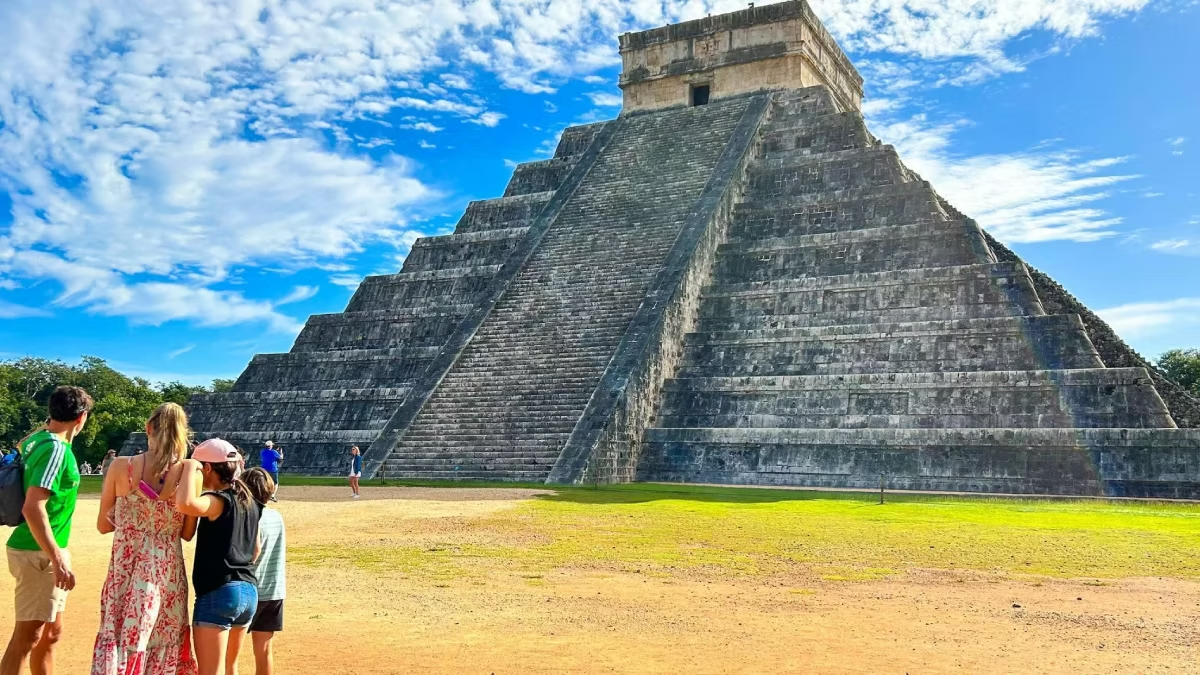
Yes, Chichén Itzá is worth visiting for most first-time travelers to the Yucatán — but only if you plan it properly. It’s one of the New Seven Wonders of the World, a UNESCO site, and the most architecturally complete Maya city in Mexico. It’s also hot, crowded after 10:30 AM, expensive ($40+ USD entry), and comes with a 5–6 hour round-trip drive from the coast. Arriving at 8 AM opening on a weekday transforms the experience from “overrated tourist trap” to “genuinely awe-inspiring.” Arriving at noon turns it into the opposite. If you want to climb pyramids (you can’t anymore at Chichén Itzá) or prefer less-crowded ruins, Ek Balam, Cobá, or Uxmal are better choices. For most travelers, the honest answer is: yes, visit — but go early, go smart, and know what you’re signing up for.
A lot of visitors come back from Chichén Itzá saying it was either the highlight of their Mexico trip or a crowded, overrated disappointment. Both reactions are common, and both are usually shaped by a single decision: what time they arrived. This guide gives the honest, no-spin answer to whether Chichén Itzá is worth it, broken down by who’s asking and what they’re trading in time, money, and comfort.
The Case for Visiting Chichén Itzá
Chichén Itzá is worth visiting because it is the best-preserved and most architecturally complete Maya city accessible to visitors — featuring El Castillo (one of the New Seven Wonders), the largest Mesoamerican ball court, a genuine astronomical observatory, and the Sacred Cenote where Maya priests conducted rain rituals. The site covers roughly 4 square miles and contains structures spanning multiple Maya periods and Toltec influences, giving it a historical depth no other Yucatán site matches.
What makes it genuinely impressive:
- El Castillo (Temple of Kukulkán) is the most famous Maya structure in the world for a reason — its proportions, alignment, and calendar-based design (365 steps, equinox serpent shadow) are architecturally extraordinary
- The Great Ball Court is the largest in Mesoamerica (168 meters long), with acoustic properties that still work today — a whisper at one end is audible at the other
- El Caracol, the observatory, is one of the few confirmed pre-Columbian astronomical structures
- The Sacred Cenote holds archaeological evidence of centuries of Maya ritual offerings
- The site’s scale — you can spend 3–4 hours exploring and still not cover everything
- Good visitor infrastructure — clearly marked paths, English signage at major structures, clean facilities at the entrance, luggage storage, and on-site toilets
- Easy to pair with a cenote and Valladolid for a satisfying full-day itinerary
For a large majority of first-time Yucatán visitors, it’s a memorable and substantive archaeological experience that justifies the effort — provided the visit is timed right.
The Case Against Visiting Chichén Itzá
Chichén Itzá has real downsides: you cannot climb any of the pyramids (prohibited since 2006), tourist crowds overwhelm the site after 10:30 AM, entry costs about $40 USD (nearly 10x what most other Maya ruins charge), the drive from Cancún or the Riviera Maya is 2.5–3 hours each way, and souvenir vendors line most paths from late morning. Many travelers who’ve seen Tulum, Cobá, Uxmal, or Ek Balam rate those sites as more enjoyable even though they’re less famous.
The honest drawbacks:
- You can’t climb anything. The pyramids were closed in 2006 after a fatal accident. If part of your Mayan-ruin fantasy is standing on top of a stepped pyramid, go to Ek Balam or Cobá instead — both still allow climbing.
- Crowds from 10:30 AM onward. Tour buses from Cancún, Playa del Carmen, Tulum, and Mérida all arrive in waves between 10:30 AM and 11:30 AM, and the site can feel circus-like after that.
- The most expensive entry fee of any Mexican Maya site. At ~692 MXN (~$40 USD) per foreign adult in 2026, entry costs 5–10x more than Tulum, Cobá, or Uxmal.
- A long drive for most visitors. 2.5–3 hours from Cancún, 2 hours from Mérida, 2.5 hours from Tulum. You’re committing at least 5–6 hours to transport alone.
- Limited shade. The main plaza is almost entirely exposed to the sun. From 11 AM to 3 PM in summer, it’s genuinely uncomfortable.
- Vendor-heavy paths. From mid-morning, dozens of souvenir sellers line the walkways. Most are polite, but the volume breaks immersion.
- No swimming, no climbing, no interactive experiences. Chichén Itzá is a look-don’t-touch archaeological site. Younger or more adventure-oriented travelers sometimes find it static compared to combo-tour alternatives.
The Deciding Factor: What Time Do You Arrive?
The biggest single factor in whether Chichén Itzá is worth it is your arrival time. Visitors arriving at 8:00 AM opening almost universally rate the experience as incredible — cool temperatures, near-empty site, perfect photo conditions, no vendors, and 2 hours of nearly solo exploration before tour buses arrive. Visitors arriving after 10:30 AM rate the same site dramatically lower because they experience it with 8,000+ other people in 32°C+ heat. Same place, opposite experiences.
A common pattern:
- 8:00 AM arrival → Site feels vast, peaceful, and atmospheric → Reviews: “Magical,” “Worth the trip,” “Highlight of Mexico”
- 11:00 AM arrival → Site feels like a theme park → Reviews: “Overcrowded,” “Hot and miserable,” “Wouldn’t go again”
If you can’t commit to an 8 AM arrival — either because of travel logistics or because you’re on a standard group tour that arrives mid-morning — the experience will be significantly diminished. Decide accordingly.
Who Should Visit Chichén Itzá
Chichén Itzá is worth it for:
- First-time visitors to Mexico who want to see one of the country’s most iconic landmarks
- History enthusiasts and archaeology buffs — the site’s depth rewards serious attention
- Photographers — if you arrive at 8 AM, El Castillo in morning light is among the most photogenic structures in the Americas
- Visitors planning a Yucatán trip of 3+ days with time for a proper day trip
- Travelers staying in Valladolid or the hacienda zone — short drive means easy 8 AM arrival
- Anyone who cares about seeing the New Seven Wonders
Who Should Consider Skipping It
Chichén Itzá may not be worth it if:
- You’re on a short beach holiday in Cancún or Riviera Maya and can’t commit a full day to the trip
- You want to climb pyramids — go to Ek Balam (1 hour from Chichén Itzá) or Cobá instead
- You’ve already seen Teotihuacán, Palenque, or other major Mexican ruins and aren’t chasing specific checklist items — the architecture is magnificent but the “no climbing” rule removes a dimension of engagement
- You’re traveling with restless young children — the heat and walking can be tough, and there’s no interactive element
- You dislike crowded tourist sites and can’t commit to arriving at 8 AM
- You’re on an extremely tight budget — entry alone is ~$40 USD, before transport and food
Chichén Itzá Compared to Other Yucatán Ruins
If you’re deciding between Chichén Itzá and other sites, here’s the short version — for a deeper comparison see our Chichén Itzá vs Tulum vs Uxmal guide.
| Site | Best for | Can you climb? | Entry cost | Crowds |
|---|---|---|---|---|
| Chichén Itzá | Iconic status, historical depth | No | ~692 MXN | Very high |
| Tulum | Coastal setting, photos | No | ~90 MXN | High |
| Uxmal | Architecture, peace | Partial | ~533 MXN | Low |
| Ek Balam | Climbing, stucco carvings | Yes | ~709 MXN | Low-medium |
| Cobá | Jungle setting, climbing | Yes (Nohoch Mul) | ~100 MXN | Medium |
Is Chichén Itzá a Tourist Trap?
A fair question. The honest answer: it’s a heavily-visited major tourist site, not a tourist trap. The ruins are genuine, significant, and well-maintained. INAH and CULTUR run a professional operation. What feels “trap-like” to some visitors is:
- The entry fee, which is higher than other sites
- The vendor density inside the zone after mid-morning
- The generic combo-tour structure (ruins + cenote + Valladolid) that can feel assembly-line
- The no-climbing rule that limits interaction with the structures
None of these make the site itself less genuine. They do mean that the experience of visiting is shaped by tourism infrastructure, which can feel commercial. Timing and independence (renting a car, staying nearby, arriving at 8 AM) reduce these effects significantly.
The Bottom Line
For most first-time Yucatán visitors who can plan ahead and arrive at 8 AM: yes, Chichén Itzá is worth it. It’s one of those places that deserves its reputation, provided you experience it properly.
For visitors who want to climb pyramids, prefer less-crowded sites, have very limited time, or are on a tight budget: Ek Balam or Cobá are better alternatives. You’ll get a more interactive experience for less money and fewer headaches.
If you’re on the fence, the fairest test is this: would you regret being in the Yucatán and not seeing the Temple of Kukulkán up close? If the answer is yes, go. If it wouldn’t bother you, consider putting your time into Ek Balam and a day in Valladolid instead — both genuinely rewarding.
For the full breakdown of how to plan a smart visit, see our best time to visit and one-day itinerary guides.
Frequently Asked Questions
Is Chichén Itzá overrated?
It depends entirely on your arrival time and expectations. Arriving at 8 AM opening, most visitors find it genuinely impressive. Arriving after 10:30 AM, many find it crowded and underwhelming. The site itself isn’t overrated — the typical visit experience often is.
Can you still climb El Castillo at Chichén Itzá?
No. Climbing was banned in 2006 after a fatal accident and to reduce erosion. This applies to all pyramids and structures at Chichén Itzá, year-round. If you want to climb a pyramid, visit Ek Balam (Acropolis) or Cobá (Nohoch Mul) — both still allow it.
Is Chichén Itzá better than Tulum?
For most visitors, yes. Chichén Itzá is significantly larger, more architecturally significant, and more historically rewarding. Tulum’s appeal is its dramatic coastal setting, not the ruins themselves — the Tulum structures are smaller and less architecturally elaborate. However, Tulum is much closer to the main resort areas and easier to visit as a half-day trip.
Is Chichén Itzá worth the drive from Cancún?
Yes, if you commit to a full day, start early, and arrive at 8 AM. The 2.5–3 hour drive each way is long, but the site justifies it for first-time visitors. If you can only spare a half-day, pair Cancún with closer alternatives like Tulum ruins (1.5 hours) instead.
How much time should I spend at Chichén Itzá?
Plan for 2.5–3 hours minimum to see the major structures (El Castillo, Great Ball Court, Temple of Warriors, Sacred Cenote, El Caracol). Add 1–2 hours if you want to explore Old Chichén and the Nunnery complex. Serious history buffs can spend 4–5 hours easily.
Is Chichén Itzá crowded?
Extremely, from about 10:30 AM to 3:00 PM on any given day. Peak crowds on equinox days can reach 15,000+ visitors. Arrive at 8 AM opening for 2 hours of near-empty exploration before tour buses begin arriving.
Is Chichén Itzá a UNESCO World Heritage Site?
Yes. Chichén Itzá was inscribed on the UNESCO World Heritage List in 1988. It was also named one of the New Seven Wonders of the World in 2007 by a global public vote.
Why is Chichén Itzá so expensive?
Admission is split between two mandatory fees — the INAH federal fee (~100 MXN) and the Yucatán state CULTUR fee (~592 MXN) — totaling about 692 MXN (~$40 USD) for foreign adults. The state fee funds tourism infrastructure and site maintenance. It’s significantly higher than other Mexican Maya sites, reflecting Chichén Itzá’s volume of visitors and its UNESCO/New Seven Wonders status.
