

FAQs About Chichén Itzá
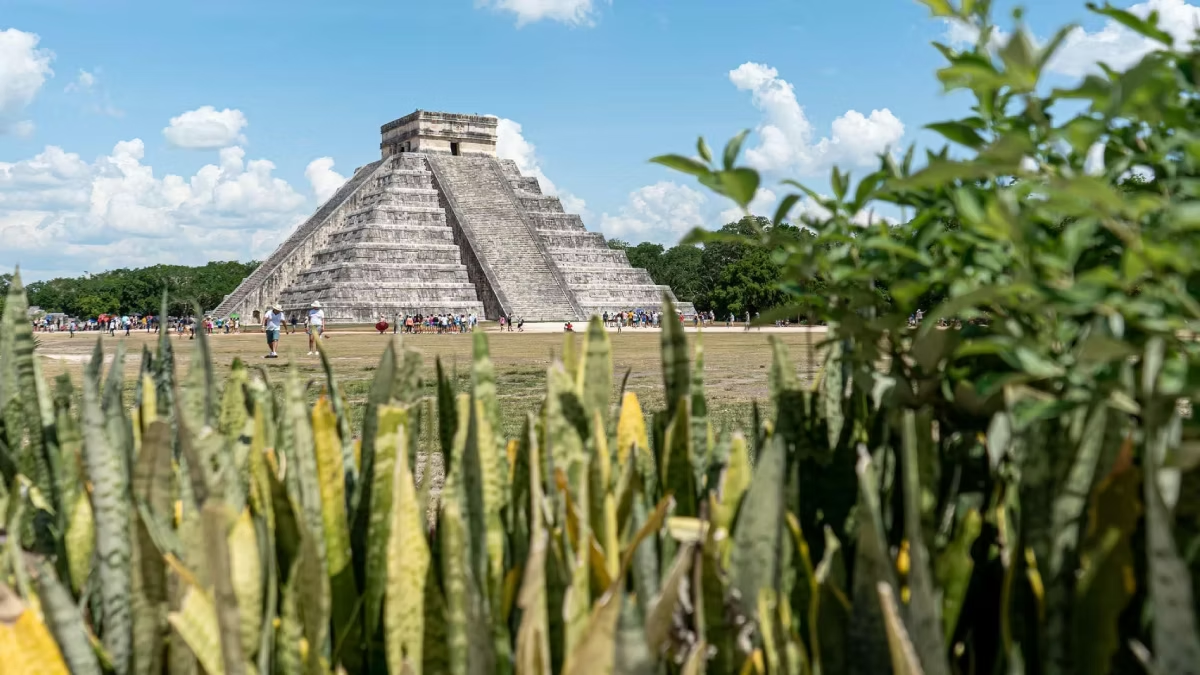
This FAQ answers the most common visitor questions about Chichén Itzá in 2026. Key facts: the site is open 8 AM to 5 PM every day (last entry 4 PM), costs approximately 692 MXN (~$40 USD) for foreign adults (split between INAH federal and CULTUR state fees), you cannot climb El Castillo (banned since 2006), and the best time to visit is a weekday at 8 AM opening between November and April for dry weather and thin crowds. The site is 2.5–3 hours from Cancún, 2 hours from Mérida, and 40 minutes from Valladolid. Drones, tripods, alcohol, and food are banned inside the archaeological zone. The famous serpent shadow appears on El Castillo around the spring equinox (March 20–21) and autumn equinox (September 22–23) between 3–5 PM. For deeper detail on any of these topics, each answer below links to a dedicated guide.
This is the master FAQ for Chichén Itzá — one place to scan for quick answers to the most common questions. Each answer is brief; where the topic deserves more depth, we link to the full article. Use this page if you want a rapid overview, or if you’re trying to answer a specific question before diving into more detailed planning.
About Chichén Itzá
What is Chichén Itzá?
Chichén Itzá is a large pre-Columbian Maya archaeological city on Mexico’s Yucatán Peninsula, covering about 4 square miles. Built between roughly 600 and 1200 AD, it was one of the most powerful Maya cities in Mesoamerica. Today it is a UNESCO World Heritage Site (1988) and one of the New Seven Wonders of the World (2007).
Where is Chichén Itzá located?
In the state of Yucatán in southeastern Mexico, about 2 km from the small town of Pisté, on Highway 180 between Mérida and Cancún. GPS: 20.6843° N, 88.5678° W. See our how to get to Chichén Itzá guide for route details.
How old is Chichén Itzá?
The site was founded around 600 AD and reached its peak between 800 and 1200 AD, before being largely abandoned in the 13th century. The most famous structures, including El Castillo, date from the 9th–12th centuries. Many buildings layer earlier Maya and later Toltec influences.
Is Chichén Itzá a Wonder of the World?
Yes. Chichén Itzá was named one of the New Seven Wonders of the World in a global public vote organized by the New7Wonders Foundation in July 2007. It is also a UNESCO World Heritage Site, inscribed in 1988.
What does “Chichén Itzá” mean?
In the Maya language, Chichén Itzá means roughly “at the mouth of the well of the Itzá” — a reference to the sacred cenote (natural sinkhole) on the site and the Itzá people who settled there.
Hours, tickets, and pricing
What time does Chichén Itzá open?
8:00 AM daily, 365 days a year. Last admission is 4:00 PM, and the site closes at 5:00 PM. See our opening hours guide for full details.
How much does it cost to enter Chichén Itzá?
Approximately 692 MXN (~$40 USD) for foreign adults in 2026, split between the INAH federal fee (~100 MXN) and the CULTUR state fee (~592 MXN). Children under 13 enter free. Mexican nationals pay a reduced rate. Admission is free for Mexican citizens and foreign residents on Sundays.
Can I buy Chichén Itzá tickets online?
Yes — through authorized ticket resellers online. Buying in advance lets you skip the gate queues and ensures both required fees are bundled into one ticket. See our official website guide for details on authentic vs fake sellers.
Why are there two ticket windows at Chichén Itzá?
Because the site is administered by two separate Mexican government agencies — INAH (federal) and CULTUR (Yucatán state) — each selling its own ticket at its own window. This is why most visitors wait in two queues unless they pre-purchase online.
Is parking available at Chichén Itzá?
Yes. The official parking lot at the main entrance charges 80–150 MXN (about $4–7 USD), cash only. Ignore unofficial lots along the approach road — they’re farther away and sometimes less secure.
Best time to visit
What is the best time of year to visit Chichén Itzá?
Late November through early April (dry season), with mid-to-late November and early February the sweet spots for avoiding both weather and crowd peaks. See our best time to visit guide for a full month-by-month breakdown.
What is the best time of day to visit Chichén Itzá?
8:00 AM when the gates open. Arriving at opening gives you roughly two hours of near-empty site before tour buses from Cancún and Mérida arrive around 10:30 AM.
Is Chichén Itzá busy on Sundays?
Yes — Sundays are the busiest day of the week because admission is free for Mexican citizens and foreign residents. If you can only visit on a weekend, choose Saturday at 8 AM over any Sunday time.
Can I visit Chichén Itzá in the rainy season?
Yes. Rainy season (May–October) typically brings short afternoon storms rather than all-day rain. You’ll face 30–50% fewer visitors and lower tour prices, but September–October has the highest storm risk due to Atlantic hurricane season.
Getting there
How do I get to Chichén Itzá from Cancún?
About 200 km / 2.5–3 hours via Highway 180D (toll road). Options: guided day tour (most popular), ADO first-class bus (departs downtown Cancún at 8:45 AM), rental car, or the Tren Maya. Full details in our how to get there guide.
How do I get to Chichén Itzá from Mérida?
About 120 km / 2 hours via Highway 180. The Tren Maya runs 6 times daily from Mérida Teya station, and ADO buses run 3–4 times daily from the TAME terminal. Self-driving is straightforward.
What is the closest town to Chichén Itzá?
Pisté, just 2 km from the main entrance along Highway 180. Valladolid (43 km / 40 minutes away) is the closest larger town and the best overall base for visitors.
Is there a train to Chichén Itzá?
Yes. The Tren Maya now connects Chichén Itzá to Mérida, Cancún, and other Yucatán destinations via a dedicated station near the site. A shuttle runs from the station to the main entrance.
What to expect on-site
How long do I need at Chichén Itzá?
Plan for 2.5–3 hours minimum to see the main structures. Serious history enthusiasts can spend 4–5 hours. See our one-day itinerary for the ideal timing.
Can I climb El Castillo at Chichén Itzá?
No. Climbing El Castillo and all other pyramids has been prohibited since 2006, following a fatal accident and preservation concerns. No exceptions. If climbing a pyramid is important to you, visit Ek Balam or Cobá instead — both still allow it.
Is there shade at Chichén Itzá?
Very little. The main plaza is almost entirely exposed to the sun. Shade is limited to a few tree-lined side paths and partial shelter from some ruined structures. This is why arriving at 8 AM is crucial in the dry season.
What are the main things to see at Chichén Itzá?
- El Castillo (Temple of Kukulkán) — the iconic step pyramid
- The Great Ball Court — largest in Mesoamerica
- Temple of the Warriors — with its famous Chac Mool figure
- Sacred Cenote — used for Maya rain-god rituals
- El Caracol — the astronomical observatory
- Group of the Thousand Columns
- Tzompantli (Wall of Skulls)
- Old Chichén and the Nunnery complex (often skipped by rushed visitors)
Rules, safety, and accessibility
Is Chichén Itzá safe?
Yes. The site is protected by the Mexican National Guard, INAH security, and Yucatán state police. Violent crime is essentially non-existent on-site. Main concerns are non-violent scams and pickpocketing in crowded queues — see our safety and scams guide for details.
Can I bring a drone to Chichén Itzá?
No. Drones are strictly banned without prior written INAH permission, which is difficult to obtain. Violators face fines and equipment confiscation at the security checkpoint.
Can I bring food into Chichén Itzá?
No. Only water is permitted inside the archaeological zone. Food can be purchased at the entrance plaza (outside the turnstiles) or in nearby Pisté. Guided tours typically include lunch afterward in Valladolid.
Is Chichén Itzá wheelchair accessible?
Partially. The entrance area is paved with ramps, and the main central plaza is flat but unpaved. Manual wheelchair users can access the major structures with some assistance. Old Chichén (southern complex) has rougher terrain. See our things to know guide for full accessibility details.
What should I wear at Chichén Itzá?
Light, breathable, light-colored clothing, closed-toe walking shoes or sturdy sandals, a wide-brimmed hat, and sunglasses. Avoid flip-flops (uneven paths) and heavy jeans (too hot). See our things to know guide for a full packing list.
Are there bathrooms at Chichén Itzá?
Yes, at the main entrance plaza (outside the turnstiles). There are no toilets inside the archaeological zone itself — use the ones at the entrance before or after your visit.
The equinox and special events
When is the Chichén Itzá equinox?
The spring equinox falls around March 20–21 and the autumn equinox around September 22–23. The famous serpent shadow on El Castillo appears between 3:00 PM and 5:10 PM on those days and for 2–3 days before and after. See our equinox guide for full details.
What is the serpent shadow at Chichén Itzá?
During the equinoxes, the setting sun casts seven triangular shadows down the north staircase of El Castillo, creating the illusion of a serpent (the feathered god Kukulkán) descending the pyramid. The effect is the result of deliberate Maya astronomical engineering.
Is the Chichén Itzá night light show worth it?
The Noches de Kukulkán light and sound show is projected onto El Castillo in the evening (starting around 7:00 PM). It’s a separate ticket from daytime admission. Reviews are mixed — some visitors love the atmosphere, others find it brief. See our night light show guide for details.
Comparing with other sites
Is Chichén Itzá better than Tulum?
For most visitors, yes — Chichén Itzá is significantly larger, more architecturally significant, and more historically rewarding. Tulum’s strength is its coastal setting, not the ruins themselves. See our full Chichén Itzá vs Tulum vs Uxmal comparison.
Is Chichén Itzá worth it?
Yes — if you arrive at 8 AM. Visitors who arrive at opening almost universally rate the experience as excellent. Visitors arriving at 11 AM often rate it as overcrowded and uncomfortable. Timing matters more than any other factor. See our is it worth it guide.
Where to stay
Can you stay at Chichén Itzá overnight?
Yes. Three hotels sit inside the archaeological zone boundary — Mayaland, The Lodge at Chichén Itzá, and Hacienda Chichén — all with private entrances to the ruins. Alternative bases are Valladolid (40 min) and Pisté (5 min). See our where to stay guide.
What is the best base for visiting Chichén Itzá?
Valladolid for most visitors — a charming colonial town 40 minutes from the ruins with excellent restaurants and affordable hotels. Pisté for budget sunrise arrivals. The on-site haciendas for luxury and pre-opening private access.
Practical logistics
Is Chichén Itzá in a different time zone?
Yes. Chichén Itzá is in Yucatán state, which observes Central Time (CST), one hour behind Cancún, Playa del Carmen, and Tulum (which observe Eastern Time). Your phone usually adjusts at the state line — double-check before making return-trip plans.
Can I take photos at Chichén Itzá?
Yes, personal photography is free with phones or regular cameras. Tripods and drones require prior INAH permission and are typically refused. Commercial and wedding-dress photo shoots need special permits.
Is there WiFi at Chichén Itzá?
Very limited. Cell signal is spotty inside the archaeological zone. Download offline maps (Google Maps, Maps.me) and save your digital tickets as screenshots before arriving.
Can I bring a stroller to Chichén Itzá?
Yes, but choose a robust or jogging stroller. Umbrella strollers struggle on the compacted dirt paths. The main plaza is stroller-friendly; Old Chichén is rougher.
Are there guided tours available at Chichén Itzá?
Yes. You can hire a licensed guide at the main entrance (typically 1,000–1,500 MXN for a small group, 1–1.5 hours), or book an organized tour with transport from Cancún, Mérida, Playa del Carmen, or Valladolid in advance. See our tours from Cancún guide for options.
Still have questions?
Every question above links to a more detailed guide on our site. For planning a full visit, start with our best time to visit and one-day itinerary guides. For on-the-ground logistics, the opening hours and things to know guides cover everything else.
Frequently Asked Questions
Do I need to book Chichén Itzá tickets in advance?
Booking online is strongly recommended. Walk-up tickets are available at the gate, but purchasing in advance bundles both required fees — INAH federal and CULTUR state — into one transaction and lets you skip two separate queues. On Sundays, when admission is free for Mexican citizens and foreign residents, gate wait times are especially long.
How long should I plan to spend at Chichén Itzá?
Plan a minimum of 2.5 to 3 hours to see the main structures: El Castillo, the Great Ball Court, the Temple of the Warriors, the Sacred Cenote, and El Caracol. Visitors with a strong interest in Maya history often spend 4 to 5 hours. There is no time limit once you are inside the site.
What should I bring to Chichén Itzá?
Bring at least 2 litres of water per person, sunscreen, a wide-brimmed hat, light breathable clothing, and comfortable closed-toe shoes. No food is permitted inside the archaeological zone — eat before you enter or buy from the entrance plaza outside the turnstiles. Download offline maps before arriving, as cell signal is limited inside the site.
Is the equinox visit to Chichén Itzá worth the extra crowds?
The serpent shadow effect — seven triangular shadows cast down El Castillo’s north staircase to create a descending serpent illusion — is a genuine spectacle and the result of deliberate Maya astronomical engineering. However, the spring equinox (March 20–21) and autumn equinox (September 22–23) draw the year’s largest crowds. The same shadow effect is visible 2–3 days before and after each equinox date with significantly fewer visitors.
What is the best place to stay near Chichén Itzá?
Valladolid (40 minutes away) is the best overall base for most visitors — a colonial town with good restaurants and affordable hotels that places you close enough for an early arrival. Pisté (5 minutes away) is the most budget-friendly option. For a premium experience, three hotels inside the archaeological zone boundary offer private access to the ruins before the gates open to the public.
