

Tzompantli Chichén Itzá 2026: Wall of Skulls, Toltec Sacrifice Rack
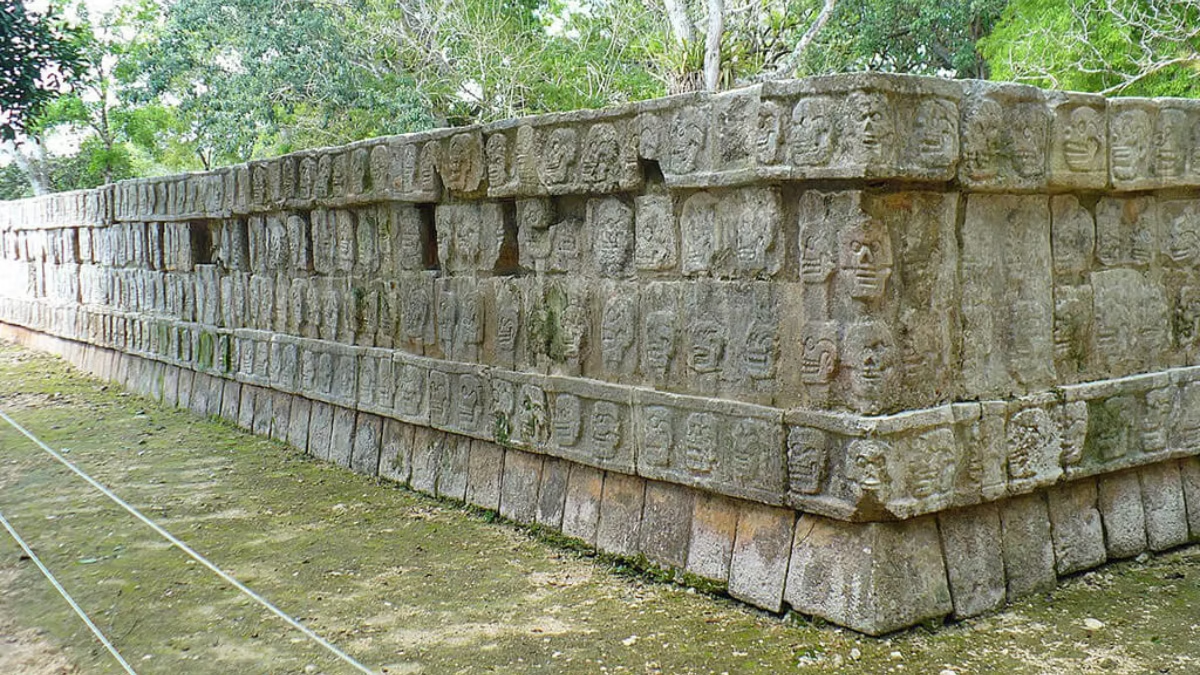
The Tzompantli (also called the Wall of Skulls or Platform of the Skulls) at Chichén Itzá is a T-shaped stone platform located immediately south of the Great Ball Court, covered in over 500 bas-relief carvings of human skulls arranged in rows along the platform’s walls. In Mesoamerican tradition, a tzompantli was a “skull rack” — a structure where the actual skulls of sacrificial victims and enemies were displayed on wooden beams, serving as a public statement of the state’s power and its commitment to religious sacrifice. The Chichén Itzá tzompantli is one of the best-preserved examples of this Mesoamerican tradition and one of the oldest known. The name “tzompantli” is Nahuatl (Aztec), literally meaning “skull banner” or “wall of skulls” — applied to this Maya-Toltec structure by later scholars because no original Maya term survives. The carved reliefs depict four main subjects: (1) the skull rack itself, (2) scenes of human sacrifice, (3) eagles eating human hearts, and (4) skeletonized warriors with shields and arrows. The structure dates from the Toltec influence period at Chichén Itzá (~900–1200 CE), when large-scale human sacrifice practices were introduced to the Maya from central Mexico. Broken ball game rings and buried Chac Mool figures have been found inside the platform, confirming its direct connection to sacrifice rituals following the ball game.
The Tzompantli is the structure at Chichén Itzá that most directly confronts visitors with the darker dimensions of Maya religious practice. There’s no ambiguity about what was displayed here — the carved rows of skulls on the platform walls are a literal image of what rested on wooden posts above. Standing in front of the platform, you’re looking at a public monument to ritualized killing. Whether this disturbs you, fascinates you, or both, the Tzompantli is a genuinely important part of understanding Chichén Itzá and the Mesoamerican world it was part of.
What a Tzompantli Actually Was
A tzompantli was a Mesoamerican structure for the public display of human skulls — typically those of sacrificial victims, defeated war captives, or ball game losers. The skulls were defleshed, drilled with holes, and mounted on wooden beams or poles arranged in a rack-like structure. The stone platform at the base (which is what survives today at Chichén Itzá and other sites) supported the wooden superstructure. The word “tzompantli” is Nahuatl (the Aztec language), meaning approximately “skull banner” or “wall of skulls.” No original Maya term for these structures survives; “tzompantli” is applied to the Chichén Itzá example by scholars because the structure parallels Aztec and Toltec examples. Tzompantlis served three clear social purposes: (1) publicly displaying the skulls of sacrificial victims and enemies; (2) honoring the gods who received the sacrifices; (3) demonstrating the military power of the state that produced them. At the Huey Tzompantli in Tenochtitlan (the Aztec capital, discovered during 2015 excavations in Mexico City), over 650 skulls have been recovered — though the Chichén Itzá tzompantli had fewer skulls displayed at any one time than the later Aztec monumental skull rack.
The Original Appearance
The Tzompantli at Chichén Itzá as you see it today is the stone platform base — the architectural foundation. Originally, above this stone platform:
- Tall wooden beams rose vertically from the platform surface
- Horizontal crossbeams connected the vertical posts in a rack-like grid
- Human skulls were mounted on the beams — either threaded laterally along horizontal beams or stacked vertically on the posts
- Fresh skulls would be added periodically; older skulls would remain or be replaced
- The full structure was visible from a distance — a deliberate public monument
The wood has long rotted; the skulls have long been removed or decayed. What survives is the carved stone base with its relief images showing what the structure looked like in use.
Why Tzompantlis Were Built
In Mesoamerican religion, human sacrifice was understood as a necessary exchange with the gods:
- Blood and life were the most valuable offerings humans could provide
- Gods required sacrifice to sustain cosmic order and natural cycles (especially rain)
- Skulls preserved the memory of the sacrificed — the victim’s soul went on, but the skull remained as physical proof
- Display was political — skulls demonstrated a ruler’s ability to conquer, capture, and sacrifice
- Sacred violence — the tzompantli publicly proclaimed the state’s engagement with the gods through sacrificial practice
This context is important for understanding why the tzompantli isn’t a morbid curiosity but a central religious monument — as fundamental to post-Classic Chichén Itzá as the pyramids themselves.
The Architecture: What You’re Looking At
The Chichén Itzá Tzompantli is located immediately south of the Great Ball Court, just across the path. It’s easy to miss on a rushed tour — visitors focused on the Ball Court often walk past without stopping.
| Feature | Detail |
|---|---|
| Shape | “T”-shaped platform |
| Dimensions | Approximately 60m long (main axis) |
| Height | Low platform, ~1.5m above ground |
| Construction period | ~900–1100 CE (Toltec influence) |
| Material | Limestone |
| Primary decoration | Bas-relief skull carvings on all sides |
| Total carved skulls | ~500 (estimates up to 2,400) |
| Location | South of the Great Ball Court, adjacent to the Platform of Venus and Platform of the Eagles and Jaguars |
| Associated finds | Broken ball court ring, buried Chac Mool figures, skull offerings |
The T-Shape
The Tzompantli’s distinctive T-shape is uncommon among Chichén Itzá structures. The long axis runs east-west, with a shorter perpendicular extension creating the T. The shape likely served both functional and ceremonial purposes — the T-shape creates multiple visible sides for skull display, and may have had specific ritual significance.
The Skull Carvings
The platform’s walls are covered in rows of carved skulls — hundreds of individual skulls, each carved in bas-relief (raised from the wall surface). Estimates of total skull carvings vary:
- Conservative counts — ~500 bas-relief skulls on visible walls
- Expansive counts — up to 2,400 including fragments and eroded sections
The skulls are shown in frontal view, with prominent teeth, hollow eye sockets, and nasal openings. They’re stylized rather than anatomically precise — each skull is a symbolic representation rather than a portrait of a specific individual.
The Four Main Relief Subjects
Beyond the skull rows, the Tzompantli’s walls feature four distinct iconographic themes:
- The skull rack itself — meta-representation: the monument depicting the monument
- Human sacrifice scenes — the moment of ritual killing, warriors with knives
- Eagles eating human hearts — Toltec military order imagery; eagles represented elite warriors
- Skeletonized warriors with shields and arrows — death personified as warrior; cosmic warfare
These themes work together to communicate: this structure displays victims of sacrifice (1); sacrifice is performed by warriors (2); those warriors are elites represented by eagles who feed on the hearts of victims (3); death itself is a warrior (4).
Additional Carvings
Beyond the four main themes, the walls also feature:
- Snakes and serpents — symbolizing death, transformation, and the underworld
- Feathered serpents (Kukulkán) at end points
- Warriors holding severed heads in triumphant poses
- Glyphs (partially decipherable inscriptions)
The Toltec Origin
The tzompantli tradition was introduced to the Maya by the Toltec during the post-Classic period of cultural contact (~900–1200 CE). Earlier Classic Maya civilization practiced human sacrifice but on a smaller scale and without the characteristic skull rack structure. The Toltec capital of Tula, in the Mexican state of Hidalgo, has its own tzompantli dating from roughly the same period — demonstrating that this specific architectural form and its ritual use traveled from central Mexico to the Yucatán alongside other Toltec influences (feathered-serpent imagery, Chac Mool sculptures, warrior columns, and others seen throughout Chichén Itzá). The Aztec Huey Tzompantli at Tenochtitlan, built later (~1400s), represents the evolved final form of the tradition — a monumental structure that archaeologists discovered in 2015 to have contained over 650 skulls. The Chichén Itzá example is thus a middle-period tzompantli, showing the Toltec architectural tradition adapting to the Maya cultural context.
The Tzompantli Tradition Timeline
- 600–900 CE (Epiclassic): Earliest known skull display structures appear in central Mexico; scholars debate possible Zapotec precursors as early as 200 BCE
- 900–1200 CE (Early Post-Classic): Toltec tzompantli at Tula; Chichén Itzá Tzompantli constructed during this period
- 1200–1400 CE: Practice spreads throughout post-Classic Mesoamerica
- 1400–1519 CE: Aztec Huey Tzompantli at Tenochtitlan — the monumental culmination
- 1519 CE onward: Spanish Conquest ends the tradition across Mesoamerica
The Chichén Itzá Tzompantli falls in the middle period — after the earliest examples but before the Aztec culmination. It’s one of the better-preserved mid-period tzompantlis and a key archaeological source for understanding the tradition.
The Ball Game Connection
The Tzompantli is located directly adjacent to the Great Ball Court at Chichén Itzá — a geographically deliberate placement that reflects the ritual connection between the Maya ball game and skull sacrifice. The bas-relief carvings on the Great Ball Court walls explicitly show a decapitated ball player with serpents emerging from the neck, confirming that ritual beheading followed certain ceremonial ball games. The severed heads of ball game losers (or in some interpretations, winners) were reportedly displayed on the Tzompantli. The Popol Vuh (the Maya creation epic) reinforces this connection: the god Hun Hunahpú is killed by the Lords of Xibalba and his severed head is hung in a gourd tree next to a ball court — a mythological parallel to the physical proximity of Tzompantli and ball court in Chichén Itzá’s architecture. During 20th-century excavations, archaeologists found a broken ball court ring buried inside the Tzompantli platform — physical confirmation of the ritual connection between the two structures.
What the Ball Court Reliefs Show
Six long relief panels on the Great Ball Court walls depict ball game scenes. The most dramatic shows:
- A kneeling, decapitated player
- Seven serpents emerging from the severed neck (representing blood or life force)
- Other players in the scene
- Ritual context — the scene follows the game, not during it
These carvings are the primary archaeological evidence linking the ball game to ritual decapitation. The skulls of the decapitated players were then displayed on the Tzompantli next door.
The Popol Vuh Parallel
The Popol Vuh — preserved by 16th-century Maya scribes after the Spanish Conquest — tells the story of the Hero Twins (Hunahpú and Xbalanqué) who play ball games against the Lords of Xibalba (the underworld). In the prequel to their story:
- Hun Hunahpú (father of the Hero Twins) is killed by the Lords of Xibalba
- His severed head is hung in a gourd tree next to a ball court
- The head eventually impregnates a maiden through a magical saliva exchange
- The Hero Twins are born and later avenge their father through ball game victory
The gourd tree with the severed head is understood as a mythological tzompantli — showing that skull display near ball courts had deep roots in Maya cosmology, not just Toltec influence.
The Platform of Venus and Nearby Structures
The Tzompantli is part of a broader cluster of low ceremonial platforms in the main plaza area:
Platform of Venus (Immediately Adjacent)
- Square platform with carved panels on all four sides
- Venus symbolism in the carved decoration
- Serpent staircases on each side
- Construction matches Tzompantli period
Platform of the Eagles and Jaguars (Nearby)
- Square platform similar to Platform of Venus
- Carved eagles and jaguars depicting the military orders
- Eagles and jaguars devouring human hearts — matching the Tzompantli iconography
- Clearly part of the same ceremonial complex
These three platforms (Tzompantli, Platform of Venus, Platform of the Eagles and Jaguars) plus the adjacent Great Ball Court form a unified ceremonial-military precinct in the northern section of Chichén Itzá’s main plaza.
Excavation Findings
Inside and around the Tzompantli platform, archaeologists have found:
- Broken ball court ring — from one of the Great Ball Court’s stone rings, reinforcing the ritual connection
- Buried Chac Mool figures — sacrifice receptacle statues
- Skull offerings — some actual skull fragments
- Ceremonial deposits — pottery, obsidian blades, and other offerings
- Structural modifications — evidence the platform was modified over time
These findings confirm that the Tzompantli wasn’t merely a symbolic monument but was actively used for ceremonies involving sacrifice, ball game rituals, and offerings.
Location at Chichén Itzá
The Tzompantli is in the northern central area of the archaeological zone:
- Immediately south of the Great Ball Court
- Adjacent to the Platform of Venus and Platform of the Eagles and Jaguars
- Approximately 100 meters west of El Castillo
You’ll pass the Tzompantli on almost any tour of Chichén Itzá — it’s on the main circulation path between El Castillo and the Great Ball Court. However, many tours only briefly mention it before moving on. Serious visitors should plan a dedicated stop.
Honest Visitor Note
The Tzompantli confronts visitors with uncomfortable aspects of Maya and Toltec religion — specifically, large-scale human sacrifice and the display of victims’ skulls. Several framings to consider:
Historical perspective: Ritualized violence appeared in many ancient cultures (Roman gladiator games, medieval public executions, etc.). Modern sensibilities are calibrated to modern norms, not ancient ones.
Religious seriousness: The Maya and Toltec took sacrifice as a religious duty — not as cruelty for its own sake. From their perspective, sacrifice maintained cosmic balance and was worth the cost.
Limited applicability: Not every Maya person across all centuries practiced human sacrifice. The practice intensified specifically during the post-Classic period under Toltec influence.
Modern interpretation: Archaeologists and historians study these practices analytically, not to glorify or judge them. The Tzompantli is a primary source for understanding post-Classic Mesoamerican society.
Visitors should feel free to take the monument seriously without becoming morbid or dismissive.
When to Visit
- For minimum crowds: Morning (8:00–10:00 AM) — you’ll walk past the Tzompantli as you move from El Castillo to the Great Ball Court
- For photography: Mid-morning — clear light on the skull carvings
- For serious examination: 10–15 minutes to slowly walk the perimeter and examine the four relief themes
- Typical tour allocation: 3–7 minutes (very rushed)
- Recommended time: 15–20 minutes if interested
What You Can and Can’t Do
You can:
- Walk around the perimeter of the platform
- View carvings from the visitor path
- Photograph the platform and its carvings
- Read interpretive signs
You cannot:
- Climb onto the platform
- Touch the carvings
- Cross the rope barriers
- Use drones (banned site-wide)
Quick Reference
| Detail | Value |
|---|---|
| Structure name | Tzompantli / Wall of Skulls / Platform of the Skulls |
| Shape | T-shaped platform |
| Total carved skulls | ~500 (estimates up to 2,400) |
| Construction period | ~900–1100 CE (Toltec influence) |
| Material | Limestone with bas-relief carving |
| Location | Immediately south of the Great Ball Court |
| Nearby structures | Platform of Venus, Platform of the Eagles and Jaguars |
| Main relief themes | Skull rack, human sacrifice, eagles eating hearts, skeletonized warriors |
| Cultural origin | Toltec tradition adapted to Maya context |
| Ball game connection | Displayed skulls of decapitated ball players |
| Typical visit time | 3–7 min (recommend 15–20) |
| Climbing | Prohibited |
Frequently Asked Questions
What is a tzompantli?
A tzompantli is a Mesoamerican structure for publicly displaying human skulls — typically those of sacrificial victims, war captives, or ball game losers. The name is Nahuatl (Aztec), meaning “skull banner” or “wall of skulls.” The structure consisted of a stone platform base supporting wooden beams and posts on which skulls were mounted. At Chichén Itzá, only the stone base survives; the wooden superstructure and actual skulls have long since decayed or been removed.
Where is the Tzompantli at Chichén Itzá?
Immediately south of the Great Ball Court, adjacent to the Platform of Venus and Platform of the Eagles and Jaguars. It’s approximately 100 meters west of El Castillo. You’ll pass it on virtually any guided tour as you walk between the main ceremonial structures.
How many skulls are carved on the Tzompantli?
Conservative estimates: ~500 bas-relief skulls on visible walls. Expansive estimates including fragments and eroded sections reach up to 2,400. The skulls appear in multiple rows along the platform’s walls, arranged in a pattern representing the real skulls that would have been displayed on wooden beams above.
Were actual human skulls on the Tzompantli?
Yes — originally. Wooden beams rose from the stone platform, and actual human skulls were mounted on them (drilled with holes to allow threading). The skulls belonged to sacrificial victims, defeated enemies, and ball game losers. The wooden structure rotted away centuries ago; the stone base is what visitors see today. The carved skulls on the stone walls are a stylized representation of the real skulls that would have been above them.
Who was sacrificed at the Tzompantli?
Multiple categories of victims were sacrificed and displayed: ball game losers (or possibly winners, debated) — decapitated after ceremonial games; war captives from military campaigns; ritual sacrifices during specific religious ceremonies; and political prisoners during periods of state consolidation. The exact demographics are debated, but archaeological and skeletal evidence from similar Mesoamerican sites shows a mix of adults and children, men and women.
When was the Tzompantli built?
Approximately 900–1100 CE — during the Toltec influence period at Chichén Itzá. This is the same era as El Castillo, the Temple of the Warriors, and most other major post-Classic structures at the site. The tzompantli tradition itself originated in central Mexico (Toltec) and spread to the Maya world during this period of cultural contact.
Is the Tzompantli tradition Maya or Toltec?
Toltec in origin, adopted by the Maya. Earlier Classic Maya civilization practiced human sacrifice but on a smaller scale and without the characteristic skull rack architecture. The Toltec introduced the tzompantli form to the Maya world during the post-Classic period (~900–1200 CE). Similar tzompantlis existed at the Toltec capital Tula and at Aztec Tenochtitlan (the Huey Tzompantli, discovered in 2015). The Chichén Itzá Tzompantli represents a Maya adaptation of a Toltec tradition.
What do the carvings on the Tzompantli show?
Four main subjects: (1) the skull rack itself — rows of carved skulls representing the real skulls above; (2) human sacrifice scenes — warriors performing ritual killing; (3) eagles eating human hearts — Toltec military order imagery; (4) skeletonized warriors with shields and arrows — death personified as warrior. Additional carvings include snakes, feathered serpents, and warriors holding severed heads.
How big is the Tzompantli?
Approximately 60 meters long on its main axis, with a perpendicular extension creating its T-shape. The platform height is relatively low (~1.5m), but the original wooden superstructure above would have been substantially taller (several meters). It’s smaller than some later tzompantlis (like the Aztec Huey Tzompantli in Mexico City) but larger than most Epiclassic examples.
Is the Tzompantli connected to the Great Ball Court?
Yes — strongly. The Tzompantli is located directly adjacent to the Great Ball Court, a geographically deliberate placement reflecting the ritual connection between the ball game and skull sacrifice. The Great Ball Court’s carvings show a decapitated ball player, and archaeologists found a broken ball game ring buried inside the Tzompantli platform — physical confirmation of the link. The Popol Vuh (Maya creation epic) also connects skull display and ball courts through the story of Hun Hunahpú’s severed head in a gourd tree.
Can you climb onto the Tzompantli?
No — climbing is prohibited. Roped barriers keep visitors 1–2 meters back from the platform. You can walk around the perimeter and photograph the carvings, but cannot touch or climb the structure. This is true of most major structures at Chichén Itzá — INAH (Mexico’s archaeological authority) has restricted climbing since 2006 for preservation reasons.
What’s the difference between the Chichén Itzá Tzompantli and the Aztec Huey Tzompantli?
The Chichén Itzá Tzompantli dates to ~900–1100 CE, features a stone platform with ~500 bas-relief skulls, and represents the Maya-Toltec period. The Huey Tzompantli (Aztec, Mexico City) dates to the ~1400s CE, is a much larger structure discovered in 2015, and contained over 650 actual skulls plus carved skulls on surrounding walls — the monumental culmination of the tradition. The Huey Tzompantli is the largest known tzompantli; the Chichén Itzá example is one of the best-preserved Maya adaptations of the Toltec tradition.
Is the Tzompantli shown in any films?
Yes — most famously in Mel Gibson’s Apocalypto (2006), which features a fictional post-Classic Maya city with a prominent tzompantli structure integrated into scenes of human sacrifice. The film’s depiction draws from archaeological evidence at sites like Chichén Itzá but conflates Maya practices with more elaborate Aztec-style rituals from a later period. The 2014 Mexican horror anthology México Bárbaro includes a segment titled “Tzompantli” exploring the ritual traditions.
How does the Tzompantli fit into Maya beliefs about death and the afterlife?
Maya cosmology understood death as a transition rather than an ending. The soul traveled to Xibalba (the underworld) or — for those with appropriate ritual treatment — to other realms. The skull preserved on the tzompantli remained as physical evidence of the sacrificial exchange; the soul had moved on. Sacrifice was understood as a reciprocal relationship with the gods — humans provided life essence (blood, hearts, life), and the gods in return maintained the cosmic order that sustained human life. The tzompantli was a public declaration of this reciprocal relationship.
Should I visit the Tzompantli if I’m sensitive to violent imagery?
Most visitors find the Tzompantli historically interesting rather than disturbing — it’s a weathered stone platform with bas-relief carvings, not a graphic display. The skull carvings are stylized and artistic rather than realistic. If you’re visiting Chichén Itzá at all, the Tzompantli is a brief stop on the main path; you won’t accidentally spend significant time there. For visitors particularly sensitive to themes of violence or sacrifice, you can walk past without stopping — the structure is easy to skip without missing the Chichén Itzá highlights.
Is there anything inside the Tzompantli platform?
Yes — archaeological excavations found: a broken ball court ring, buried Chac Mool sculptures, skull offerings, ceremonial deposits (pottery, obsidian blades, incense), and evidence of multiple periods of use and modification. These finds confirm that the Tzompantli wasn’t just a symbolic monument but was actively used for ceremonies over a long period. Visitors cannot access the interior; these finds are in museum collections.
