

Maya Astronomy Chichén Itzá 2026: Calendar, Venus, Equinox Serpent
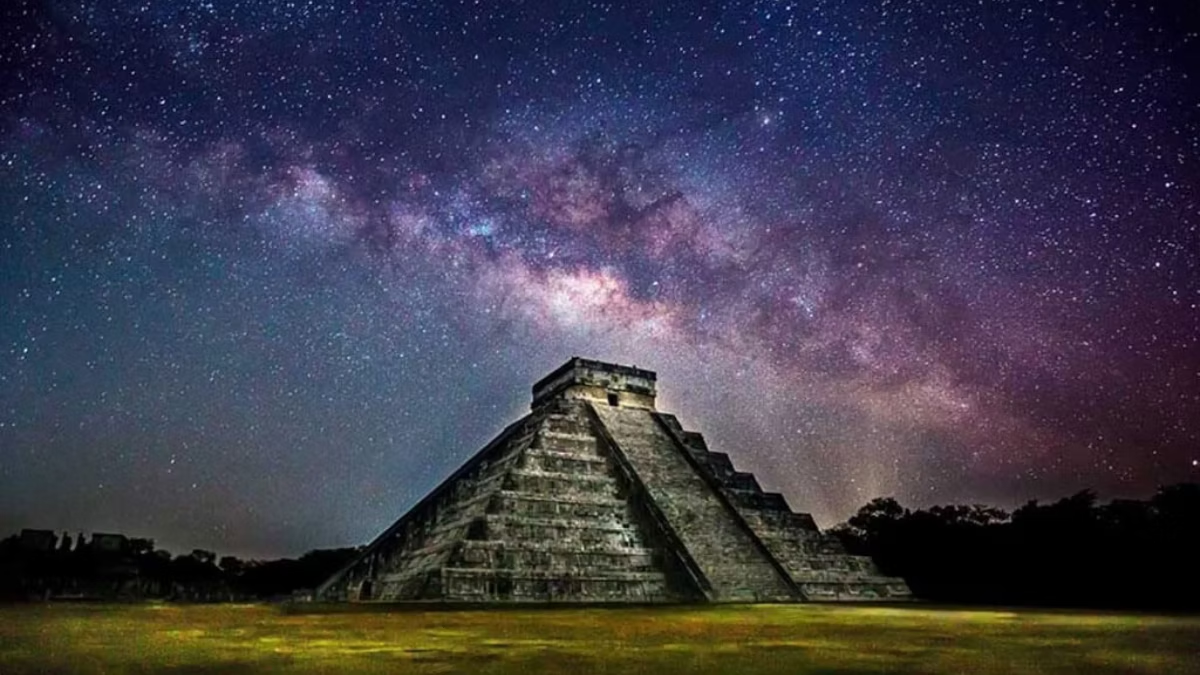
Maya astronomy was among the most sophisticated naked-eye observational sciences of the ancient world — and Chichén Itzá contains some of the most spectacular physical evidence of this tradition. Without telescopes, computers, or modern instruments, Maya astronomers tracked the sun, moon, Venus, Mars, Jupiter, and bright stars with precision that still impresses modern researchers. They developed three interlocking calendar systems (the 365-day haab’, the 260-day tzolk’in, and the Long Count), predicted lunar eclipses hundreds of years in advance, calculated Venus cycles to within minutes of modern measurements, and embedded astronomical knowledge into the architecture of their buildings. At Chichén Itzá, this astronomical tradition is embodied in: El Castillo (the pyramid whose 365 steps encode the solar year and whose equinox-shadow serpent effect has become iconic), El Caracol (the round observatory whose windows align with Venus’s extreme horizon positions, solstices, and equinoxes), and numerous secondary alignments throughout the site. The Dresden Codex (a surviving Maya astronomical manuscript preserved after the Spanish Conquest) contains Venus tables, eclipse predictions, and calendrical calculations that cross-reference with the physical alignments visible at Chichén Itzá’s buildings. The city was a working astronomical center where scientific observation, religious calendar, and political legitimacy converged — its astronomer-priests produced knowledge that justified rulership and anchored Maya cosmology.
If El Castillo is the most recognizable structure at Chichén Itzá, its encoded astronomy is the most important intellectual legacy. The Maya didn’t just build pretty pyramids — they built calculation devices, calendar monuments, and horizon markers in stone. Understanding Maya astronomy is essential for understanding why Chichén Itzá looks the way it does: almost every major building contains some astronomical orientation, symbolism, or encoded calculation.
Why astronomy mattered to the Maya
Maya astronomy wasn’t a specialized academic pursuit separate from daily life — it was foundational to every aspect of Maya civilization:
- Agriculture — knowing when to plant, burn fields, and harvest depended on precise calendar knowledge tied to the solar year and seasonal rainfall
- Religion — ceremonies had to be held on astronomically significant dates; specific gods were linked to specific celestial bodies
- Politics — rulers legitimized their authority by demonstrating astronomical knowledge (predicting eclipses and solar events)
- Warfare — military campaigns were timed to favorable Venus positions (Venus was associated with war)
- Trade — long-distance travel required knowledge of celestial navigation
- Architecture — buildings were oriented to align with astronomical events, embedding the city in cosmic order
- Mythology — creation stories in the Popol Vuh feature the Hero Twins playing ball games that parallel the movements of the sun and Venus
In a society without writing for most people (literacy was restricted to elites) and without mechanical clocks, the sky was the common reference frame for time, agriculture, religion, and identity.
The three calendar systems
The Maya used three interlocking calendar systems simultaneously. The haab’ was a 365-day solar calendar divided into 18 months of 20 days each plus a 5-day “unlucky” period — approximating the solar year. The tzolk’in (also called the Sacred Round) was a 260-day ritual calendar combining 20 day-names with 13 numbers; its origin is debated but may relate to the 9-month human gestation period, agricultural cycles, or Venus’s synodic period. The two calendars combined formed the Calendar Round of 52 years (18,980 days), the period required before a specific date in both calendars recurred. The Long Count was a linear numerical system tracking days from a mythological starting date (August 11, 3114 BCE in the Gregorian calendar) — used for historical records beyond the 52-year Calendar Round cycle. Long Count dates appear at Chichén Itzá starting with the 832 CE inscription at the Initial Series Group (the earliest dated monument) and continuing through the 998 CE inscription at the Osario temple (the latest known date). The three-calendar system was more sophisticated than any Old World calendar of the same era and allowed the Maya to track time across millennia.
The haab’ (365-day solar)
18 months × 20 days = 360 days + 5-day “Wayeb'” period (considered unlucky) = 365 days.
Each month had its own name and iconographic character. The 5-day Wayeb’ was believed to be a dangerous period when the boundary between the worlds was thin — ritual precautions were taken.
The tzolk’in (260-day ritual)
20 day-names × 13 numbers = 260 days.
Every day had both a number (1-13) and a name (e.g., Imix, Ik’, Akbal, K’an, Chikchan). The combination of number + name uniquely identified each day in the 260-day cycle. The origin of the 260-day period is debated; candidates include:
- Human pregnancy (~260 days from conception to birth)
- Maize agricultural cycle (seed to harvest in central Mexican highlands)
- Venus’s synodic period (584 days) — related through mathematical ratios
- Zenith passage interval in the tropics (the two dates when the sun passes directly overhead are about 260 days apart at certain latitudes)
The tzolk’in was used primarily for ritual, religious, and prophetic purposes — determining auspicious days for ceremonies, naming children, timing sacrifices, and divination.
The Calendar Round (52 years)
The haab’ and tzolk’in run simultaneously. Because 52 haab’ years = 73 tzolk’in cycles = 18,980 days, every 52 years a specific date in both calendars recurs. The Calendar Round was the Maya equivalent of a “century” — the primary long-period reference. Every 52 years, the calendars “reset” to the same combined date, marking a ceremonially significant moment.
The Long Count
For tracking time beyond 52 years, the Maya used the Long Count — a linear counting system from a mythological starting date (August 11, 3114 BCE in the Gregorian calendar).
Long Count units: – K’in = 1 day – Winal = 20 k’in = 20 days – Tun = 18 winal = 360 days – K’atun = 20 tun = 7,200 days (~19.7 years) – Bak’tun = 20 k’atun = 144,000 days (~394.3 years)
A Long Count date like 9.17.0.0.0 means 9 bak’tun + 17 k’atun + 0 tun + 0 winal + 0 k’in from the starting date.
Chichén Itzá’s earliest dated Long Count inscription (832 CE) is read as approximately 10.1.2.9.4 in Long Count notation.
El Castillo: the calendar in stone
El Castillo (the Temple of Kukulkán) at Chichén Itzá is the most famous example of Maya astronomical architecture, encoding the solar calendar in its physical structure. The pyramid has 4 staircases of 91 steps each (4 × 91 = 364) plus the top platform counted as one additional step, equaling 365 — the number of days in the solar year (haab’). Each side has 9 terraces bisected by the staircase, creating 18 sections — equal to the number of months in the haab’. The 52 panels on the pyramid’s sides reference the 52-year Calendar Round. Most famously, on the days around the spring and autumn equinoxes (March 20-21 and September 22-23), the setting sun casts a series of triangular shadows along the western balustrade of the northern staircase that creates the illusion of a serpent slithering down the pyramid — interpreted as the feathered serpent god Kukulkán descending from the sky to the earthly realm. The effect is visible for several weeks around each equinox (most dramatic during the 4-5 PM window on the actual equinox day), drawing tens of thousands of visitors. Modern scholars note the effect can be observed across several weeks, making it unlikely that El Castillo was specifically designed to mark the equinox — but the astronomical resonance remains meaningful regardless of original intent.
The 365-step encoding
This is the most commonly cited fact about El Castillo. Count the steps on all four staircases:
- North staircase: 91 steps
- South staircase: 91 steps
- East staircase: 91 steps
- West staircase: 91 steps
- Total: 4 × 91 = 364 steps
- Plus the top platform: +1 = 365 steps = one solar year
This encoding is visually confirmable and is the most striking example of Maya calendar knowledge expressed through architecture.
The 18 terraces (months)
The pyramid has 9 stepped terraces on each face, bisected by the staircase — making 18 terrace sections per face. 18 = the number of named months in the haab’ calendar (the 19th period being the 5-day Wayeb’).
The equinox serpent shadow
The most famous visual spectacle at Chichén Itzá:
What happens: As the sun sets on the day of equinox (or days near it), sunlight strikes the northwest corner of the pyramid at a specific angle. The 9-terrace corner casts a series of triangular shadows onto the western side of the northern staircase balustrade. The balustrade itself ends in a carved serpent head at ground level. Together, the shadow triangles on the balustrade and the serpent head appear to form a complete serpent undulating down the pyramid from sky to earth.
When: March 20-21 (spring equinox) and September 22-23 (autumn equinox), approximately 4:30-5:10 PM for the peak effect. Visible (with less dramatic effect) for several weeks around each date.
Why: Commonly interpreted as Kukulkán descending from the sky — a visual manifestation of the feathered serpent deity entering the earthly realm. In Maya religious logic, this would be the moment when Kukulkán blessed the city and its rulers.
The skeptical view: Modern scholarship notes that the effect is visible across several weeks, not exclusively on the equinox. The pyramid may have been oriented for religious reasons that coincidentally produce this effect around the equinox. Whether the serpent shadow was deliberately engineered or emerged as a secondary effect of religious orientation is debated — but the visual impact is genuine regardless.
Inner chamber astronomy
The inner chamber of El Castillo (now closed to visitors since 2006) contained a red Jaguar Throne with jade-inlaid spots — representing a night-sky-like pattern. The throne’s orientation and the inner chamber’s positioning have been analyzed for astronomical significance, though conclusions are less certain than for the exterior alignments.
El Caracol: the observatory
El Caracol (“The Snail”) is the dedicated astronomical observatory at Chichén Itzá — a round tower approximately 22.5 meters (75 feet) tall built around 906 CE on a large rectangular platform. The structure is named for its spiral staircase inside the tower (caracol = snail/spiral in Spanish). The landmark 1975 study by archaeoastronomer Anthony Aveni published in the journal Science demonstrated that 20 of 29 astronomically significant alignments can be found in the structure’s architecture. The most important alignments are to Venus — the tower’s viewing windows align with Venus’s extreme northern and southern horizon positions, enabling observers to track the planet’s 8-year return cycle (5 Venus synodic cycles of 584 days = 8 solar years of 365 days). Other alignments include summer and winter solstice sunrise/sunset positions (along the building’s NE-SW diagonal) and approximate equinox sunset (through Window I). El Caracol is uniquely purpose-built for astronomy — other Chichén Itzá structures incorporate astronomical alignments alongside ceremonial functions, but El Caracol was designed primarily as an observational instrument. The tower’s location in the southern section of the site and its round architectural form (rare in Maya building) set it apart from every other structure at Chichén Itzá.
Why a flat landscape needed artificial horizon markers
The Yucatán Peninsula is extraordinarily flat — no mountains, few hills, minimal natural horizon markers. In other civilizations (Greek, Egyptian, Inca), astronomers used natural features as reference points for where the sun or Venus rose on specific dates. The Maya had no such features near Chichén Itzá.
El Caracol’s solution: artificial horizon markers built in stone. A narrow window cut at a specific compass bearing creates a permanent, reliable “sightline” that produces consistent astronomical data across seasons and decades.
Venus tracking
Venus was the most intensively tracked planet in Maya astronomy:
- Synodic period (apparent cycle): 584 days — the time from one Venus-as-morning-star appearance to the next
- 5 cycles = 8 solar years — 5 × 584 = 2,920 days = 8 × 365 — mathematically exact coincidence that allowed long-term prediction
- Northern and southern extremes — Venus rises and sets at points along the horizon that vary seasonally, reaching maximum northern and southern positions about every 8 years
- Religious significance — identified with Kukulkán/Quetzalcoatl; associated with warfare, transformation, and the cycle of life
- Dresden Codex — contains extensive Venus tables predicting positions across centuries with stunning accuracy
The Aveni study
Anthony Aveni’s 1975 paper in Science, based on field measurements of El Caracol’s alignments, established the observatory’s astronomical function rigorously. Key conclusions:
- Venus alignments at extreme horizon positions are the most strongly supported
- Solstice alignments along the building’s NE-SW diagonal are clear
- Equinox alignment through Window I is approximate, not exact
- Individual star alignments are weak evidence (too many bright stars to rule out coincidence)
- The building was designed as an observatory, not retrofitted into one
Aveni’s work remains the authoritative archaeoastronomical analysis of El Caracol.
The Dresden Codex
The Dresden Codex is one of only four surviving pre-Hispanic Maya books (most were burned by Spanish priests after the Conquest). Dating from approximately the 11th-12th centuries CE, it contains:
- Venus tables — 65 pages tracking Venus positions over multiple 584-day cycles
- Lunar eclipse tables — predicting lunar eclipses up to 33 years in advance
- Agricultural and ritual calendars — ceremonial days and associated deities
- Astronomical cycles for multiple planets
- Hieroglyphic prayers and invocations accompanying the tables
The Codex was likely produced at or near Chichén Itzá or a related northern Yucatán center during the city’s peak. It cross-references with El Caracol’s physical alignments: the same Venus cycles tracked by the codex’s tables are the cycles the observatory was designed to monitor. The codex is mathematical; the observatory is physical; together they represent two halves of a single astronomical system.
The codex is preserved today at the Saxon State Library in Dresden, Germany, where it has been housed since 1739.
Other astronomical alignments at Chichén Itzá
Beyond El Castillo and El Caracol, astronomical orientations are found throughout the site:
The Sacred Cenote axis
The 300-meter sacbe (raised causeway) from El Castillo to the Sacred Cenote runs approximately north-south — loosely aligned with astronomical cardinal directions. The cenote’s position north of the main plaza places it in the celestial sphere’s “watery underworld” direction in Maya cosmology.
The Great Ball Court orientation
The Great Ball Court’s long axis runs approximately north-south, aligning with cardinal directions and placing sunset/sunrise events visible along the playing alley at specific dates.
Temple of the Warriors
The Temple of the Warriors faces west — the direction of the setting sun, the descent of the sun-god into the underworld, and the direction associated with death in Maya cosmology. This orientation is religious rather than specifically astronomical, but reflects the integration of cosmology into architecture.
Osario (High Priest’s Grave)
The Osario temple contains the latest dated inscription at Chichén Itzá (998 CE) and shows astronomical alignments similar to El Castillo’s on a smaller scale. Archaeologists have identified it as a “mini El Castillo” with related calendar encoding.
El Castillo’s shadow observations (beyond the equinox)
While the equinox serpent is the famous effect, El Castillo’s shadow also marks:
- Solstices — at dawn on summer solstice and sunset on winter solstice, shadows fall at specific angles
- Zenith passage dates — when the sun is directly overhead (no shadow cast at all)
- Other calendar dates — various intermediate positions during the year
The pyramid was effectively a year-round calendar observation tool, not just an equinox monument.
The political function of astronomy
Maya rulers used astronomy to demonstrate divine authority and legitimacy:
- Predicting eclipses proved the ruler was in contact with cosmic forces
- Timing ceremonies correctly required specialist astronomical knowledge controlled by the elite
- Calendar knowledge was restricted — access to accurate calendars reinforced elite authority
- Dynastic dates carved on monuments placed individual rulers in cosmic time
- Architectural alignments physicalized the ruler’s connection to celestial order
When a Chichén Itzá ruler commissioned El Castillo or El Caracol, he wasn’t just building a pretty monument — he was creating a physical demonstration of his cosmic authority. The buildings were political instruments as much as religious or scientific ones.
What the Maya knew and didn’t know
What they knew
– Sun’s apparent horizon motion through the year with ±1 day accuracy on key dates – Lunar phases and synodic period (29.5 days) – Venus synodic period (584 days) with high precision – Lunar eclipse cycles — predictable hundreds of years in advance – Solar eclipse possibility — when they might occur (not always where) – Mars and Jupiter cycles — tracked less documented – Bright star risings and settings at specific seasonal markers
What they didn’t know
– Heliocentric model — they assumed Earth was the center – Actual distances to planets and stars – Nature of stars as distant suns – Physical causes (no gravity theory) – Telescopic detail — all observations naked-eye
What they did with it
– Calibrated calendars accurately – Predicted astronomical events for political and religious purposes – Timed agriculture, ceremonies, and warfare – Aligned buildings with cosmic order – Built stone monuments that still function as astronomical instruments today
The Maya accomplished all of this without metal tools, without telescopes, without numerical notation systems used elsewhere in the ancient world (though they developed their own positional notation including zero). Their astronomical tradition is among humanity’s great intellectual achievements.
How to observe Maya astronomy at Chichén Itzá today
For the equinox serpent shadow
– Dates: March 20-21 or September 22-23 (closest to actual equinox) – Time: 4:30-5:10 PM (sunset approach) – Position: North side of El Castillo, west balustrade of the northern staircase – Crowds: Extreme — tens of thousands of visitors come specifically for this – Alternative: Dates ±2 weeks show a less dramatic version of the effect with far fewer crowds
For El Caracol
– Walk to the southern section of the site – Examine the rectangular base and the round tower – Note the NE-SW diagonal alignment of the corners (solstice alignment) – Look at the surviving window slits in the upper tower – The structure’s orientation and windows communicate astronomical function visually
For the broader astronomical context
– Visit El Castillo’s four staircases and count the steps (91 each) – Examine the 52 panels visible on the pyramid’s sides – Notice El Castillo’s orientation relative to the Sacred Cenote — the cenote is roughly north of the pyramid – Observe where the sun is relative to major structures at different times of day
Quick reference
| Detail | Value |
|---|---|
| Haab' calendar | 365 days (18 × 20 + 5) |
| Tzolk'in calendar | 260 days (20 day-names × 13 numbers) |
| Calendar Round | 52 haab' years = 18,980 days |
| Long Count start | August 11, 3114 BCE |
| Earliest Chichén Itzá Long Count | 832 CE |
| Latest Chichén Itzá Long Count | 998 CE |
| El Castillo total steps | 365 (91 × 4 staircases + 1 top platform) |
| El Castillo terraces | 9 per side (= 18 sections bisected by staircase) |
| Equinox serpent dates | March 20-21; September 22-23 |
| Equinox peak time | 4:30-5:10 PM |
| El Caracol built | ~906 CE |
| El Caracol total sightlines | 20 of 29 possible astronomical events |
| Venus synodic period | 584 days |
| Venus-solar ratio | 5 Venus cycles = 8 solar years |
| Dresden Codex location | Saxon State Library, Dresden, Germany |
| Key academic source | Aveni 1975 (Science journal) |
Frequently Asked Questions
Why did the Maya study astronomy?
Astronomy was foundational to Maya civilization. It enabled agricultural planning (when to plant and harvest), religious timing (when to hold ceremonies), political legitimacy (rulers who could predict eclipses held divine authority), warfare timing (Venus positions were auspicious/inauspicious for war), architectural alignment (buildings oriented to cosmic order), and calendar accuracy (the basis of all social and economic life). Without mechanical clocks or written records accessible to most people, the sky was the primary reference frame for time and identity.
How many calendars did the Maya use?
Three interlocking systems: – Haab’ — 365-day solar calendar (18 months × 20 days + 5 days) – Tzolk’in — 260-day ritual calendar (20 day-names × 13 numbers) – Long Count — linear numerical system from a mythological starting date The haab’ and tzolk’in combined formed the 52-year Calendar Round. The Long Count allowed tracking of time beyond the Calendar Round cycle.
What is the Tzolk’in calendar?
A 260-day ritual calendar used primarily for religious, ceremonial, and prophetic purposes. Each day had both a number (1-13) and a name (from 20 day-names). The 260-day period’s origin is debated — candidates include human pregnancy duration, maize agricultural cycle, Venus synodic period (584 days), or the interval between solar zenith passages at tropical latitudes. The tzolk’in was used for naming children, timing ceremonies, and divination — a “sacred time” running parallel to the secular haab’ calendar.
What is El Castillo’s astronomical significance?
El Castillo encodes the Maya solar calendar in its physical structure: – 365 steps (4 staircases × 91 + 1 top platform) = days in the solar year – 18 terrace sections = months in the haab’ – 52 panels on the pyramid’s sides = years in the Calendar Round – Equinox serpent shadow = the feathered serpent Kukulkán descending from the sky to earth on the days of equinox The pyramid functions as a three-dimensional calendar that was both a religious monument and an architectural expression of Maya time-keeping knowledge.
What causes the equinox shadow serpent effect?
The angle of the setting sun relative to the pyramid’s northwest corner on the days of equinox (March 20-21 and September 22-23) creates triangular shadows cast by the 9-terrace corner onto the western side of the northern staircase balustrade. The balustrade ends in a carved serpent head at ground level. Together, the shadow triangles and the serpent head appear to form a complete undulating serpent descending the pyramid. The effect is visible for several weeks around each equinox, with peak drama at sunset (approximately 4:30-5:10 PM) on the equinox itself.
When is the best time to see the equinox serpent?
Spring equinox (March 20-21) or autumn equinox (September 22-23), approximately 4:30-5:10 PM for peak effect. The spring equinox is far more popular than the autumn one due to weather and tourism patterns. Crowds are extreme on equinox days — tens of thousands of visitors arrive specifically for this event. For a less crowded experience, visit within 2 weeks before or after the equinox date: you’ll see a less dramatic but still visible version of the effect.
What is El Caracol’s role in Maya astronomy?
El Caracol was the dedicated astronomical observatory at Chichén Itzá. Built around 906 CE, its round tower contains viewing windows aligned with Venus’s extreme horizon positions, solstices, and equinoxes. The 1975 Aveni study in *Science* identified 20 of 29 astronomically significant alignments in the structure. El Caracol was purpose-built for observation — unlike other Chichén Itzá structures with ceremonial functions, this building’s primary purpose was scientific.
Why was Venus so important to the Maya?
Venus was the most important celestial body after the sun and moon in Maya religion. Reasons include: (1) Venus is the brightest object in the night sky (visible even through cloud cover); (2) its 225-day synodic cycle is predictable with naked-eye observation; (3) the god Kukulkán (feathered serpent) was specifically associated with Venus as the morning star; (4) Venus positions were considered auspicious/inauspicious for warfare — Maya rulers timed military campaigns to specific Venus phases; (5) the 5-to-8 ratio (5 Venus cycles = 8 solar years) allowed long-term calendrical prediction.
What is the Dresden Codex?
One of only four surviving pre-Hispanic Maya books (most were burned by Spanish priests after the Conquest). Dating from ~11th-12th centuries CE, the Dresden Codex contains Venus tables, lunar eclipse predictions, agricultural and ritual calendars, and astronomical cycles for multiple planets. It’s likely produced at or near Chichén Itzá during the city’s peak. The codex is preserved today at the Saxon State Library in Dresden, Germany. It cross-references with El Caracol’s physical alignments — the mathematical tables match the observational alignments of the observatory.
Could the Maya predict eclipses?
Yes — lunar eclipses especially, with remarkable accuracy. The Dresden Codex contains lunar eclipse tables predicting eclipses up to 33 years in advance. This was achieved through long-term observation and mathematical pattern recognition — by recording eclipse events across many generations, Maya astronomers identified that lunar eclipses occur on an approximately 18-year cycle (known as the Saros cycle in Western astronomy, though the Maya had their own terminology). Solar eclipses were harder to predict precisely because they’re visible only from specific geographic areas, but the Maya knew the possibility window for each.
What’s the 365-step calendar encoding on El Castillo?
Count the steps: 4 staircases × 91 steps per staircase = 364 steps. Plus the top platform as one additional step = 365 total steps = one solar year. This encoding is visually confirmable — you can count the steps on any side of the pyramid. It’s the most striking example of Maya calendar knowledge expressed architecturally.
Did the Maya know the Earth was round?
They didn’t conceptualize the Earth the way modern science does. Maya cosmology viewed the world as a multi-layered cosmos with an upper sky realm, a flat earthly middle realm, and a lower underworld (Xibalba). The flat earthly realm was typically shown resting on the back of a turtle in creation imagery. Whether individual Maya astronomers had developed theoretical insights about Earth’s shape beyond this cosmological model is unclear — their naked-eye astronomy worked perfectly well within a geocentric flat-earth framework for practical prediction.
What’s the “Long Count” calendar?
A linear numerical counting system tracking days from a mythological starting date (August 11, 3114 BCE in the Gregorian calendar). Unlike the cyclical haab’ and tzolk’in calendars, the Long Count progresses continuously — making it useful for historical dates beyond the 52-year Calendar Round cycle. Units: k’in (day), winal (20 days), tun (360 days), k’atun (~19.7 years), bak’tun (~394.3 years). Chichén Itzá’s earliest dated Long Count inscription is 832 CE; the latest is 998 CE (at the Osario temple).
Why do the Maya calendar systems still work today?
Because they’re based on astronomical observations (solar year, lunar cycles, Venus positions) that continue to occur in the same way today. The Maya calendars aren’t arbitrary — they’re empirical measurements of recurring celestial phenomena. Modern astronomers can cross-reference Maya Long Count dates with Gregorian dates with great precision because the underlying astronomical events (solstices, equinoxes, eclipses) are continuous. This is why the 2012 Long Count “end date” generated so much attention — it marked the end of the 13th bak’tun cycle, though the Maya themselves didn’t interpret this as an apocalyptic endpoint (despite modern misinterpretations).
Were the Maya more advanced in astronomy than ancient Europeans?
In some specific respects, yes. Pre-Columbian Maya astronomy exceeded contemporary European astronomy in: Venus tracking precision (Maya Venus tables are more accurate than any European Venus tables of the same era); lunar eclipse prediction (the Dresden Codex tables predict eclipses more accurately than European calendars before the 16th century); and calendar integration (the three-calendar Maya system was more sophisticated than the Julian calendar used in Europe during the same period). However, European astronomy had other strengths — particularly the theoretical/mathematical tradition from ancient Greek astronomy that the Maya lacked. It’s not a simple “more/less advanced” comparison; each tradition had distinct strengths.
What should I look for at Chichén Itzá to see Maya astronomy?
Four things to examine: 1. El Castillo’s 365 steps — count them on any staircase 2. El Castillo’s equinox shadow — visit during equinox weeks to see the serpent effect 3. El Caracol’s orientation — note the round tower and rectangular base, the NE-SW diagonal alignment 4. Overall site orientation — notice how major structures relate to cardinal directions and to each other Even on a brief visit, these four observations demonstrate how Maya astronomical knowledge is embedded in the architecture you’re seeing.
Is there anywhere I can see original Maya astronomical texts?
The Dresden Codex is at the Saxon State Library in Dresden, Germany (not on public display typically, but high-resolution digital images are widely available). The other three surviving Maya codices are at: Madrid (Madrid Codex), Paris (Paris Codex), and Mexico City (Grolier Codex/Mexico Codex). The Great Museum of Chichén Itzá (opened 2025) includes astronomical and calendrical exhibits interpreting Maya astronomical knowledge for general audiences. Educational programs at universities with Mesoamerican archaeology departments also offer courses and materials on Maya astronomy.
