

The Great Ball Court Chichén Itzá 2026: Dimensions, Acoustics, Maya Game
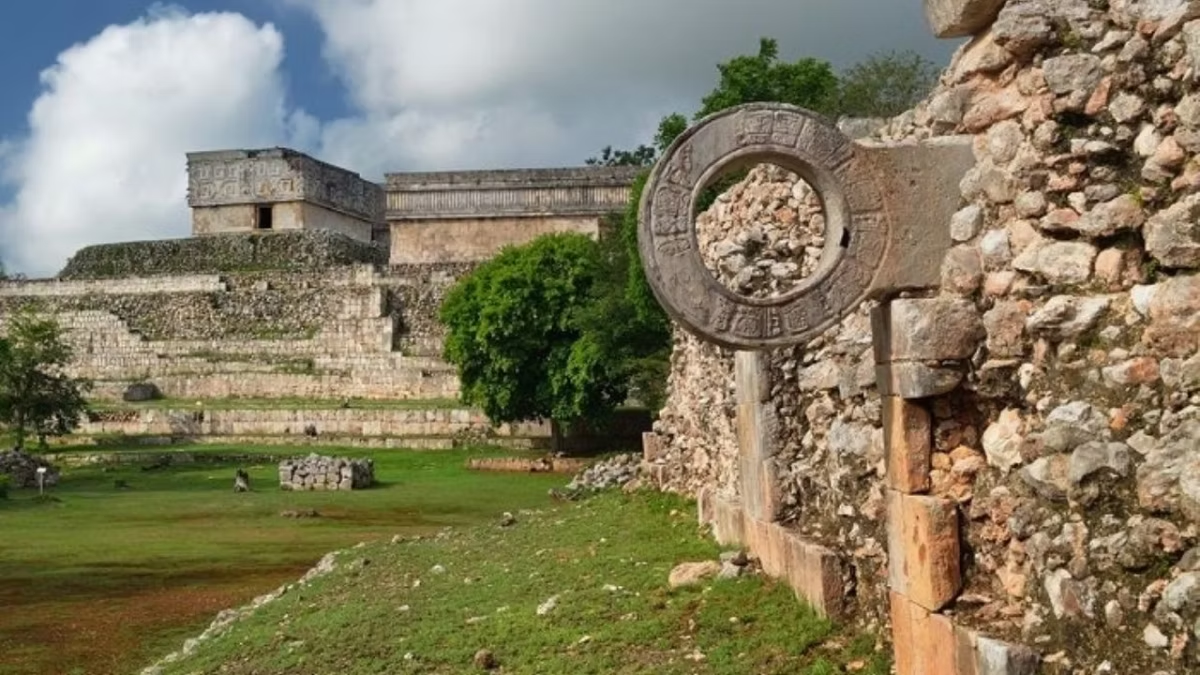
The Great Ball Court (Spanish: Gran Juego de Pelota) at Chichén Itzá is the largest Mesoamerican ball court ever built — measuring 168 meters long by 70 meters wide (551 × 230 feet) with parallel stone walls 8 meters (26 feet) high. Built around 900–1000 CE, it was one of at least thirteen ball courts at Chichén Itzá and the ceremonial centerpiece where the Maya ball game (Pitz or Pok-a-Tok) was played with a solid rubber ball. The court is famous for its remarkable acoustics: a whisper at one end can be heard clearly 135 meters away at the other, and a handclap produces distinctive echoes — a phenomenon studied by conductor Leopold Stokowski in 1931 in an attempt to replicate it for modern theater design (he failed). The vertical walls feature bas-relief carvings showing ball players, ceremonial scenes, and the ritual sacrifice of losing players. Two carved stone rings mounted six meters up on opposite walls served as goals. Flanking the court are the Temple of the Bearded Man (North Temple), Temple of the Jaguars (eastern side), and South Temple. The Great Ball Court sits approximately 150 meters northwest of El Castillo and is typically the second stop on any Chichén Itzá guided tour.
The Great Ball Court isn’t just a sports venue — it was a ceremonial space where the Maya enacted a cosmological drama they considered essential to the continued existence of the world. The game symbolized the mythic battle between day and night, life and death, with outcomes that determined whether the sun would rise again. Standing at the center of the court today, looking at the 8-meter walls, the 6-meter-high stone rings, and the carved panels showing decapitated players, you’re looking at the largest ritual arena the Maya ever built — and one where the line between sport and sacrifice was deliberately blurred.
The Architecture: Dimensions and Layout
At 168m × 70m, the Great Ball Court is the largest ball court ever discovered in Mesoamerica. For comparison, it’s approximately 2.2 times the size of an American football field. The next-largest known ball court is at El Tajín in Veracruz; the smallest known Mesoamerican ball court at Tikal is roughly one-sixth the size of this one.
| Feature | Detail |
|---|---|
| Overall length | 168 meters / 551 feet |
| Overall width | 70 meters / 230 feet |
| Wall height | 8 meters / 26 feet |
| Court shape | “I” shape — central corridor + two lateral end zones |
| Platform length (each side) | 95 meters / 312 feet |
| Ring height above playing alley | 6 meters / 20 feet |
| Wall construction | Vertical stone, lined with bas-relief panels |
| Orientation | Roughly north-south |
| Ring diameter | Slightly larger than the ball |
| Approximate completion | 900–1000 CE |
The court’s “I” shape (common to Mesoamerican ball courts) consists of a long central playing alley flanked by two parallel stone platforms, with smaller perpendicular end zones creating the characteristic shape. The walls are vertical rather than sloping — a distinctive feature of the largest Classic-era ball courts, including those at El Tajín. Sloping walls are more common in smaller regional ball courts.
The Ring Goals
Two stone rings, each decorated with carved feathered serpents (representing Kukulkán), are mounted high on the middle of each long wall. The rings are only slightly larger than the rubber ball they were designed to admit, making scoring extraordinarily difficult — historians believe successfully putting the ball through a ring was a rare event, possibly ending the game immediately.
The rings’ height (6 meters / 20 feet above the playing surface) is one reason players couldn’t use their hands; the ball had to be propelled upward from the hip or thigh with enough force to reach the ring.
The Maya Ball Game
The Maya ball game played at the Great Ball Court was called Pitz in Classic Maya (later known by various names including Pok-a-Tok and Ulama in Nahuatl descendants still played today). It used a solid rubber ball weighing up to 4 kilograms (9 pounds) and roughly the size of a volleyball. Players could propel the ball only with their hips and thighs — not hands or feet — wearing heavy protective padding on the hips, knees, and forearms. The exact scoring rules are lost to time, but we know from carved reliefs and the Popol Vuh (Maya creation epic) that the game had profound ceremonial meaning, symbolizing the mythic battle between light and darkness, life and death. Games could be played one-on-one, in pairs, or in teams, and some concluded with ritual sacrifice of players — though archaeologists debate whether the winning or losing team was sacrificed, and whether this occurred in every game or only in specific ceremonial matches.
What We Know About the Rules
- Ball: Solid rubber, up to 4 kg (9 lbs), roughly volleyball-sized
- Body contact: Hips, thighs, sometimes shoulders and forearms — never hands or feet once the ball was in play
- Start of play: The ball was thrown into the court by hand
- Team size: Variable — 1-on-1, 2-on-2, or larger teams depending on the specific game
- Scoring: Likely points for keeping the ball in play; automatic victory for putting the ball through a ring (extraordinarily rare)
- Duration: Unknown, possibly dawn-to-dusk for ceremonial games
- Fouls: Using hands or feet, letting the ball leave the court
- Equipment: Heavy hip protectors (yokes), knee pads, and sometimes helmets
What We Don’t Know
The precise scoring system, the exact duration of matches, how winners were determined in non-ring games, and the selection criteria for sacrificial games all remain unknown. The Popol Vuh provides mythological context but not technical rules. Archaeological evidence comes primarily from carved reliefs, which show game action without explaining the underlying rules.
The Acoustic Phenomenon
The Great Ball Court exhibits an extraordinary acoustic phenomenon: a whisper at one end of the 168-meter court can be clearly heard at the opposite end, and a handclap in certain positions produces distinctive echoes and reverberations. The sound waves are reportedly unaffected by wind direction, time of day, or weather. In 1931, the legendary conductor Leopold Stokowski spent four days at the site attempting to analyze the acoustic principles for use in a proposed outdoor theater — he was unable to replicate the effect with modern engineering. The acoustic phenomenon is most pronounced from the North Temple (Temple of the Bearded Man) at one end, where elite observers could hear activity across the entire court. The specific acoustic principles involved are still not fully understood, though modern researchers have proposed explanations involving the height and spacing of the walls, the precise limestone composition, and possible intentional engineering by Maya architects.
What the Acoustics Actually Do
Standing at the Great Ball Court today, visitors experience multiple distinct acoustic effects:
- Long-distance speech transmission — A voice at the North Temple can be heard clearly at the South Temple 135+ meters away
- Handclap echo — Clapping at specific points produces rapid multi-echo returns
- Directional acoustics — Sound travels along the court length better than across it
- Elevated listening advantage — The North Temple’s raised position gives privileged acoustic access
These effects make guided tours of the court particularly memorable — many guides will demonstrate the phenomenon by clapping or speaking from specific positions.
The Stokowski Expedition
Leopold Stokowski was conductor of the Philadelphia Orchestra and one of the most innovative figures in 20th-century music. In 1931, he visited Chichén Itzá specifically to study the Great Ball Court’s acoustics, hoping to apply the principles to an open-air concert venue he was designing. He spent four days at the site with acoustic measuring equipment — and left unable to explain how the Maya had achieved the effect. Nearly a century later, the acoustic engineering behind the court remains only partially understood.
The Bas-Relief Carvings
The vertical walls of the Great Ball Court are lined with carved stone panels showing ball players, ceremonial scenes, and — most dramatically — the ritual sacrifice of a player. Six long panels (three on each wall) depict various stages of the ball game and its religious context.
The Sacrifice Scene
The most famous panel shows a decapitated player kneeling with blood represented as seven serpents emerging from the severed neck. This image is interpreted multiple ways:
- Literal representation of ritual sacrifice following a specific game
- Cosmological symbol of life force transferring between worlds
- Metaphor for the game’s symbolic battle between life and death
- Propaganda — reminder of consequences to opposing teams
Most modern archaeologists accept that some ball games ended with player sacrifice, but the precise circumstances (winner vs. loser sacrificed, frequency, specific ceremonies) remain debated.
Other Carvings
Beyond the sacrifice scene, the panels show:
- Ball players in full protective gear
- Elite spectators in ceremonial dress
- Ball game equipment — rubber balls, yokes, protective pads
- Feathered serpents (Kukulkán) at the end of each panel
- Glyph inscriptions (partially decipherable)
The Surrounding Structures
The Great Ball Court is part of a broader architectural complex with four associated structures:
North Temple (Temple of the Bearded Man)
- Small elegant three-tier building at the court’s north end
- Flanked by two large columns
- Inside features murals with reliefs of bearded men (unusual in Maya art) — hence the name
- Functioned as an elite viewing platform overlooking the court
- The North Temple is where the acoustic phenomenon is most pronounced
Temple of the Jaguars (Eastern Side)
- Two-story structure on the eastern side of the court
- Lower level faces the Great Plaza and Platform of the Skulls
- Upper level faces the ball court itself
- Inside: a jaguar throne (hence the name)
- Elite viewing vantage point for royalty and nobility
South Temple
- Large temple at the southern end of the court
- Currently in ruins — far less restored than other Ball Court structures
- Its original condition would have mirrored the North Temple’s architectural elegance
Platform of the Skulls (Tzompantli)
- Directly adjacent to the Ball Court (just south)
- Features carved rows of skulls
- Dedicated article on Tzompantli: Wall of Skulls covers this structure in depth
Why This Court and Not Another
Chichén Itzá contains at least thirteen ball courts (some sources say up to seventeen) — the Great Ball Court is just the largest. The others are scattered throughout the site, often smaller and less elaborately decorated. This concentration of ball courts at a single site is exceptional; most Maya cities had only one or two.
Why so many? Theories:
- Specialized uses — different ball courts for different ceremonies, seasons, or social classes
- Political demonstrations — each ruler built a ball court to commemorate their reign
- Religious specialization — specific deities associated with specific courts
- Training vs. ceremonial — smaller courts for practice, Great Ball Court for major events
The Great Ball Court’s size — 6× larger than the next-largest court at Chichén Itzá — strongly suggests it was reserved for the most significant ceremonial matches, possibly the state’s highest-profile religious events.
How the Ball Game Fit Into Maya Cosmology
The Maya ball game was fundamentally a cosmological ritual, not merely a sport. In Maya belief, the movement of the rubber ball through space symbolized the movement of the sun and moon across the sky — the eternal battle between day and night, life and death, order and chaos. When the ball was kept in play, the cosmos remained in balance; when it fell to the ground, it represented a cosmic disruption. The Popol Vuh (the Maya creation epic) features the Hero Twins Hunahpú and Xbalanqué, who play ball games against the Lords of Xibalba (the underworld) in a confrontation that determined the fate of humanity. For the Maya, ceremonial ball games recreated this mythic drama — the players weren’t just athletes but ritual participants in a cosmic performance. This is why sacrifice could be part of the ceremony: the game’s outcome wasn’t separate from religious meaning but central to it.
When to Visit
- For minimum crowds: Early morning (8:00–9:30 AM) — you’ll reach the Ball Court within 15–20 minutes of gate opening
- For best acoustics demo: Mid-morning with a guide who knows the demonstration positions
- For photography: Morning light (8:00–10:00 AM) — sun from the east lights the western wall panels clearly
- Peak congestion time: 10:30 AM – 1:00 PM (tour bus wave)
- For shadow avoidance in photos: Late afternoon (after 3:00 PM) — less harsh overhead sun
Most guided tours allocate 15–25 minutes at the Great Ball Court, typically rushed. Serious visitors should plan 30–45 minutes.
How to Appreciate the Court During Your Visit
A methodical approach:
- Enter the court from the main path and walk to the center of the playing alley
- Look up at both rings — note they’re slightly larger than a volleyball, 6 meters up
- Walk to the panels on each side — examine the ball-player carvings, including the sacrifice scene
- Position yourself at the North Temple base — the best acoustic spot
- Try the acoustic demo — have a companion walk to the far end; speak at normal volume; they should hear you clearly
- Clap your hands sharply from various positions — listen for the echo
- Walk up to the Temple of the Jaguars (if open) on the eastern side
- Observe the South Temple ruins at the far end
- Take in the scale — stand at one end and try to comprehend the 168-meter length
Most visitors rush through in under 15 minutes. Allowing 30–45 minutes transforms the visit.
What You Can’t Do (But Might Want To)
- Climb onto the court structure — walking on the central corridor is allowed; climbing the walls, platforms, and temples is prohibited
- Enter the Temple of the Jaguars — periodically closed for preservation
- Get close to the bas-relief panels — roped barriers keep you 1–2 meters back
- Use drones — all drone photography banned site-wide
- Play the ball game — no live recreations on the actual court
Some modern recreations of the Maya ball game occur at Yucatán festivals and cultural events, particularly in Mérida, but not at Chichén Itzá itself.
Quick Reference
| Detail | Value |
|---|---|
| Structure name | The Great Ball Court (Gran Juego de Pelota) |
| Size | 168m × 70m (551 × 230 ft) — largest in Mesoamerica |
| Wall height | 8m / 26 ft |
| Ring height | 6m / 20 ft above playing alley |
| Game played | Pitz (also called Pok-a-Tok) |
| Ball | Solid rubber, up to 4 kg |
| Body contact rule | Hips and thighs only — no hands or feet |
| Acoustic phenomenon | Whisper carries 135+ meters end-to-end |
| Notable visitor | Leopold Stokowski, 1931 |
| Associated structures | North Temple, Temple of the Jaguars, South Temple |
| Typical tour allocation | 15–25 minutes (recommend 30–45) |
| Approximate age | Built ~900–1000 CE |
Frequently Asked Questions
How big is the Great Ball Court at Chichén Itzá?
168 meters long by 70 meters wide (551 by 230 feet), with stone walls 8 meters (26 feet) high. It’s the largest ball court ever built in Mesoamerica — approximately 2.2 times the size of an American football field. The next-largest known Mesoamerican ball court is at El Tajín in Veracruz.
Why is the Great Ball Court acoustically famous?
A whisper spoken at one end of the 168-meter court can be heard clearly at the opposite end, and handclaps produce distinctive echoes. The acoustic phenomenon has been studied since 1931, when conductor Leopold Stokowski spent four days at the site attempting to replicate the effect for theater design — he failed. The engineering principles behind the acoustics are still not fully understood today.
What was the Maya ball game called?
Pitz in Classic Maya; also known as Pok-a-Tok or Ulama in later terminology. It was played with a solid rubber ball weighing up to 4 kg (9 lbs) — roughly volleyball-sized. Players used hips and thighs only; hands and feet couldn’t touch the ball once play began.
Were losers of the ball game sacrificed?
Probably yes, in some ceremonial games — but archaeologists debate whether winners or losers were sacrificed, and whether every game ended with sacrifice or only specific ritual matches. The bas-relief carvings on the court walls clearly show a decapitated player with seven serpents emerging from the neck as blood, confirming that sacrifice was at least associated with the game. The precise frequency and circumstances remain debated.
How was the ball game played?
Teams (size varied from 1-on-1 to larger groups) propelled a solid rubber ball through the court using only their hips and thighs — hands and feet were forbidden once the ball was in play. Players wore heavy padding to protect from the 4 kg ball. Points were likely scored by keeping the ball in play; putting the ball through one of the 6-meter-high stone rings was likely an automatic win, though this was extraordinarily rare.
Can you still see the stone rings at the Great Ball Court?
Yes. The two stone rings — carved with feathered serpents (representing Kukulkán) — are still mounted on opposite walls, 6 meters up from the playing alley. They’re visible from anywhere inside the court.
Where is the Great Ball Court at Chichén Itzá?
Approximately 150 meters northwest of El Castillo, accessible via the main path from the site entrance. It’s typically the second stop on guided tours after El Castillo, and you can’t miss it — the 8-meter walls are visible from the central plaza.
How many ball courts are at Chichén Itzá total?
At least 13 (some sources say up to 17). The Great Ball Court is just the largest; the others are smaller, scattered throughout the site, and less elaborately decorated. This concentration of ball courts at a single site is exceptional — most Maya cities had only one or two.
Can you climb or walk on the Great Ball Court?
You can walk through the central playing alley (the long corridor between the walls). You cannot climb the walls, platforms, temples, or any architectural features. Ropes and signs mark the permitted visitor paths.
What are the bas-relief carvings on the walls?
Carved stone panels showing ball players, ceremonial scenes, game equipment, and — most famously — the ritual sacrifice of a player with seven serpents emerging from a decapitated neck. Six long panels (three on each wall) depict various stages of the ball game. Feathered serpents (Kukulkán) appear at the end of each panel.
What’s the Temple of the Bearded Man?
The North Temple at the far end of the Great Ball Court. Its interior features bas-relief murals showing bearded men — unusual in Maya art, which typically depicts clean-shaven figures — hence the “Bearded Man” name. The temple functioned as an elite viewing platform; it’s also where the acoustic phenomenon is most pronounced.
What’s the Temple of the Jaguars?
A two-story structure on the eastern side of the Great Ball Court. The upper level faces the court (elite viewing); the lower level faces the Great Plaza and features a jaguar throne inside. It’s named for the throne and the associated jaguar iconography.
How long should I spend at the Great Ball Court?
Most guided tours allocate 15–25 minutes, which is genuinely rushed. Serious visitors should plan 30–45 minutes to walk the length, examine the panels, try the acoustic demo, and appreciate the surrounding structures. For travelers specifically interested in Maya ball culture, an hour isn’t excessive.
Was the ball game played to the death?
Sometimes, in ceremonial contexts, yes. The bas-relief carvings clearly depict sacrifice, and archaeological evidence from other Maya sites supports that sacrifice could follow specific games. However, not every game involved sacrifice — routine practice games and smaller matches likely didn’t. The specific ceremonies that included sacrifice were probably tied to religious calendars, political events, or cosmological significance rather than routine sport.
What was the cosmological meaning of the ball game?
The ball’s movement symbolized the sun and moon traveling across the sky — the eternal battle between day and night. Keeping the ball in play maintained cosmic balance; letting it fall disrupted the order. The Popol Vuh (Maya creation epic) features Hero Twins playing ball games against the Lords of Xibalba (underworld) — games that determined the fate of humanity. Ceremonial matches at the Great Ball Court recreated this cosmic drama, making the players ritual participants rather than athletes.
