

El Castillo Chichén Itzá 2026: Temple of Kukulkán Complete Guide
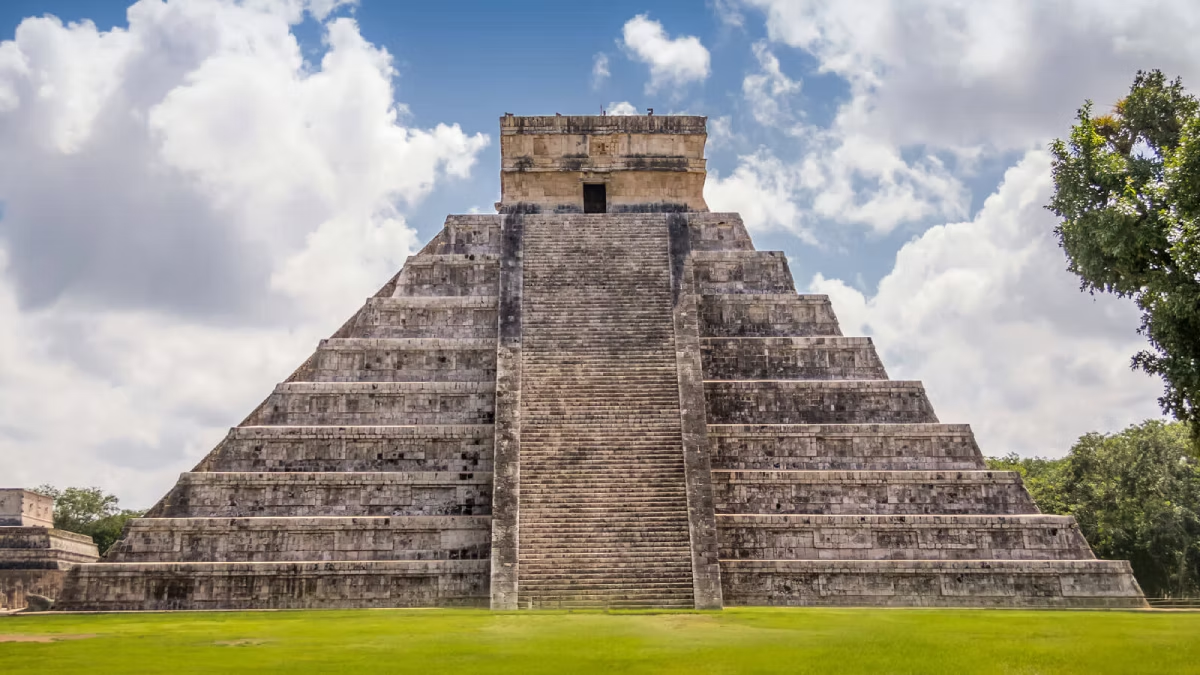
El Castillo (Spanish for “the Castle”), formally the Temple of Kukulkán (or Pyramid of Kukulcán), is the centerpiece of Chichén Itzá and arguably the most famous Maya pyramid in the world. The structure stands 30 meters (98 feet) tall, consists of nine square terraces topped by a 6-meter temple, with a base of approximately 55.3 meters per side. Built by the Toltec-Maya between approximately 1050 and 1300 CE, the pyramid is dedicated to Kukulkán, the Yucatec Maya feathered serpent deity. Its most famous feature is the equinox shadow phenomenon: twice a year, around March 20–21 and September 22–23, the late afternoon sun creates a series of seven triangular shadows down the northern staircase that resemble a serpent slithering down the pyramid, ending at carved stone serpent heads at the base. The pyramid also encodes the Maya solar calendar (91 steps × 4 sides + 1 top platform = 365), demonstrates a quetzal-bird acoustic effect when clapping at the base, and contains a hidden cenote discovered beneath it in 2015. Climbing El Castillo has been prohibited since 2006 to preserve the structure. This is the single most important sight at Chichén Itzá and the centerpiece of any visit.
El Castillo isn’t just a beautiful pyramid — it’s a deliberate architectural encoding of Maya astronomical and calendrical knowledge, designed to function as both a religious shrine and a precise calendrical observatory. Every dimension, every staircase, every angle reflects intentional mathematical and cosmological symbolism. Standing in front of it, you’re looking at the result of centuries of accumulated Maya astronomical observation translated into stone. This guide explains what you’re actually looking at — the architecture, the equinox phenomenon, the acoustics, the inner pyramid, and how to make the most of your visit.
The Architecture: What You’re Looking At
El Castillo is what archaeologists call a stepped pyramid — a structure built up in successively smaller square platforms. Some specifics worth knowing as you stand in front of it:
| Feature | Detail |
|---|---|
| Total height | 30 meters / 98 feet |
| Number of terraces | 9 square terraces, each ~2.57 m / 8.4 ft tall |
| Top temple height | 6 meters / 20 feet |
| Base width | 55.3 meters / 181 feet per side |
| Pyramid angle | ~53° (steeper than most Maya pyramids) |
| Staircase angle | ~45° |
| Steps per staircase | 91 |
| Total steps (4 staircases + top platform) | 365 |
| Formal designation | Chichén Itzá Structure 5B18 |
The four sides of the pyramid are aligned with the four cardinal directions (north, south, east, west) — a deliberate astronomical orientation that makes the equinox shadow phenomenon possible. The northern staircase, which is what most visitors photograph and where the equinox serpent appears, is flanked by carved stone serpent heads at its base, representing Kukulkán himself.
The 365-Step Calendar Encoding
Each of El Castillo’s four staircases has 91 steps — totaling 364 steps. Adding the top temple platform as the final “step” gives exactly 365, the number of days in the Maya solar year (haab’). This is widely interpreted as deliberate calendrical encoding by the Maya architects, demonstrating that the pyramid was designed not just as a religious structure but as an explicit physical representation of the Maya calendar. Other architectural elements may encode additional calendrical features: the 18 terraced sections per side could correspond to the 18 months of the Maya haab’, and the 52 panels on each face have been interpreted as referring to the 52-year Calendar Round cycle when the haab’ (365-day solar) and tzolk’in (260-day ritual) calendars realign.
The 365-step encoding is the single most cited “Maya math” feature of any Mesoamerican pyramid. Whether or not every Maya architect deliberately calculated each detail, the overall design intent to embed calendrical knowledge in architecture is well-established at Chichén Itzá and other Maya sites.
The Equinox Phenomenon: The Serpent Shadow
Twice a year, around the spring equinox (March 20–21) and the fall equinox (September 22–23), the late afternoon sun strikes El Castillo’s northwest corner at a specific angle that casts a series of seven triangular shadows down the northern balustrade. These shadows merge with the carved stone serpent heads at the base of the staircase, creating the visual illusion of a giant feathered serpent (Kukulkán) descending the pyramid. The phenomenon begins around 3:00 PM, peaks between 4:30 and 5:10 PM, and lasts in its full form for about 45 minutes. The complete shadow display unfolds over approximately 5 hours total. Thousands of visitors gather around the pyramid on equinox dates to witness the phenomenon. The serpent shadow effect can actually be observed for several weeks before and after the actual equinox dates, just less dramatically.
Specifics worth knowing about the equinox visit:
- Best dates: March 20–21 and September 22–23
- Effect window: Late March through late April; mid-September through mid-October (less intense)
- Time: Shadow forms 3:00–8:00 PM; peak 4:30–5:10 PM
- Duration of full effect: ~45 minutes at peak
- Crowds: 10,000–15,000+ visitors on actual equinox days (vs. typical ~5,000)
- Best viewing position: North side of the pyramid, looking up at the staircase
- Shadow appearance: Seven distinct triangular shadows that move down the steps as the sun changes angle
Was the Equinox Effect Deliberately Designed?
This is debated among archaeologists. Some scholars argue the precision of the alignment is too perfect to be coincidence; others note that the light-and-shadow effect appears for weeks around the equinox without major visual changes, making it imprecise as a calendrical indicator. The most likely interpretation: the orientation was deliberate as part of the broader Maya astronomical design, even if the exact “snake” effect wasn’t the explicit primary goal.
What’s certain: the Maya built El Castillo to be aligned with celestial events, and they built it knowing that the equinox sun would interact with the staircase in dramatic ways. Whether or not they specifically designed the seven-triangle effect, they created the conditions for it — and that’s a remarkable achievement in pre-modern architecture.
A 72-Year Viewing Window
Some sources note that the equinox phenomenon as currently observed will only be visible during a 72-year window from 1976 to 2048. Earth’s axial precession (the slow wobble of the planet’s rotational axis) gradually shifts the angle at which the sun strikes the pyramid. After 2048, the precise current effect may diminish or disappear, though the broader equinox-light interaction will continue. This is one reason why visiting during the current era has cultural urgency.
The Acoustic Phenomenon: The Quetzal Echo
El Castillo produces a remarkable acoustic effect: a single hand clap near the base of the pyramid produces a chirping echo that mimics the call of the quetzal bird — a sacred bird in Maya religious tradition associated with Kukulkán. The chirp is created when the sound of the clap reflects off the high, narrow limestone steps of the staircase, with each successive reflection arriving at slightly different frequencies. Researchers since 1998 have studied this phenomenon, with most concluding it is likely not accidental: the geometry of the steps creates acoustic conditions specifically conducive to the chirping sound. The Maya may have deliberately designed the pyramid to produce a sonic representation of the quetzal as a religious feature.
The acoustic effect is observable today — visitors and guides regularly demonstrate the clap-chirp at the base of the pyramid (especially the northern staircase). The chirp is most pronounced when:
- You clap close to the base of the staircase (within 10 meters)
- You clap once, sharply rather than multiple claps in succession
- The site is relatively quiet around you
If you’re visiting during peak crowds, the ambient noise can mask the effect. Early morning or late afternoon visits offer better acoustic conditions.
What’s Inside: The Castillo-Sub Pyramid
El Castillo is not actually a single pyramid — it’s a pyramid built on top of an earlier pyramid. This older interior structure, often called Castillo-sub (or “Pyramid Sub”), was discovered by archaeologists in the 1930s when they were exploring the structure for restoration purposes.
Inside El Castillo is an earlier, smaller pyramid known as Castillo-sub. Discovered in the 1930s during archaeological excavation, this older structure was built before the outer pyramid — likely between 800 and 1000 CE — and includes an inner temple chamber featuring a famous Red Jaguar Throne and a Chac Mool sculpture. The Maya constructed a new, larger pyramid around the older one rather than demolishing it, a common Mesoamerican architectural practice (the Pyramid of the Sun in Teotihuacán similarly contains earlier structures within it). Recent 3D modeling and multimodal scanning research published in 2025 has revealed even more architectural detail about Castillo-sub, including evidence of multiple successive construction stages within the inner pyramid itself.
Castillo-sub specifics:
- Width: Approximately 33 meters (108 feet) — significantly smaller than the outer pyramid
- Height: Approximately 17 meters (56 feet) to the base of the temple
- Steps: 9 steps on each of its staircases
- Inner chamber: Contains the Red Jaguar Throne (decorated with shells, paint, and cinnabar pigment) and a Chac Mool reclining figure
- Visitor access: The inner chamber was once open to visitors but has been closed since 2006 for preservation
You cannot currently enter Castillo-sub or view its interior in person. The chamber’s contents — particularly the Red Jaguar Throne — can be seen in archaeological photographs and museum displays, but the actual chamber is no longer accessible to tourists.
The Hidden Cenote Below
In 2015, researchers using non-invasive imaging techniques discovered a previously unknown cenote (sinkhole) directly beneath El Castillo. The cenote measures approximately 35 meters across with water depth exceeding 20 meters. This discovery has profound implications: it suggests the Maya chose this specific location to build El Castillo precisely because of the underlying cenote, treating the pyramid as an axis mundi (world center) connecting heaven (the temple at the top), earth (the staircases and base), and the underworld (the cenote below). The Maya considered cenotes to be portals to Xibalba, the underworld. The pyramid’s position above a sacred cenote transforms its religious significance — it’s not just a temple to Kukulkán but a complete cosmological structure. In 2018, archaeologists began exploring the underground water system in an effort to confirm a connection between this cenote and other parts of Chichén Itzá’s water network.
The cenote-below discovery is one of the most significant archaeological revelations about Chichén Itzá in recent decades. It changes how we understand the pyramid’s purpose: not just as a religious monument but as a deliberate marker of a sacred location.
Why El Castillo Was Built Where It Was
Combining the cenote discovery with the broader Chichén Itzá site layout reveals deliberate Maya planning:
- Cenote below El Castillo — connects the pyramid to the underworld
- Sacred Cenote (Cenote Sagrado) to the north — used for ritual offerings and sacrifices
- Cenote Xtoloc to the south — provided drinking water
- El Castillo at the center — the cosmological pivot point
The pyramid was built where it was because the location was already sacred — and the Maya knew it.
Climbing Has Been Banned Since 2006
Climbing El Castillo has been prohibited since 2006. Two reasons drove the ban: (1) The original stone steps were severely worn from decades of foot traffic — the Maya stone was being eroded by visitors’ shoes; (2) A fatal accident in 2006 (a visitor died falling from the pyramid) prompted INAH (Mexico’s National Institute of Anthropology and History) to permanently close the structure to climbers. The closure applies to El Castillo specifically — other Chichén Itzá structures (the Great Ball Court, Temple of the Warriors, etc.) are viewable from paths but also not climbable. If you specifically want to climb a major Maya pyramid, the alternatives are Ek Balam (Acropolis, ~30m) and Cobá (Nohoch Mul, 42m, reopened December 2025 after closure).
For travelers disappointed about the climbing ban: there are real alternatives. Ek Balam and Cobá both offer climbable major Maya pyramids with extensive views. See our Ek Balam tours and Cobá tour guides for specifics.
Best Viewing Positions
Where to stand to get the most out of El Castillo:
- Northern staircase view (default photographer’s position): Stand 30–50 meters back from the north side. This is the side with the serpent heads at the base and where the equinox shadow appears.
- Side view (east or west): Stand 50–70 meters from the side to see the full nine terraces clearly. Good for capturing the pyramid’s scale.
- Diagonal corner view: Stand at the northwest or northeast corner, ~30 meters back. Shows two faces of the pyramid simultaneously.
- Acoustic spot: Within 10 meters of the northern staircase base. Clap once, sharply, and listen for the chirp.
How Long to Spend at El Castillo
For a comprehensive visit:
- Quick view: 10–15 minutes (just walk past, take photos)
- Standard visit: 30–45 minutes (multiple angles, acoustic clap, read interpretive signs)
- Deep visit: 1–1.5 hours (slow walk around all four sides, read all signs, sit and take in the structure, observe shadow patterns at different times)
Most guided tours allocate 20–30 minutes at El Castillo specifically — typically rushed if you want to fully appreciate the structure. If El Castillo is your priority, consider a private tour or an early access tour where you have more time.
Best Times to Visit
- For minimum crowds: Early access tours (8:00 AM site opening) — you’ll be at El Castillo within 10 minutes of arrival, before tour buses
- For best photography lighting: Early morning (8:00–9:30 AM) or late afternoon (4:00–5:00 PM)
- For the equinox shadow: March 20–21 or September 22–23, late afternoon (3:00–5:00 PM)
- For empty photos (no people): Site opening (8:00 AM) for first 30 minutes
- Worst times: 10:30 AM – 1:00 PM (peak tour bus arrival, full sun, peak crowds)
For the equinox specifically, see our Things to Know page for crowd, transport, and timing details.
How El Castillo Fits Into a Chichén Itzá Visit
El Castillo is the centerpiece, but it’s not the only must-see structure. A typical 2.5-hour Chichén Itzá visit covers:
- El Castillo — 25–30 minutes (the centerpiece)
- Great Ball Court — 20–25 minutes (largest in Mesoamerica)
- Temple of the Warriors — 15–20 minutes (massive colonnaded complex)
- Sacred Cenote (Cenote Sagrado) — 15 minutes (sacred sacrificial site)
- El Caracol observatory — 15 minutes (Maya astronomical observation tower)
- Tzompantli (Skull Platform) — 10 minutes
- Other structures — 30+ minutes (Group of a Thousand Columns, Platform of Venus, etc.)
For each of these structures, see our What to See category guides.
Practical Visiting Tips
- Bring sun protection — there’s no shade near El Castillo, and the open plaza becomes intensely hot 11 AM – 2 PM
- Carry water — the pyramid plaza is large; staying hydrated matters
- Wear good walking shoes — the path between structures is unpaved gravel
- Hats and sunglasses — essential for midday visits
- Respect the no-climb signs — they’re enforced and important for preservation
- Time the acoustic clap — wait for a momentary lull in surrounding noise
- Camera positioning — stand 30+ meters back to get the full pyramid in frame
- Equinox crowds — if visiting on March 20–21 or September 22–23, arrive by mid-morning to claim a viewing position; expect 10,000+ visitors
Honest Expectations
What El Castillo delivers:
- Iconic photograph — instantly recognizable Maya pyramid
- Genuine awe — the scale and precision are real
- Cultural depth — knowing the calendar/equinox/acoustic context elevates the visit
- Distinctive acoustic experience — the quetzal-clap is unique
- Equinox shadow (during specific dates) — once-in-a-lifetime visual
What El Castillo doesn’t deliver:
- Climbing experience — not since 2006
- Inner chamber access — closed since 2006
- Solitude during peak hours — almost always crowded 10 AM – 3 PM
- Surprise — you’ve already seen photos of it
Knowing what to expect makes the visit better. Approach El Castillo with the historical/architectural context in mind, and you’ll get more from the experience than visitors who treat it as a simple photo stop.
Frequently Asked Questions
How tall is El Castillo?
30 meters (98 feet) tall — including the 6-meter temple at the top. The pyramid consists of nine square terraces, each about 2.57 meters tall.
How many steps does El Castillo have?
91 steps on each of the four staircases, totaling 364 steps. Adding the top temple platform as the final “step” gives exactly 365 — corresponding to the days in the Maya solar year. This is one of the most famous calendrical encodings in Mesoamerican architecture.
Can you climb El Castillo?
No — climbing has been prohibited since 2006. The ban was implemented to preserve the structure (centuries of foot traffic were eroding the original stone steps) and following a fatal accident the same year. If you specifically want to climb a Maya pyramid, the alternatives are Ek Balam (Acropolis, 30m, climbable) and Cobá (Nohoch Mul, 42m, reopened for climbing December 2025).
When is the equinox phenomenon?
March 20–21 (spring equinox) and September 22–23 (fall equinox). The serpent shadow effect appears in the late afternoon (3:00–8:00 PM) with peak around 4:30–5:10 PM. The effect is visible for several weeks before and after the actual equinox dates, just less dramatically.
What is the equinox shadow effect?
The late afternoon sun strikes the northwest corner of the pyramid at a specific angle, casting seven triangular shadows down the northern balustrade. These shadows merge with the carved stone serpent heads at the base, creating the visual illusion of a giant feathered serpent (Kukulkán) slithering down the pyramid. The full effect lasts about 45 minutes at peak, with the complete shadow display unfolding over approximately 5 hours.
How crowded does El Castillo get on the equinox?
Very crowded — typically 10,000–15,000+ visitors on the actual equinox days, vs. the standard ~5,000 daily visitors. Expect long lines at admission, packed plazas around the pyramid, and limited photo angles. Booking equinox tours 2–3 months in advance is essential.
Does El Castillo really make a chirping sound?
Yes — clapping once sharply at the base of the northern staircase produces a distinctive chirping echo that mimics the quetzal bird’s call. The effect is created by sound reflecting off the limestone steps at slightly different frequencies. Most guides demonstrate this when visiting. The effect is most pronounced in quieter conditions (early morning or late afternoon).
What’s inside El Castillo?
Castillo-sub — an earlier, smaller pyramid built around 800–1000 CE that was enclosed within the larger El Castillo. It contains an inner temple chamber featuring a Red Jaguar Throne (painted with cinnabar) and a Chac Mool sculpture. The chamber was once open to visitors but has been closed since 2006. You cannot currently enter the interior.
Is there a cenote below El Castillo?
Yes — researchers discovered a previously unknown cenote beneath El Castillo in 2015 using non-invasive imaging. The cenote measures approximately 35 meters across with water depth over 20 meters. The discovery suggests the Maya chose this specific location for the pyramid because of the underlying cenote, treating the structure as a cosmological pivot connecting heaven, earth, and the underworld.
When was El Castillo built?
The current outer pyramid was built between approximately 1050 and 1300 CE by the Toltec-Maya. The inner Castillo-sub pyramid was built earlier — likely between 800 and 1000 CE. The structure was first described in detail by Friar Diego de Landa in 1566.
Why is it called “El Castillo” instead of its Maya name?
The name “El Castillo” (Spanish for “the Castle”) was given by Spanish colonizers in the 16th century based on the pyramid’s resemblance to a Spanish castle. The structure’s actual Maya name has been lost to history. The pyramid is also commonly called the Temple of Kukulkán or Pyramid of Kukulcán, referencing the deity to whom it was dedicated.
What does Kukulkán mean?
Kukulkán (also spelled Kukulcán) is the Yucatec Maya name for the feathered serpent deity — a creator god associated with rebirth, agriculture, and the descent from heaven to earth. The Aztec equivalent is Quetzalcoatl. Kukulkán was one of three creator gods in Maya cosmology and is associated with the equinox shadow phenomenon at El Castillo.
How long should I spend at El Castillo during my visit?
At minimum 25–30 minutes to walk around all four sides, hear the acoustic effect, and read the interpretive signs. Ideally 45–60 minutes for a slower, more contemplative visit including time to observe the structure from multiple angles. Most guided tours allocate 20–30 minutes, which is rushed if you want to fully appreciate the pyramid.
What’s the best photo angle of El Castillo?
The northern face is the iconic photographer’s position — it’s where the serpent shadow appears during equinoxes and where the carved serpent heads sit at the base. Stand 30–50 meters back to capture the full pyramid in frame. For dramatic side views, the eastern and western faces show the nine terraces clearly. Diagonal corner shots (NE or NW) capture two faces simultaneously and add depth.
Is El Castillo the only thing to see at Chichén Itzá?
No — while El Castillo is the centerpiece, Chichén Itzá includes many other significant structures: the Great Ball Court (largest in Mesoamerica), Temple of the Warriors, Sacred Cenote (used for ritual offerings), El Caracol observatory, Tzompantli (Skull Platform), Group of a Thousand Columns, Nunnery, and many more. A complete visit takes 2.5–3 hours minimum. See our What to See category for guides to each major structure.
